JULY 11, 2023:
GENOA, Neb. (AP) — Amid a renewed push for answers, archeologists plan to resume digging for student remains at the site of a former Native American boarding school. The dig began on Monday (July 10, 2023) and is expected to continue on Tuesday. Researchers and community members have tried to find the cemetery for decades near the former Genoa Indian Industrial School in Nebraska. In November, a team using ground-penetrating radar found an area that was consistent with graves. In 2021, hundreds of children’s remains were found at Native American boarding school sites in the U.S. and Canada. Since then, searches for Native American remains have gained interest.
Extended version:
GENOA, Neb. (AP) — Amid a renewed push for answers, archeologists planned to resume digging Tuesday (July 11, 2023) at the remote site of a former Native American boarding school in central Nebraska, searching for the remains of children who died there decades ago.
The search for a hidden cemetery near the former Genoa Indian Industrial School in Nebraska gained renewed interest after the discovery of hundreds of children’s remains at Native American boarding school sites in the U.S. and Canada since 2021, said Dave Williams, the state’s archeologist who’s digging at the site with teammates this week.
The team hadn’t found any remains by Monday afternoon, but the dig had only just begun.
“Where is the cemetery and how many people are buried there? It’s the big question that’s hanging in the air,” said Alyce Tejral, a board member of the nearby Genoa U.S. Indian School Foundation Museum.
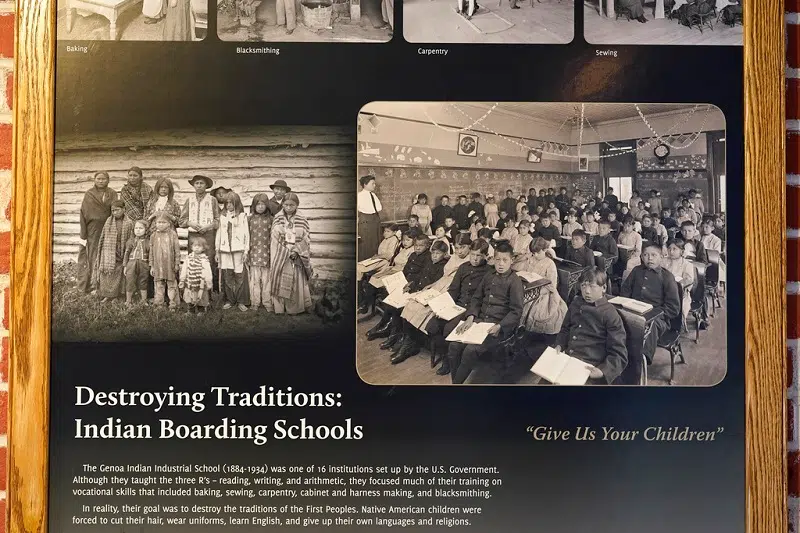
Genoa was part of a national system of more than 400 Native American boarding schools that attempted to assimilate Indigenous people into white culture by separating children from their families, cutting them off from their heritage and inflicting physical and emotional abuse.
Judi gaiashkibos, the executive director of the Nebraska Commission on Indian Affairs, whose mother attended the school in the late 1920s, has been involved in the cemetery effort for years. She said it’s difficult to spend time in the community where many Native Americans suffered, but the vital search can help with healing and bringing the children’s voices to the surface.
Williams, the archeologist, said finding the location of the cemetery and the burials contained within it may provide some peace and comfort to people who have suffered a long period of not knowing exactly what happened to their relatives who were sent to boarding schools and never came home.
The school, about 90 miles (145 kilometers) west of Omaha, opened in 1884 and at its height was home to nearly 600 students from more than 40 tribes across the country. It closed in 1931 and most buildings were long ago demolished.
Newspaper clippings, records and a student’s letter indicate at least 86 students died at the school, usually due to diseases such as tuberculosis and typhoid, but at least one death was blamed on an accidental shooting.
Researchers identified 49 of the children killed but have not been able to find names for 37 students. The bodies of some of those children were returned to their homes but others are believed to have been buried on the school grounds at a location long forgotten.
As part of an effort to find the cemetery, last summer dogs trained to detect the faint odor of decaying remains searched the area and signaled they had found a burial site in a narrow piece of land bordered by a farm field, railroad tracks and a canal.
A team using ground-penetrating radar last November also showed an area that was consistent with graves, but there will be no guarantees until researchers finish digging into the ground, Williams said.
The process is expected to take several days.
If the dig reveals human remains, the State Archeology Office will continue to work with the Nebraska Commission on Indian Affairs in deciding what’s next. They could rebury the remains in the field and create a memorial or exhume and return the bodies to tribes.
Last year, the U.S. Interior Department — led by Secretary Deb Haaland, a member of Laguna Pueblo in New Mexico and the first Native American Cabinet secretary — released a first-of-its-kind report that named hundreds of schools the federal government supported to strip Native Americans of their cultures and identities.
At least 500 children died at some of the schools, but that number is expected to reach into the thousands or tens of thousands as research continues.
JULY 10, 2023:
GENOA, Neb. (AP) — Archeologists are digging in a central Nebraska field to find the bodies of more than 80 children who were buried at a Native American boarding school. Crews are using shovels, trowels and smaller tools Monday (July 10, 2023) as they seek to find the remains of children who once attended the Genoa Indian Industrial School west of Omaha. The school opened in 1884 and at its height was home to nearly 600 students before closing in 1931. Residents of the tiny community of Genoa have been looking for the cemetery for decades with help from researchers and state officials.
Extended version:
GENOA, Neb. (AP) — Bodies of dozens of children who died at a Native American boarding school have been lost for decades, a mystery that archeologists aim to unravel as they dig in a central Nebraska field that a century ago was part of the sprawling campus.
Crews toting shovels, trowels and even smaller tools are searching at the site experts suspect is the Genoa Indian Industrial School cemetery. Genoa was part of a national system of more than 400 Native American boarding schools that attempted to integrate Indigenous people into white culture by separating children from their families and cutting them off from their heritage.
The school, about 90 miles (145 kilometers) west of Omaha, opened in 1884 and at its height was home to nearly 600 students from more than 40 tribes across the country. It closed in 1931 and most buildings were long ago demolished.
For decades, residents of the tiny community of Genoa, with help from Native Americans, researchers and state officials, have sought the location of a forgotten cemetery where the bodies of up to 80 students are believed to be buried.
Judi gaiashkibos, the executive director of the Nebraska Commission on Indian Affairs, whose mother attended the school in the late 1920s, has been involved in the cemetery effort for years and planned to travel to Genoa on Monday. She said it’s difficult to spend time in the community where many Native Americans suffered, but the vital search can help with healing and bringing the children’s voices to the surface.
“It’s an honor to go on behalf of my ancestors and those who lost their lives there and I feel entrusted with a huge responsibility,” gaiashkibos said.
Newspaper clippings, records and a student’s letter indicate at least 86 students died at the school, usually due to diseases such as tuberculosis and typhoid, but at least one death was blamed on an accidental shooting.
Researchers identified 49 of the children killed but have not been able to find names for 37 students. The bodies of some of those children were returned to their homes but others are believed to have been buried on the school grounds at a location long ago forgotten.
As part of an effort to find the cemetery, last summer dogs trained to detect the faint odor of decaying remains searched the area and signaled they had found a burial site in a narrow piece of land bordered by a farm field, railroad tracks and a canal.
A team using ground-penetrating radar last November also showed an area that was consistent with graves, but there will be no guarantees until researchers can dig into the ground, said Dave Williams, Nebraska’s state archeologist.
The process is expected to take several days.
“We’re going to take the soil down and first see if what’s showing up in the ground-penetrating radar are in fact grave-like features,” Williams said. “And once we get that figured out, taking the feature down and determining if there are any human remains still contained within that area.”
If the dig reveals human remains, the State Archeology Office will continue to work with the Nebraska Commission on Indian Affairs in deciding what’s next. They could rebury the remains in the field and create a memorial or exhume and return the bodies to tribes, Williams said.
DNA could indicate the region of the country each child was from but narrowing that to individual tribes would be challenging, Williams said.
The federal government is taking a closer examination of the boarding school system. The U.S. Interior Department, led by Secretary Deb Haaland, a member of Laguna Pueblo in New Mexico and the first Native American Cabinet secretary, released an initial report in 2022 and is working on a second report with additional details.


Comments