By: Professor Ernie Goss, Ph.D. Creighton University, Jack MacAllister Chair in Regional Economics
The rapid growth of Artificial Intelligence (AI) applications—particularly large language models and other data-intensive services—is driving a sharp rise in electricity consumption. As a result, U.S. data centers are projected to account for nearly half of all national electricity demand growth through 2030. AI-related computing alone could more than triple its share of total U.S. electricity use by the end of the decade, reversing more than a decade of flat demand. By 2028, data center electricity use is expected to reach between 6.7% and 12% of total U.S. consumption, up from 4.4% in 2023.
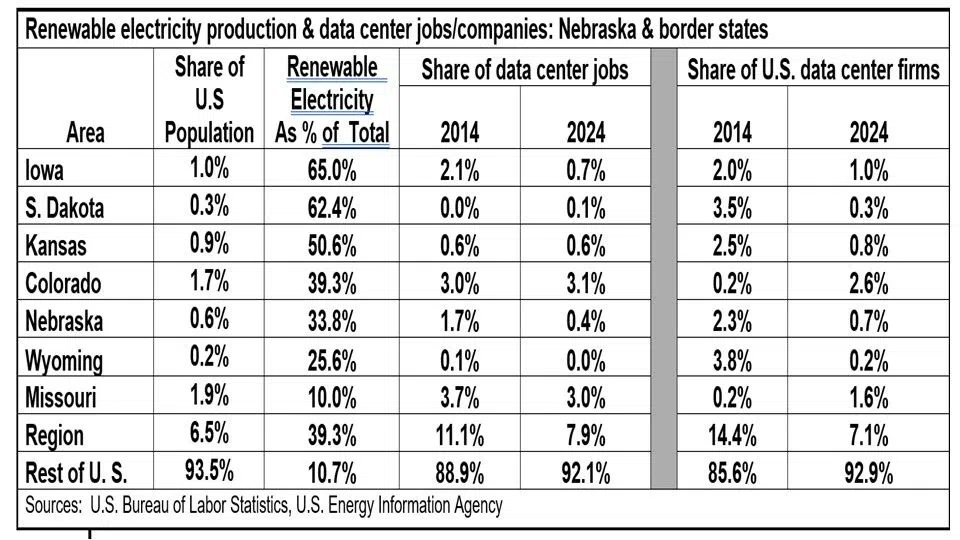
In response to rising energy needs, many data centers have relocated or expanded in regions with greater grid capacity. The accompanying data table illustrates how Nebraska and neighboring states ranked in 2014 by data center employment concentration. That year, both Nebraska and Iowa had data center employment shares well above their proportion of the national population. The region accounted for just 6.5% of U.S. population but produced 39.4% of its electricity from renewable sources—far above the 10.7% average for the rest of the country.
However, from 2014 to 2024, data center growth in the region was constrained by the intermittent nature of renewable energy. Solar power peaks midday and drops to zero at night, while wind production varies seasonally and often surges during periods of low electricity demand. This mismatch between renewable supply and data center load underscores the growing need for battery storage and other grid-balancing technologies to ensure reliability and attract further investment.
Some economic development officials question whether recruiting data centers is worthwhile, citing the relatively low number of jobs created per facility. However, data center positions command high wages: technicians earn an average of $105,000, while directors can earn up to $215,000—far above the 2025 national average salary of $66,622. In addition, data centers contribute significant property tax revenues. In Sarpy County, Nebraska, each of the three major data centers examined paid between $3 million and $4 million annually in property taxes, making them the largest contributors in the county.
While many forward-looking utilities are embracing battery storage, others continue to resist its deployment when it challenges profits, centralized control, or outdated regulatory models. The transition from resistance to adoption is still underway and hinges largely on the role of state regulators, public utility commissions, and energy policy reform. For states with high renewable energy penetration, supporting large-scale battery storage is essential. These technologies are no longer optional—they are central to ensuring grid stability, enabling economic development, and keeping pace with the energy demands of the digital age.


Comments