July 30, 2025:
ARLINGTON, Va. (AP) — Investigators have found that a helicopter involved in a deadly crash with a passenger plane over Washington was flying above its height limit. The helicopter’s altitude-measuring instrument was also inaccurate. These findings were revealed during the first day of National Transportation Safety Board hearings. The crash, which occurred in January 2025, killed 67 people. The board is examining how the Federal Aviation Administration and the Army may have contributed to the incident. The hearings will continue for three days, focusing on military helicopter routes, collision avoidance technology, and air traffic controller training at Ronald Reagan National Airport.
Story
ARLINGTON, Va. (AP) — Investigators probing the January midair collision of a passenger plane and an Army helicopter over Washington that killed 67 people found the chopper was flying higher than the it should have been and the altitude readings were inaccurate.
The details came out of the first day of National Transportation Safety Board hearings in Washington, where investigators aim to uncover insights into what caused the crash between the American Airlines plane from Wichita, Kansas, and the Black Hawk helicopter over Ronald Reagan National Airport.
The board opened the three days of hearings by showing an animation and playing audio and video from the night of the collision, as well as questioning witnesses and investigators about how the Federal Aviation Administration and the Army may have contributed to nation’s deadliest plane crash since November 2001.
It’s likely too early for the board to identify what caused the crash.
The January 2025 incident was the first in a string of crashes and near misses this year that have alarmed officials and the traveling public, despite statistics that still show flying remains the safest form of transportation.
Animation, altimeter discrepancy
The hearing opened Wednesday with a video animation showing where the helicopter and airliner were leading up to the collision. It showed how the helicopter flew above the 200 feet (61 meters) altitude limit on the helicopter route along the Potomac River before colliding with the plane.
Investigators said Wednesday the flight data recorder showed the helicopter was actually 80 feet to 100 feet (24 to 30 meters) higher than the barometric altimeter the pilots relied upon showed they were flying. So the NTSB conducted tests on three other helicopters from the same unit in a flight over the same area and found similar discrepancies in their altimeters.
Dan Cooper with Sikorsky helicopters said that when the Black Hawk helicopter involved in the crash was designed in the 1970s, it used a style of altimeter that was common at the time. Newer helicopters have air data computers that didn’t exist back then that help provide more accurate altitude readings.
Chief Warrant Officer Kylene Lewis told the board that she wouldn’t find an 80 to 100 foot discrepancy between the different altimeters on a helicopter alarming because at lower altitudes she would be relying more on the radar altimeter than the barometric altimeter. Below 500 feet (152 meters) , Lewis said she would be checking both instruments and cross referencing them.
She said as long as an altimeter registers an altitude within 70 feet of the published altitude before takeoff the altimeter is considered accurate under the checklists.
But previously, NTSB Chairwoman Jennifer Homendy highlighted that the published helicopter routes around Washington D.C. would allow planes and helicopters to routinely come within 75 feet of each other during landing.
Army officials said Wednesday that the flight manual for these older Black Hawks doesn’t highlight the discrepancies in altimeters that has been documented previously, but typical flight separations are at least 500 feet around airports.
Previously disclosed air traffic control audio had the helicopter pilot telling the controller twice that they saw the airplane and would avoid it. The animation ended with surveillance video showing the helicopter colliding with the plane in a fiery crash.
Investigations have already shown the FAA failed to recognize a troubling history of 85 near misses around Reagan airport in the years before the collision, and that the Army’s helicopters routinely flew around the nation’s capitol with a key piece of locating equipment, known as ADS-B Out, turned off.
Aviation attorney Bob Clifford, who is working to file one of the first lawsuits against the government next month, said he hopes NTSB will look beyond the immediate factors that caused this crash to highlight the bigger ongoing concerns in the crowded Washington airspace.
Proposed changes
Even though the final NTSB report won’t be released until sometime next year, U.S. Sen. Ted Cruz isn’t waiting to propose changes. He introduced legislation Tuesday that would require all aircraft operators to use both forms of ADS-B, or Automatic Dependent Surveillance Broadcast, the technology to broadcast aircraft location data to other planes and air traffic controllers. Most aircraft today are equipped with ADS-B Out equipment but the airlines would have to add the more comprehensive ADS-B In technology to their planes.
“There cannot be a double standard in aviation safety,” Cruz said. “We should not tolerate special exceptions for military training flights, operating in congested air space.”
The legislation would revoke an exemption on ADS-B transmission requests for Department of Defense aircrafts. It also would require the FAA to evaluate helicopter routes near airports and require the Army Inspector General to review the Army’s aviation safety practices.
Homendy said her agency has been recommending that move for decades after several other crashes.
Transportation Secretary Sean Duffy said that while he’d like to discuss “a few tweaks,” the legislation is “the right approach.” He also suggested that the previous administration “was asleep at the wheel” amid dozens of near-misses in the airspace around Washington’s airspace.
‘Fact-finding proceeding’
Homendy said the hearings over the next few days will be a “fact-finding proceeding.” The NTSB will also post thousands of pages of evidence from the crash investigation online.
FAA Administrator Bryan Bedford said that he expects “we’re going to have some very uncomfortable conversations over the next two and a half days” but that “they need to be had in the clear light of day – and simply put the best interest of the traveling public ahead of any of our personal interests, perhaps.”
The hearings in Washington involve NTSB board members, investigators and witnesses for organizations involved in the crash. Panels will focus on military helicopter routes in the Washington area, collision avoidance technology and training for air traffic controllers at Ronald Reagan National Airport, among other subjects.
Federal officials have also raised concerns over the nation’s outdated and understaffed air traffic control system. During January’s mid-air crash above Washington, one controller was handing both commercial airline and helicopter traffic at the busy airport.
Duffy has announced a multi-billion-dollar plan to overhaul the system controllers use that relies on old technology like floppy disks.
February 4, 2025, update:
ARLINGTON, Va. (AP) — The remains of all 67 victims of last week’s midair collision of an American Airlines flight and an Army helicopter near the nation’s capital have been recovered, authorities said Tuesday (Feb. 4, 2025).
The chief medical examiner is still trying to positively identify one set of remains, officials said in a news release.
“Our hearts are with the victims’ families as they navigate this tragic loss,” they said in a joint release from the city and federal agencies involved, including the U.S. Army Corps of Engineers, Navy dive teams and Washington, D.C., police and fire crews.
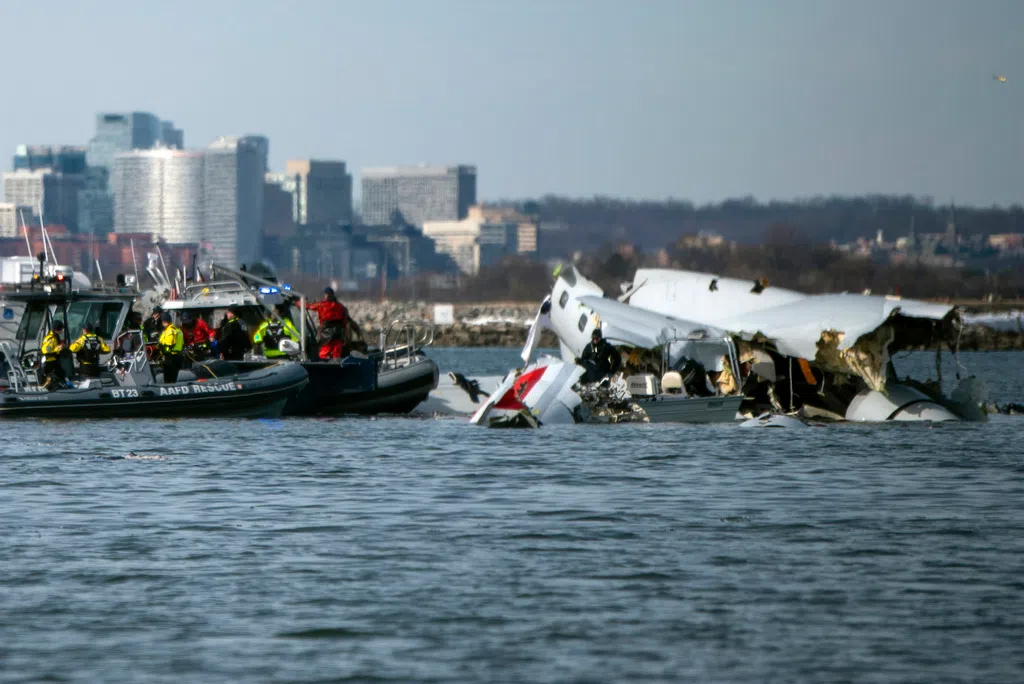
The news came as crews worked to try to recover the cockpit and other parts of the jetliner from the Potomac River. Officials said their work might depend upon the wind and tidal conditions in the river, where the aircraft crashed last Wednesday night after colliding as the plane was about to land at nearby Ronald Reagan National Airport, killing everyone on board the two aircraft were killed.
Throughout the day, crews could be seen lifting large pieces of the plane from the river. The National Transportation Safety Board said it didn’t plan to provide further updates from the scene.
Authorities said early on in the effort that they had expected to recover the remains of everyone who died. They are focusing first on the jet and hope to recover the Black Hawk helicopter later this week.
Col. Francis B. Pera of the Army Corps of Engineers said salvage crews on Monday were able to pull one of the two jet engines from the river, along with large pieces of the plane’s exterior. They were also working to recover a wing of the plane, which had flown out of Wichita, Kansas.
Sixty passengers and four crew were on the American Airlines flight, including figure skaters returning from the 2025 U.S. Figure Skating Championships in Wichita.
The Black Hawk was on a training mission. Army Staff Sgt. Ryan Austin O’Hara, 28, of Lilburn, Georgia; Chief Warrant Officer 2 Andrew Loyd Eaves, 39, of Great Mills, Maryland; and Capt. Rebecca M. Lobach, of Durham, North Carolina, were aboard.
Federal investigators are trying to piece together the events that led to the collision. Full investigations typically take a year or more, but investigators hope to have a preliminary report within 30 days.
Wednesday’s crash was the deadliest in the U.S. since Nov. 12, 2001, when a jet slammed into a New York City neighborhood just after takeoff, killing all 260 people on board and five on the ground.
February 4, 2025, update:
ARLINGTON, Va. (AP) — Crews worked Tuesday (Feb. 4, 2025) to try to recover the plane’s cockpit and the rest of the remains of the 67 people who died in last week’s midair collision between a passenger jet and Army helicopter near the nation’s capital.
They said their work might depend upon the wind and tidal conditions in the Potomac River, where the aircraft crashed last Wednesday night after colliding as the American Airlines flight was about to land at nearby Ronald Reagan National Airport. All 67 people on both aircraft were killed.
By midday, they were working to raise another large piece of the plane. The National Transportation Safety Board said it didn’t plan to provide further updates from the scene.
Authorities have recovered and identified the remains of 55 of the 67 people and have said they are confident they will find all of the victims. They are focusing first on the jet and hope to recover the Black Hawk helicopter later this week.
Col. Francis B. Pera of the Army Corps of Engineers said salvage crews on Monday were able to pull one of the two jet engines from the river, along with large pieces of the plane’s exterior. They were also working to recover a wing of the plane, which had flown out of Wichita, Kansas.
Sixty passengers and four crew were on the American Airlines flight, including figure skaters returning from the 2025 U.S. Figure Skating Championships in Wichita.
The Black Hawk helicopter was on a training mission. Army Staff Sgt. Ryan Austin O’Hara, 28, of Lilburn, Georgia; Chief Warrant Officer 2 Andrew Loyd Eaves, 39, of Great Mills, Maryland; and Capt. Rebecca M. Lobach, of Durham, North Carolina, were aboard.
Federal investigators are trying to piece together the events that led to the collision. Full investigations typically take a year or more, but investigators hope to have a preliminary report within 30 days.
Wednesday’s crash was the deadliest in the U.S. since Nov. 12, 2001, when a jet slammed into a New York City neighborhood just after takeoff, killing all 260 people on board and five on the ground.
February 4, 2025:
ARLINGTON, Va. (AP) — Salvage crews have recovered an engine and large pieces of fuselage and are working to retrieve a wing from the wreckage of a commercial airliner involved in last week’s midair collision near Washington’s Reagan National Airport, officials said Monday (Feb. 3, 2025).
They also recovered more human remains from the Potomac River, although they declined to offer specifics, reiterating only that 55 of the 67 victims have been found and identified since the crash Wednesday.
Authorities have said the operation to remove the plane will take several days and they will then work to remove the military helicopter involved. The crash between the American Airlines jet and an Army helicopter over Washington D.C. was the deadliest U.S. air disaster since 2001.
More than 300 responders were taking part in the recovery effort at any given time, officials said. Two Navy barges were also deployed to lift heavy wreckage.
Washington, D.C. Fire Department Assistant Chief Gary Steen told a news briefing that officials are confident all of the victims would be found.
Divers and salvage workers are adhering to strict protocols and stopped moving debris at times when human remains were being recovered, said U.S. Army Corps of Engineers Col. Francis Pera. The “dignified recovery” of remains takes precedence over all else, he said.
Portions of the two aircraft that collided over the river Wednesday night near Ronald Reagan Washington National Airport — an American Airlines jet with 64 people aboard and an Army Black Hawk helicopter with 3 aboard — are being loaded onto flatbed trucks and will be taken to a hangar for investigation. Crews hoped to recover the jet’s cockpit on Tuesday, Pera said.
The crash occurred when the jet, en route from Wichita, Kansas, was about to land. The Black Hawk was on a training mission. There were no survivors.
On Sunday, family members were taken in buses with a police escort to the Potomac River bank near where the two aircraft came to rest after colliding.
The plane’s passengers included figure skaters returning from the 2025 U.S. Figure Skating Championships in Wichita and a group of hunters returning from a guided trip. Army Staff Sgt. Ryan Austin O’Hara, 28, of Lilburn, Georgia; Chief Warrant Officer 2 Andrew Loyd Eaves, 39, of Great Mills, Maryland; and Capt. Rebecca M. Lobach, of Durham, North Carolina, were in the helicopter.
Federal investigators were working to piece together the events that led to the collision. Full investigations typically take a year or more. Investigators hope to have a preliminary report within 30 days.
Wednesday’s crash was the deadliest in the U.S. since Nov. 12, 2001, when a jet slammed into a New York City neighborhood just after takeoff, killing all 260 people on board and five on the ground.
Experts stress that plane travel is overwhelmingly safe, but the crowded airspace around Reagan Airport can challenge even experienced pilots.
The NTSB said Saturday that preliminary data showed conflicting readings about the altitudes of the airliner and the helicopter.
Investigators also said that about a second before impact, the jet’s flight recorder showed a change in its pitch. But they did not say whether that change in angle meant that pilots were trying to perform an evasive maneuver to avoid the crash.
Data from the jet’s flight recorder showed its altitude as 325 feet (99 meters), plus or minus 25 feet (7.6 meters), when the crash happened, NTSB officials told reporters. Data in the control tower, though, showed the Black Hawk at 200 feet (61 meters), the maximum allowed altitude for helicopters in the area.
The discrepancy has yet to be explained.
On Monday, officials cautioned against premature speculation about the cause of the crash or the helicopter’s altitude, or whether or why it may have been traveling above the 200-foot ceiling in the area.
“There are all kinds of reasons that you could deviate from an altitude, you know, something as simple as a flock of birds is in front of you or you may deviate if you see something that’s an obstacle or other threat,” said Col. Mark Ott, deputy director of aviation for the Army.
Investigators said they hoped to reconcile the difference with data from the helicopter’s black box and planned to refine the tower data, which can be less reliable. All five air traffic controllers in the Reagan Airport tower at the time of the collision have been interviewed, the NTSB said Monday.
February 3, 2025:
ARLINGTON, Va. (AP) — Authorities say they have recovered the remains of 55 of the 67 people killed in the deadliest U.S. air disaster since 2001. Washington, D.C. Fire and EMS Chief John Donnelly said Sunday that divers still need to find the bodies of 12 more victims and are committed to the dignified recovery of remains as they prepare to lift wreckage from the Potomac River as early as Monday morning. Col. Francis B. Pera of the Army Corps of Engineers says portions of the aircraft will be loaded onto flatbed trucks and taken to a hangar for further investigation. They spoke hours after families of the victims visited the crash site.
January 31, 2025:
ARLINGTON, Va. (AP) — Police boats returned to the Potomac River on Friday (Jan. 31, 2025) as part of the recovery and investigation after a midair collision killed 67 people in the United States’ deadliest aviation disaster in almost a quarter century.
More than 40 bodies have been pulled from the river as the massive recovery effort continued, law enforcement officials told The Associated Press on Friday. The officials were not authorized to discuss details of the investigation and spoke on condition of anonymity.
Investigators have already recovered the cockpit voice recorder and flight data recorder of the American Airlines plane that collided with an Army helicopter as the plane was landing Wednesday night at Ronald Reagan National Airport next to Washington, D.C. Officials are scrutinizing a range of factors in what National Transportation Safety Board Chairwoman Jennifer Hommendy has called an “all-hands-on-deck event.”
All aboard the two aircraft were killed, with officials examining the actions of the military pilot as well as air traffic control after the helicopter apparently flew into the path of the American Airlines jet.
Air crash investigations can take months, and federal investigators told reporters Thursday they would not speculate on the cause.
Authorities were still looking for the helicopter’s black box recorder, Defense Secretary Pete Hegseth said Friday on Fox News Channel. Other factors in the crash, including the helicopter’s altitude and whether the crew was using its night vision goggles, are still under investigation, Hegseth said.
Military aircraft frequently conduct such flights in and around the nation’s capital for familiarization with routes they would fly in case of a major catastrophe or an attack on the U.S. that would require relocation of key officials from the capital region.
“You need to train as you fight, you need to rehearse in ways that would reflect a real world scenario,” Hegseth said. He stressed that it remained the Pentagon’s duty to also mitigate risks, while conducting such training. But he underscored U.S. forces need “to ensure, if unfortunately, there were a real world event where things needed to happen we could respond to it day or night.”
The plane carried 60 passengers and four crew members, and three soldiers were aboard the helicopter.
One air traffic controller was responsible for coordinating helicopter traffic and arriving and departing planes when the collision happened, according to a report by the Federal Aviation Administration that was obtained by The Associated Press. Those duties are often divided between two people, but the airport typically combines the roles at 9:30 p.m., once traffic begins to slow down. On Wednesday the tower supervisor directed that they be combined earlier.
“The position configuration was not normal for the time of day and volume of traffic,” the report said.
A person familiar with the matter, however, said the tower staffing that night was at a normal level. The positions are regularly combined when controllers need to step away from the console for breaks, during shift changes or when air traffic is slow, the person said, speaking on the condition of anonymity to discuss internal procedures.
The FAA has long struggled with a shortage of air traffic controllers.
Officials said flight conditions were clear as the jet arrived from Wichita, Kansas, carrying, among others, a group of elite young figure skaters, their parents and coaches, and four union steamfitters from the Washington area.
A top Army aviation official said the crew of the helicopter, a Black Hawk, was “very experienced” and familiar with the congested flying that occurs daily around the city.
“Both pilots had flown this specific route before, at night. This wasn’t something new to either one of them,” said Jonathan Koziol, chief of staff for Army aviation.
The helicopter’s maximum allowed altitude at the time was 200 feet (about 60 meters), Koziol said. It was not immediately clear whether it exceeded that limit, but Hegseth said altitude seemed to be a factor in the collision.
Koziol said investigators need to analyze the flight data before making conclusions about altitude.
President Donald Trump said in a Friday morning post on his Truth Social platform that the helicopter was “flying too high” at the time of the crash.
“It was far above the 200 foot limit. That’s not really too complicated to understand, is it???” Trump said. His comments come the day after he questioned the actions of a U.S. Army helicopter pilot involved in the midair collision with a commercial airliner, while also blaming diversity initiatives for undermining air safety.
Flights at Reagan National resumed around midday Thursday.
Wednesday’s crash was the deadliest in the U.S. since Nov. 12, 2001, when an American Airlines flight slammed into a residential area of Belle Harbor, New York, just after takeoff from Kennedy Airport, killing all 260 people aboard and five people on the ground.
The last major fatal crash involving a U.S. commercial airline occurred in 2009 near Buffalo, New York. Everyone aboard the Bombardier DHC-8 propeller plane was killed, along with one person on the ground, bringing the total death toll to 50.
Experts often highlight that plane travel is overwhelmingly safe, however. The National Safety Council estimates that Americans have a 1-in-93 chance of dying in a motor vehicle crash, while deaths on airplanes are too rare to calculate the odds. Figures from the Department of Transportation tell a similar story.
But the airspace around Reagan National can challenge even the most experienced pilots no matter how ideal the conditions. They must navigate hundreds of other commercial planes, military aircraft and restricted areas around sensitive sites.
Just over 24 hours before the fatal collision, a different regional jet had to go around for a second chance at landing at Reagan National after it was advised about a military helicopter nearby, according to flight tracking sites and control logs. It landed safely minutes later.
January 30, 2025, update:
Story Body


Comments