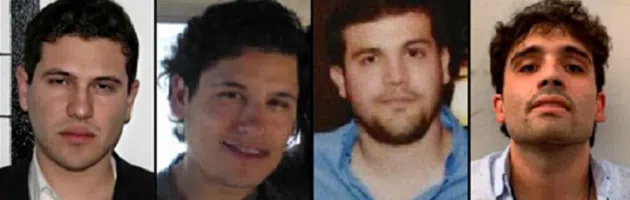
Dec. 2, 2025:
CHICAGO (AP) — One of the sons of notorious Mexican drug kingpin “El Chapo” pleaded guilty on Monday (Dec. 1, 2025) to U.S. drug trafficking charges, months after his brother entered a plea deal.
Known locally in Mexico as the “Chapitos” — or “little Chapos” — Joaquín Guzmán López and brother Ovidio Guzmán López are accused of running a faction of the Sinaloa cartel. Federal authorities in 2023 described the operation as a massive effort to send “staggering” quantities of fentanyl into the U.S.
Joaquín Guzmán López, 39, pleaded guilty to two counts of drug trafficking and continuing criminal enterprise after admitting his role in overseeing the transport of tens of thousands of kilograms (pounds) of drugs to the U.S., mostly through underground tunnels. With the plea deal, his attorney said, he is expected to avoid life in prison.
Security was tight at Chicago’s federal court ahead of the hearing in which prosecutors detailed events leading up to Guzmán López’s dramatic arrest with another longtime Sinaloa leader on U.S. soil in July 2024.
Wearing an orange jumpsuit and matching shoes, Guzmán López spoke little in court Monday. At the outset of the hearing, U.S. District Judge Sharon Coleman asked him what he did for work.
“Drug trafficking,” he said.
“Oh that’s your job,” Coleman said with a chuckle. “There you go.”
If Guzmán López cooperates with the U.S. government, prosecutors said, they would reduce the life sentence attached to the charges. Regardless, he faces at least 10 years in prison, said Andrew Erskine, an attorney representing the federal government.
Guzmán López would have no opportunity to appeal the sentence as part of the plea deal.
His defense attorney, Jeffrey Lichtman, commended both U.S. and Mexican authorities.
“The government has been very fair with Joaquín thus far,” he told reporters after the hearing. “I do appreciate the fact that the Mexican government didn’t interfere.”
Guzmán López and another longtime Sinaloa leader, Ismael “El Mayo” Zambada, were arrested in July 2024 in Texas after they landed in the U.S. on a private plane. Both men have previously pleaded not guilty to various drug trafficking, money laundering and firearms charges. Their surprising capture prompted a surge in violence in Mexico’s northern state of Sinaloa as two factions of the Sinaloa cartel clashed.
As part of the plea deal, Joaquín Guzmán López admitted to helping oversee the production and smuggling of large quantities of cocaine, heroin, methamphetamine, marijuana and fentanyl into the United States, fueling a crisis that has contributed to tens of thousands of overdose deaths annually.
Guzmán López also admitted to kidnapping an unnamed individual purported to be Zambada. Erskine described the alleged kidnapping in court, saying Guzmán López had the glass from a floor-to-ceiling window removed. During a meeting in the room with the unnamed person, Guzmán López allegedly had others enter through the open window, seize the individual, put a bag over his head and take him to a plane. On board, he was zip tied and given sedatives before the plane landed at a New Mexico airport near the border with Texas.
Erskine said the alleged kidnapping was part of an attempt to show cooperation with the U.S. government, which did not sanction those actions. He said Guzmán López also would not receive cooperation credit because of that.
Zambada’s attorney has previously claimed that his client was “forcibly kidnapped” by Guzmán López onto the flight to the U.S.
Lichtman said he would try to seek a lower sentence.
“I don’t know how this ends up,” Lichtman said. “If he gets a 10-year sentence, it’s still a lot of time for anybody to spend in prison.”
In court, observers were instructed to turn off electronic devices while authorities used police dogs to sniff bags and equipment in the lobby of the downtown courthouse.
In July, Ovidio Guzmán López became the first son of drug lord Joaquín “El Chapo” Guzmán to enter a plea deal. He pleaded guilty to drug trafficking, money laundering and firearms charges tied to his leadership role in the cartel. Legal experts called that plea deal a significant step for the U.S. government in their investigation and prosecution of Sinaloa cartel leaders.
Joaquín “El Chapo” Guzmán is serving a life sentence after being convicted in 2019 for his role as the former leader of the Sinaloa cartel, having smuggled mountains of cocaine and other drugs into the United States over 25 years. The brothers allegedly assumed their father’s former role as leaders of the cartel.
Aug. 26, 2025:
NEW YORK (AP) — Former Mexican cartel kingpin Ismael “El Mayo” Zambada will spend the rest of his life in prison after pleading guilty Monday (Aug. 25, 2025) to U.S. drug trafficking charges and saying he was sorry for helping flood the U.S. with cocaine, heroin and other illicit substances and for fueling deadly violence in Mexico.
“I recognize the great harm illegal drugs have done to the people of the United States, of Mexico, and elsewhere,” Zambada, 75, said through a Spanish-language interpreter. “I take responsibility for my role in all of it and I apologize to everyone who has suffered or been affected by my actions.”
Under Zambada’s leadership and that of Joaquín “El Chapo” Guzmán, the Sinaloa cartel evolved from a regional player into the largest drug trafficking organization in the world, prosecutors say.
“Culpable,” Zambada said, using the Spanish word for “guilty,” as he entered his plea in a Brooklyn courtroom, about 2,200 miles (3,500 kilometers) from Mexico’s Sinaloa state.
He acknowledged the extent of the Sinaloa operation, including underlings who built relationships with cocaine producers in Colombia, oversaw importing cocaine to Mexico by boat and plane and smuggling the drug across the U.S.-Mexico border. He said the cartel raked in hundreds of millions of dollars a year and admitted that people working for him paid bribes to Mexican police and military commanders “so they could operate freely.”
U.S. Attorney General Pam Bondi flew to New York to herald Zambada’s guilty plea as a “landmark victory,” telling reporters at a news conference that he “will die in a U.S. federal prison, where he belongs.”
“This guy, ‘El Mayo,’ was living like a king,” Bondi said. ”Now he’s living like a criminal for the rest of his life.”
Bondi’s visit to Brooklyn underscored President Donald Trump’s anti-cartel crusade. His administration has declared drug cartels to be terrorist organizations, positioned military assets off Venezuela and compelled the Mexican government to hand over several dozen high-ranking cartel officials for prosecution.
The kingpin’s legacy
Sought by U.S. law enforcement for more than two decades, Zambada was arrested in Texas last year, at the end of the Biden administration, when the drug lord arrived in a private plane with one of Guzmán’s sons, Joaquín Guzmán López. Zambada says he was kidnapped in Mexico and taken against his will to the U.S.
His arrest, along with that of Guzmán López, touched off deadly fighting in his home state of Sinaloa between rival cartel factions, pitting his loyalists against backers of Guzmán’s sons, dubbed the Chapitos, or “little Chapos.”
Considered a good negotiator, Zambada was seen as the cartel’s strategist and dealmaker who was more involved in its day-to-day doings than the flamboyant Guzmán. Prosecutors have said Zambada was enmeshed in the group’s violence, at one point ordering the murder of his own nephew.
In the Sinaloan capital of Culiacan, dead bodies lie in streets or sometimes appear hanging from highway underpasses. Businesses shutter early because people don’t want to be out after dark. Schools grind to a halt during sudden bursts of conflict. People ranging from social media influencers to animal caregivers have been touched by the bloodshed.
Prosecutors promised not to seek the death penalty
Zambada’s plea came two weeks after prosecutors said they wouldn’t seek the death penalty.
His lawyer, Frank Perez, stressed after court that the plea agreement doesn’t obligate Zambada to cooperate with government investigators. The attorney said his client never really wanted to go to trial, and that once the death penalty was off the table, his “focus shifted to accepting responsibility and moving forward.”
Bondi noted Mexico’s opposition to the death penalty, which is a factor in its willingness to extradite suspects to the U.S. Although Zambada wasn’t extradited, she alluded to the nations’ understanding that “we cannot seek the death penalty” for those who are.
Zambada is due to be sentenced Jan. 13 to life in prison. He also faces billions of dollars in financial penalties.
Zambada describes his drug trade
Zambada appeared momentarily unsteady as he arrived in court; a marshal grabbed his arm to direct him to his seat.
As Judge Brian M. Cogan described the plea agreement, the bearded ex-Sinaloa boss sat attentively, at times brushing his right hand through his white hair.
Then, in an eight-minute speech, Zambada traced his involvement with illegal drugs to his teenage years, when — after leaving school with a sixth-grade education — he first planted marijuana in 1969. He said he went on to sell heroin and other drugs, but especially cocaine. From 1980 until last year, he and his cartel were responsible for transporting at least 1.5 million kilograms of cocaine, “most of which went to the United States,” he said.
Prosecutors said in his indictment that he and the cartel also trafficked in fentanyl and methamphetamine.
Zambada pleaded guilty to charges of engaging in a continuing criminal enterprise between 1989 and 2024 and racketeering conspiracy, which encompasses involvement in a number of crimes from 2000 to 2012.
Guzmán was sentenced to life behind bars following his conviction in the same federal court in Brooklyn in 2019.
July 11, 2025:
CHICAGO (AP) — A son of notorious Mexican drug kingpin “El Chapo” pleaded guilty Friday to U.S. drug trafficking charges, becoming the first of the drug lord’s sons to enter a plea deal.
Prosecutors allege Ovidio Guzman Lopez and his brother, Joaquin Guzman Lopez, ran a faction of the Sinaloa cartel. They became known locally as the “Chapitos,” or “little Chapos,” and federal authorities in 2023 described the operation as a massive effort to send “staggering” quantities of fentanyl into the U.S.
As part of a plea agreement, Ovidio Guzman Lopez admitted to helping oversee the production and smuggling of large quantities of cocaine, heroin, methamphetamine, marijuana and fentanyl into the United States, fueling a crisis that has contributed to tens of thousands of overdose deaths annually.
Guzman Lopez pleaded guilty to drug trafficking, money laundering and firearms charges tied to his leadership role in the cartel. Terms of the deal, including sentencing recommendations or cooperation agreements, were not immediately disclosed.
Speculation about a deal had percolated for months, as behind-the-scenes negotiations quietly progressed.
Jeffrey Lichtman, an attorney for the two brothers, said Friday he would wait until Ovidio Guzman Lopez was sentenced before discussing whether the agreement was a good deal.
Guzman Lopez’s sentencing was postponed while he cooperates with U.S. authorities, as he agreed to do so on Friday. Whether he avoids a life in prison sentence depends on whether authorities say he has held up his end of the agreement.
Lichtman said he didn’t know whether the case against Joaquin Guzman Lopez could be resolved with a plea deal, noting that it is “completely different.”
“Remember, Joaquin was arrested in America well after Ovidio was, so it takes time,” he said.
Laurie Levenson, a law professor at Loyola Law School and former assistant U.S. attorney in Los Angeles, said that Guzman Lopez, by pleading guilty, may have “saved other family members.”
“In this way, he has some control over who he’s cooperating against and what the world will know about that cooperation.”
Levenson called the plea change a “big step” for the U.S. government and said Guzman Lopez could provide “a roadmap of how to identify members of the cartel.”
“This is big,” she said. “The best way for them to take out the cartel is to find out about its operations from an insider, and that’s what they get from his cooperation.”
Mexican President Claudia Sheinbaum on Friday criticized the “lack of coherence” in American policy toward Mexican cartels, highlighting the disparity between the U.S. government declaring cartels foreign terrorist organizations, but also striking plea deals with their leaders.
Joaquin “El Chapo” Guzman is serving a life sentence after being convicted in 2019 for his role as the former leader of the Sinaloa cartel, having smuggled mountains of cocaine and other drugs into the United States over 25 years. The brothers allegedly assumed their father’s former role as leaders of the cartel.
Ovidio Guzman Lopez was arrested in Mexico in 2023 and extradited to the United States. He initially pleaded not guilty but had signaled in recent months his intent to change his plea.
Joaquin Guzman Lopez and another longtime Sinaloa leader, Ismael “El Mayo” Zambada, were arrested in July 2024 in Texas after they landed in the U.S. on a private plane. Both men have pleaded not guilty to multiple charges. Their dramatic capture prompted a surge in violence in Mexico’s northern state of Sinaloa as two factions of the Sinaloa cartel clashed.
June 9, 2025:
The U.S. Department of the Treasury’s Office of Foreign Assets Control (OFAC) sanctioned (June 9, 2025) Los Chapitos, a powerful faction of the Mexico-based Sinaloa Cartel that facilitates illicit fentanyl trafficking and production. Los Chapitos-controlled laboratories are responsible for introducing fentanyl in counterfeit pills manufactured by the Sinaloa Cartel and trafficked to the United States. Gunmen linked to the Sinaloa Cartel were also involved in the October 18, 2024 killing of former U.S. Marine Nicholas Quets in Sonora, Mexico.
Additionally, OFAC is designating two fugitive leaders of Los Chapitos, Archivaldo Ivan Guzman Salazar and Jesus Alfredo Guzman Salazar, sons of incarcerated Sinaloa Cartel leader Joaquin “El Chapo” Guzman Loera. Through its Narcotics Rewards Program, the U.S. Department of State is offering a reward of up to $10 million each for information leading to the arrest and/or conviction of Archivaldo Ivan Guzman Salazar and Jesus Alfredo Guzman Salazar.
“Los Chapitos is a powerful, hyperviolent faction of the Sinaloa Cartel at the forefront of fentanyl trafficking into the United States,” said Secretary of the Treasury Scott Bessent. “At the Department of the Treasury, we are executing on President Trump’s mandate to completely eliminate drug cartels and take on violent leaders like ‘El Chapo’s’ children. Treasury is maximizing all available tools to stop the fentanyl crisis and help save lives.”
OFAC also sanctioned a regional network of Los Chapitos associates and businesses based in Mazatlan, Sinaloa, Mexico, that engages in drug trafficking, extortion, kidnapping, and money laundering. Today’s action was coordinated with the U.S. Drug Enforcement Administration (DEA).
Today’s action is pursuant to Executive Order (E.O.) 14059, which targets the proliferation of illicit drugs and their means of production, and pursuant to E.O. 13224, as amended, which targets terrorists and their supporters. This is OFAC’s ninth action taken against the cartels, international drug trafficking, and human smuggling across the southern border since the beginning of the Administration.
SINALOA CARTEL
The Sinaloa Cartel is one of the oldest and most powerful cartels in Mexico and represents a major threat to the United States. The Sinaloa Cartel was identified by the United States as a significant foreign narcotics trafficker on April 15, 2009 pursuant to the Foreign Narcotics Kingpin Designation Act (Kingpin Act). On December 15, 2021, OFAC also designated the Sinaloa Cartel pursuant to E.O. 14059. The Sinaloa Cartel has trafficked fentanyl, methamphetamine, cocaine, and other illicit drugs into the United States and engaged in widespread violence. On February 20, 2025, the U.S. Department of State designated the Sinaloa Cartel as a Foreign Terrorist Organization (FTO) and a Specially Designated Global Terrorist (SDGT).
FLOOD OF FENTANYL: LOS CHAPITOS
Collectively referred to as Los Chapitos, the four sons of El Chapo—Archivaldo Ivan Guzman Salazar (Ivan), Jesus Alfredo Guzman Salazar (Alfredo), Ovidio Guzman Lopez (Ovidio), and Joaquin Guzman Lopez (Joaquin)—have consolidated control over and assumed leadership of the Sinaloa Cartel through their self-named Los Chapitos faction. Although Ovidio and Joaquin are now in U.S. custody, Ivan and Alfredo remain fugitives in Mexico. Los Chapitos’ dominance over fentanyl trafficking is largely the result of the faction’s capacity to procure precursor chemicals, while also controlling production via its secret laboratories in Sinaloa. Since September 2024, turf wars between Los Chapitos and its rivals have engulfed the Mexican state of Sinaloa, resulting in the deaths of over 600 people.
Los Chapitos is being sanctioned pursuant to E.O. 14059 and pursuant to E.O. 13224, as amended, for being owned, controlled, or directed by, or having acted or purported to act for or on behalf of, directly or indirectly, the Sinaloa Cartel.

From left to right: Archivaldo Ivan Guzman Salazar; Jesus Alfredo Guzman Salazar; Joaquin Guzman Lopez; Ovidio Guzman Lopez.
Ivan’s leadership of Los Chapitos has sparked an alarming spate of violence in Mexico and the United States against civilians, law enforcement, and rival cartel members. Alfredo, serving as lieutenant to his brother Ivan, has participated in the torture of rivals to solicit information about potential infiltration into Los Chapitos-controlled territory. Ivan and Alfredo were previously designated on May 8, 2012 and June 7, 2012, pursuant to the Kingpin Act and again in 2021 pursuant to E.O. 14059.
Archivaldo Ivan Guzman Salazar and Jesus Alfredo Guzman Salazar are being designated pursuant to E.O. 13224, as amended, for being owned, controlled, or directed by, or having acted or purported to act for or on behalf of, directly or indirectly, the Sinaloa Cartel.
MURDER AND MONEY IN MAZATLAN
Today’s action also targeted an important cell of Los Chapitos in Mazatlan, Sinaloa, Mexico. The Mazatlan cell is led by Victor Manuel Barraza Pablos (Barraza), a Los Chapitos plaza boss who manages the group’s violent and criminal activities in the region, including drug trafficking, murder, kidnapping, extortion, and the production of fentanyl. Many of Barraza’s nefarious activities are financed by Mexican businessman Jose Raul Nunez Rios (Nunez). Nunez, a close associate of both Ivan and Barraza, appears to have become wealthy in a short period of time. Beginning in approximately 2021, Nunez purchased properties and established real estate development, construction, and hospitality companies in Mazatlan and throughout the state of Sinaloa in what appears to be an effort to launder the illicit proceeds from drug trafficking for several high-ranking leaders of the Sinaloa Cartel. Nunez eventually sided with Los Chapitos and is currently funding Barraza’s war against the group’s rivals in Mazatlan.
Victor Manuel Barraza Pablos and Jose Raul Nunez Rios are being designated pursuant to E.O. 14059, and pursuant to E.O. 13224, as amended, for being owned, controlled, or directed by, or having acted or purported to act for or on behalf of, directly or indirectly, the Sinaloa Cartel.
Nunez’s wife, Sheila Paola Urias Vazquez (Urias), is a Mazatlan-based make-up artist who is also involved in her husband’s criminal network as the nominal owner of multiple entities including a spa, salon, real estate, and hospitality businesses. Nunez has and continues to use Urias as a front person to operate companies on his behalf.
Sheila Paola Urias Vazquez is being designated pursuant to E.O. 14059, and pursuant to E.O. 13224, as amended, for being owned, controlled, or directed by, or having acted or purported to act for or on behalf of, directly or indirectly, Nunez.
In addition to designating the key individuals in Los Chapitos’ Mazatlan financial network, OFAC is sanctioning ten businesses owned or controlled by Nunez. Beach Y Marina, S.A. de C.V.; Club Playa Real, S.A. de C.V.; Proyecta Interna, S.A. de C.V.; Eco Campestres Ultra, S.A.P.I. de C.V.; IMB 24 Siete, S.A. de C.V.; MKT 24 Siete, S.A. de C.V.; Mue Renta Y Venta de Vestidos; Carpe Diem Spa; Sea Wa Beach Club, S.A. de C.V.; and Comercializadora Copado, S.A. de C.V. are being designated pursuant to E.O. 14059, and pursuant to E.O. 13224, as amended, for being owned, controlled, or directed by, or having acted or purported to act for or on behalf of, directly or indirectly, Nunez.
SANCTIONS IMPLICATIONS
As a result of today’s action, all property and interests in property of the designated or blocked persons described above that are in the United States or in the possession or control of U.S. persons are blocked and must be reported to OFAC. In addition, any entities that are owned, directly or indirectly, individually or in the aggregate, 50 percent or more by one or more blocked persons are also blocked. Unless authorized by a general or specific license issued by OFAC, or exempt, OFAC’s regulations generally prohibit all transactions by U.S. persons or within (or transiting) the United States that involve any property or interests in property of blocked persons.
Violations of U.S. sanctions may result in the imposition of civil or criminal penalties on U.S. and foreign persons. OFAC may impose civil penalties for sanctions violations on a strict liability basis. OFAC’s Economic Sanctions Enforcement Guidelines provide more information regarding OFAC’s enforcement of U.S. economic sanctions. In addition, financial institutions and other persons may risk exposure to sanctions for engaging in certain transactions or activities involving designated or otherwise blocked persons. The prohibitions include the making of any contribution or provision of funds, goods, or services by, to, or for the benefit of any designated or blocked person, or the receipt of any contribution or provision of funds, goods, or services from any such person.
Furthermore, engaging in certain transactions involving the persons designated today may risk the imposition of secondary sanctions on participating foreign financial institutions. OFAC can prohibit or impose strict conditions on opening or maintaining, in the United States, a correspondent account or a payable-through account of a foreign financial institution that knowingly conducts or facilitates any significant transaction on behalf of a person who is designated pursuant to the relevant authority.
The power and integrity of OFAC sanctions derive not only from OFAC’s ability to designate and add persons to the Specially Designated Nationals and Blocked Persons List (SDN List), but also from its willingness to remove persons from the SDN List consistent with the law. The ultimate goal of sanctions is not to punish, but to bring about a positive change in behavior. For information concerning the process for seeking removal from an OFAC list, including the SDN List, or to submit a request, please refer to OFAC’s guidance on Filing a Petition for Removal from an OFAC List.
Click here for more information on the persons designated today.
To view a chart on the individuals and entities designated today, click here.
May 14, 2025:
MEXICO CITY (AP) — Mexico’s security chief confirmed Tuesday that 17 family members of cartel leaders crossed into the U.S. last week as part of a deal between a son of the former head of the Sinaloa Cartel and the Trump administration.
Mexican Security Secretary Omar García Harfuch confirmed a report by independent journalist Luis Chaparro that family members of Ovidio Guzman Lopez, who was extradited to the United States in 2023, had entered the U.S.
Guzmán Lopez is one of the brothers left running a faction of the Sinaloa Cartel after notorious capo Joaquín “El Chapo” Guzmán was imprisoned in the U.S. Video showed the family members walking across the border from Tijuana with their suitcases to waiting U.S. agents.
Rumors had circulated last week that the younger Guzmán would plead guilty to avoid trial for several drug trafficking charges in the U.S. after being extradited in 2023.
García Harfuch confirmed the family members’ crossing in a radio interview and said it was clear to Mexican authorities that they were doing so after negotiations between Guzmán López and the U.S. government.
He believed that was the case because the former cartel boss, whose lawyer said in January he had entered negotiations with U.S. authorities, had been pointing fingers at members of other criminal organizations likely as part of a cooperation agreement.
“It is evident that his family is going to the U.S. because of a negotiation or an offer that the Department of Justice is giving him,” Garcia Harfuch said.
He said that none of the family members were being pursued by Mexican authorities and that the government of U.S. President Donald Trump “has to share information” with Mexican prosecutors, something it has not yet done.
The confirmation by García Harfuch comes the same day that the U.S. Attorney General’s Office announced it was charging a number of top cartel leaders with “narcoterrorism” for the first time since the Trump administration declared a number of cartels as foreign terrorist organizations.
While prosecutors declined to comment on the video of the family, U.S. Attorney Adam Gordon for the Southern District of California and other officials sent a warning to cartel members, repeatedly citing the Sinaloa Cartel by name.
“Let me be direct, to the leaders of the Sinaloa Cartel, you are no longer the hunters, you are the hunted. You will be betrayed by your friends, you will be hounded by your enemies, and you will ultimately find yourself and your face here in a courtroom in the Southern District of California,” Gordon said.


Comments