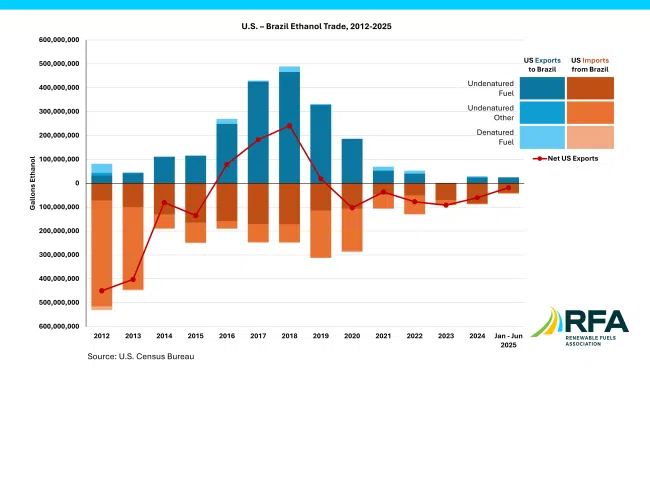
In a U.S. Trade Representative hearing Sept. 3, 2025, in Washington, the Renewable Fuels Association will outline the harmful impacts of Brazil’s unfair trade policies on the U.S. ethanol industry and call on the Trump administration to pursue further actions to level the playing field. In July, the USTR initiated an investigation of Brazil under Section 301 of the Trade Act of 1974, to determine whether acts, policies, and practices of the Government of Brazil are unreasonable or discriminatory and burden or restrict U.S. commerce.
“RFA strongly believes a thorough investigation is justified and necessary, and we commend the U.S. Trade Representative for bringing much-needed scrutiny to Brazil’s prejudicial and unreasonable actions,” RFA President and CEO Geoff Cooper is testifying. “Over the past eight years, Brazil has implemented tariff and non-tariff barriers specifically designed to block U.S.-produced ethanol from entering the Brazilian marketplace. Whereas Brazil was once the world’s largest importer of U.S. ethanol, the market has disintegrated over the past five years due to the imposition of numerous barriers.”
Adding insult to injury, Cooper states, “Brazilian ethanol has had virtually unfettered access to the U.S. market for the past 14 years, facing only a 2.5 percent ad valorem duty. In fact, policies like the RFS and state low carbon fuel programs actually give preferential treatment to Brazilian sugarcane ethanol imports over U.S. grain-based ethanol.”
Cooper stresses five actions RFA supports:
- Continuing negotiations focused on permanently removing the Brazilian tariff on imported ethanol;
- Until the Brazilian tariff on U.S. ethanol is removed, fully enforcing the 50-percent tariff on Brazilian imports recently enacted by the Trump administration;
- Working with Brazil to eliminate the unfeasible barriers that block U.S. ethanol producers from participation in the RenovaBio program;
- Collaborating with EPA to implement adjustments to RFS compliance credit values for ethanol imported from Brazil; and
- Removing Brazil’s Generalized System of Preferences (GSP) designation.
Click here for comments filed by RFA last month in response to the USTR investigation.


Comments