Sept. 23, 2025:
WASHINGTON (AP) — The Trump administration’s abrupt decision to slap a $100,000 fee on H-1B visas has stunned and confused employers, students and workers from the United States to India and beyond.
Since announcing the decision Friday (Sept. 19, 2025), the White House has tried to reassure jittery companies that the fee does not apply to existing visa holders and that their H-1B employees traveling abroad will not be stranded, unable to re-enter the United States without coming up with $100,000. The new policy took effect at 12:01 a.m. Eastern Sunday.
Despite the effort at reassurance, “there’s still some folks out there recommending to their H-1B employees that they not travel right now until it’s a little clearer,” Leon Rodriguez, a partner at the Seyfarth law firm who was director of U.S. Citizenship and Immigration Services in the Obama administration.
Other questions remain, some of them basic. “What actually is the process for paying this $100,000,” Rodriguez said. “Usually, when an agency is going to charge a fee, there’s a whole process. There’s the creation of forms for collecting that fee. … At this point, we don’t actually know what that process will be like.”
“Key questions remain, such as whether the new fee will apply to universities and nonprofit research organizations, employers that Congress has exempted from the annual limit on H-1B visas,” said Bo Cooper, partner at the immigration law firm Fragomen, Del Rey, Bernsen & Loewy.
Here’s a look at what the H-1B visa program is and what the Trump administration is doing to it.
What are H-1B visas and who uses them?
Created by the 1990 Immigration Act, they are type of nonimmigrant visa, meant to allow American companies to bring in people with technical skills that are hard to find in the United States. The visas are not intended for people who want to stay permanently. Some eventually do, but only after transitioning to different immigration statuses.
An H-1B allows employers to hire foreign workers who have specialized skills and a bachelor’s degree or the equivalent. They are good for three years and can be extended another three years, suggesting that there are now “around 700,000 H-1B visa holders in the country and another half a million or so dependents,” economist Stephen Brown of Capital Economics wrote in a commentary Monday.
At least 60% of the H-1B visas approved since 2012 have been for computer-related jobs, according to the Pew Research Center. But hospitals, banks, universities and a wide range of other employers can and do apply for H-1B visas.
The number of new visas issued annually is capped at 65,000, plus an additional 20,000 for people with a master’s degree or higher. Those visas are handed out by a lottery. Some employers, such as universities and nonprofits, are exempt from the limits.
According to Pew, nearly three-quarters of those whose applications were approved in 2023 came from India.
What did Trump do?
The White House announced the $100,000 fee. The application fee is currently $215, plus other relatively nominal processing charges. It took effect barely 24 hours later.
Commerce Secretary Howard Lutnick said the fee would be applied annually, for a total of $600,000 over the maximum number of renewals allowed. The White House clarified Saturday that it was a one-time fee and said it would not apply to current visa holders.
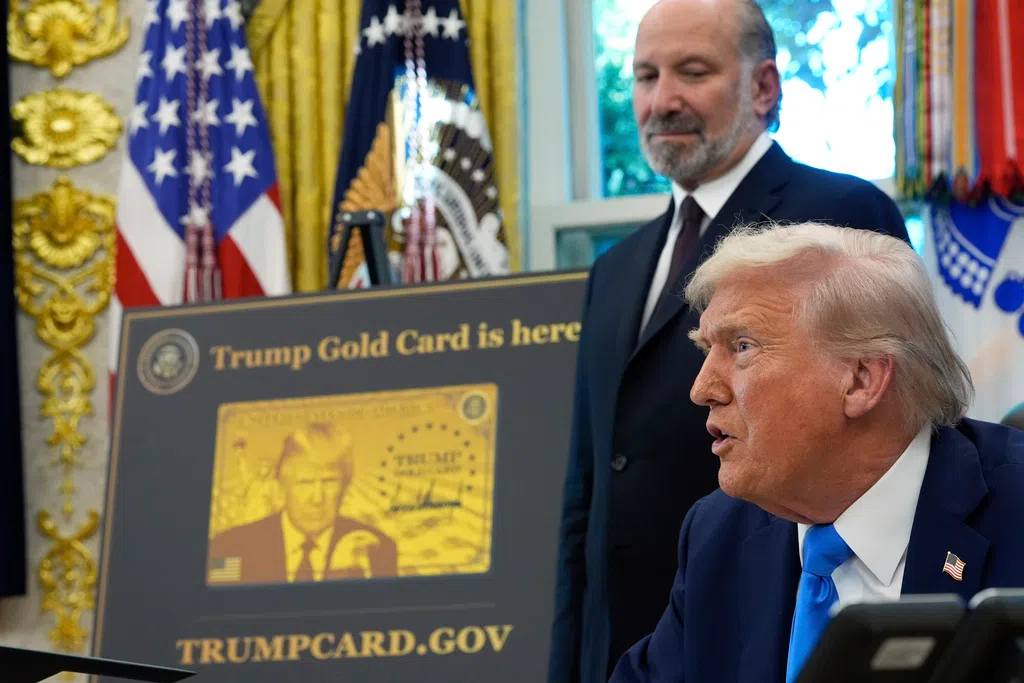
Trump also rolled out a $1 million “gold card” visa for wealthy individuals.
The moves are certain to draw lawsuits charging that the president was improperly sidestepping Congress with a dramatic overhaul of the legal immigration system.
Why target H-1B visas?
Critics say they undercut American workers, luring people from overseas who are often willing to work for less than American tech workers do. Staffing companies such as Tata Consultancy Services often supply Indian workers to corporate clients.
“To take advantage of artificially low labor costs incentivized by the program, companies close their IT divisions, fire their American staff, and outsource IT jobs to lower-paid foreign workers,” the White House said in its proclamation Friday.
In a 2020 report, the left-leaning Economic Policy Institute found that 60% of the H-1B positions certified by U.S. Labor Department are assigned wages below the median for the job.
Brown at Capital Economics wrote that “it is hard to disagree with the administration’s argument that the program needs reform.”
Giovanni Peri, director of the Global Migration Center at the University of California, Davis, said that abuses of the program — such as bringing in mid-level coders to replace higher-paid Americans — do occur but are relatively rare.
Most H-1B visa holders, he said, really are highly skilled workers who are hard to find. “Most of these people come in, and they have helped the productivity of firms; they have helped innovation,” Peri said. “They have complemented the work of Americans, and they have allowed growth.’’
What impact will the H-1B crackdown have?
Brown said that many tech firms can probably afford to pay $100,000 to bring in skilled workers.
“Nonetheless,″ he wrote, “the upfront fee will clearly be too high for many companies to stomach. Last year, the healthcare, retail and accommodation & food services sectors accounted for a quarter of H-1B visas between them, and firms in those sectors will probably find it harder to afford the fee.″
The higher fee — along with other Trump administration attempts to curb immigration — is likely to reduce the U.S. labor supply and push wages higher, Brown said.
Foreign workers like Alan Wu are worried – and stunned by the speed with which Trump disrupted the H-1B process. “Can you release some policy which impacts tons of people just like that?” said Wu, who is working in Indianapolis as a data scientist for a pharmaceutical company.
He is working legally on his student visa after earning a doctorate. He’s failed to win the H-1B lottery for two consecutive years. And he’s now rethinking his plan to live permanently in the United States, where he’s lived for more than a decade. “I am definitely concerned about my job now that the cost and risk of hiring a foreigner is so high,” he said.
Navneet Singh, who runs a consultancy “Go Global Immigration” in India’s Punjab state, said changes to H-1B visa policies are likely to significantly impact future migration to the U.S., particularly from India.
“Trump is trying to suffocate new immigrants who are skilled, so that they won’t take the jobs away from the average American. But by doing so, they will be making (U.S.) production expensive,” Singh said.
He said the new policy is likely to create advantages for competitors in other countries. “Countries like France, Netherlands, Germany and Canada are set to gain from this move,” he added.
Some Indian students aspiring to pursue higher studies in the U.S. are disappointed. “It feels like a door closing,” said one aspiring student who requested anonymity.
What businesses will be hurt the most?
Greg Morrisett, dean and vice provost at Cornell Tech, said startups and small businesses are likely to be the most affected by the fees since there’s “no way they can” pay them. Cornell Tech, for instance, has launched about 120 startups and the “vast majority” have students coming from overseas. The result? “They’ll pick up and move to Europe or Asia, wherever they can find,” he said.
“The big tech companies will likely move a lot of operations and things into other countries. We saw this when, for example, you know, Ireland made it really attractive from a tax perspective. All of a sudden all the headquarters move to Ireland,” Morrisett said.
And startups, he added, “the next Amazon, the next Google will give up here and go somewhere else and then we won’t have that advantage in the next generation of tech leadership.”
Sept. 20, 2025:
WASHINGTON (AP) — President Donald Trump on Friday (Sept. 19, 2025) signed a proclamation that will require a $100,000 annual visa fee for highly-skilled foreign workers and rolled out a $1 million “gold card” visa as a pathway to U.S. citizenship for wealthy individuals, moves that face near-certain legal challenges amid widespread criticism he is sidestepping Congress.
If the moves survive legal muster, they will deliver staggering price increases. The visa fee for skilled workers would jump from $215. The fee for investor visas, which are common in many European countries, would climb from $10,000-$20,000 a year.
H-1B visas, which require at least a bachelor’s degree, are meant for high-skilled jobs that tech companies find difficult to fill. Critics say the program is a pipeline for overseas workers who are often willing to work for as little as $60,000 annually, well below the $100,000-plus salaries typically paid to U.S. technology workers.
Trump on Friday insisted that the tech industry would not oppose the move. Commerce Secretary Howard Lutnick said “all big companies” are on board.
Representatives for the biggest tech companies, including Amazon, Apple, Google and Meta, did not immediately respond to messages for comment on Friday. Microsoft declined to comment.
Lutnick said the change will likely result in far fewer H-1B visas than the 85,000 annual cap allows because “it’s just not economic anymore.”
“If you’re going to train people, you’re going to train Americans.” Lutnick said on a conference call with reporters. “If you have a very sophisticated engineer and you want to bring them in … then you can pay $100,000 a year for your H-1B visa.”
Trump also announced he will start selling a “gold card” visa with a path to U.S. citizenship for $1 million after vetting. For companies, it will cost $2 million to sponsor an employee.
The “Trump Platinum Card” will be available for a $5 million and allow foreigners to spend up to 270 days in the U.S. without being subject to U.S. taxes on non-U.S. income. Trump announced a $5 million gold card in February to replace an existing investor visa — this is now the platinum card.
Lutnick said the gold and platinum cards would replace employment-based visas that offer paths to citizenship, including for professors, scientists, artists and athletes.
Critics of H-1Bs visas who say they are used to replace American workers applauded the move. U.S. Tech Workers, an advocacy group, called it “the next best thing” to abolishing the visas altogether.
Doug Rand, a senior official at U.S. Citizenship and Immigration Services during the Biden administration, said the proposed fee increase was “ludicrously lawless.”
“This isn’t real policy — it’s fan service for immigration restrictionists,” Rand said. “Trump gets his headlines, and inflicts a jolt of panic, and doesn’t care whether this survives first contact with the courts.”
Lutnick said the H-1B fees and gold card could be introduced by the president but the platinum card needs congressional approval.
Historically, H-1B visas have been doled out through lottery. This year, Amazon was by far the top recipient of H-1B visas with more than 10,000 awarded, followed by Tata Consultancy, Microsoft, Apple and Google. Geographically, California has the highest number of H-1B workers.
Critics say H-1B spots often go to entry-level jobs, rather than senior positions with unique skill requirements. And while the program isn’t supposed to undercut U.S. wages or displace U.S. workers, critics say companies can pay less by classifying jobs at the lowest skill levels, even if the specific workers hired have more experience.
As a result, many U.S. companies find it cheaper to contract out help desks, programming and other basic tasks to consulting companies such as Wipro, Infosys, HCL Technologies and Tata in India and IBM and Cognizant in the U.S. These consulting companies hire foreign workers, often from India, and contract them out to U.S. employers looking to save money.
First lady Melania Trump, the former Melania Knauss, was granted an H-1B work visa in October 1996 to work as a model. She was born in Slovenia.
In 2024, lottery bids for the visas plunged nearly 40%, which authorities said was due to success against people who were “gaming the system” by submitting multiple, sometimes dubious, applications to unfairly increase chances of being selected.
Major technology companies that use H-1B visas sought changes after massive increases in bids left their employees and prospective hires with slimmer chances of winning the random lottery. Facing what it acknowledged was likely fraud and abuse, USCIS this year said each employee had only one shot at the lottery, whether the person had one job offer or 50.
Critics welcomed the change but said more needs to be done. The AFL-CIO wrote last year that while changes to the lottery “included some steps in the right direction,” it fell short of needed reforms. The labor group wants visas awarded to companies that pay the highest wages instead of by random lottery, a change that Trump sought during his first term in the White House.


Comments