Oct. 1, 2025:
SEOUL, South Korea (AP) — The United States has agreed to allow South Korean workers on short-term visas or a visa waiver program to help build industrial sites in America, Seoul’s Foreign Ministry said Wednesday (Oct. 1, 2025).
The announcement came weeks after South Korea flew home more than 300 of its nationals who had been detained in a massive immigration raid at a battery factory being built on Hyundai’s sprawling auto plant campus near Savannah, Georgia.
The roundup, along with U.S. video footage showing Korean workers shackled at the hands, ankles and waist, fueled public outrage and a sense of betrayal in South Korea — a key U.S. ally that had pledged hundreds of billions of dollars in U.S. investments just weeks earlier in hopes of avoiding the Trump administration’s steepest tariffs.
The incident also triggered pent-up frustrations in Seoul over Washington’s failure to act on its long-standing request to improve the visa system for skilled Korean workers, even as the United States presses its ally to expand industrial investments.
South Korean companies have been mostly relying on short-term visas or a visa waiver program called the Electronic System for Travel Authorization, or ESTA, to send workers needed to launch manufacturing sites and handle other setup tasks, a practice that had been largely tolerated for years.
After bilateral visa talks Tuesday in Washington, South Korea’s Foreign Ministry said their American counterparts reaffirmed that South Korean companies can use B-1 short-term business visas or ESTAs to send workers to install, service and repair equipment needed for their projects in the United States. The statement was consistent with earlier remarks by South Korean Foreign Minister Cho Hyun, who, after traveling to Washington to negotiate the workers’ release, said that U.S. officials had agreed to allow them to return later to complete their work.
South Korea has called for more fundamental steps, such as creating a new visa category to expand access for skilled workers. But U.S. officials at the Washington meeting said major changes would be difficult because of legislative constraints, according to a statement from the South Korean ministry.
Most of the Korean workers detained in Georgia were employed by LG Energy Solution and its subcontractors and held ESTAs as well as other visas.
LG said in a statement that it will “thoroughly prepare and work diligently to normalize the construction and operation of our factories in the United States.”
Sept. 11, 2025:
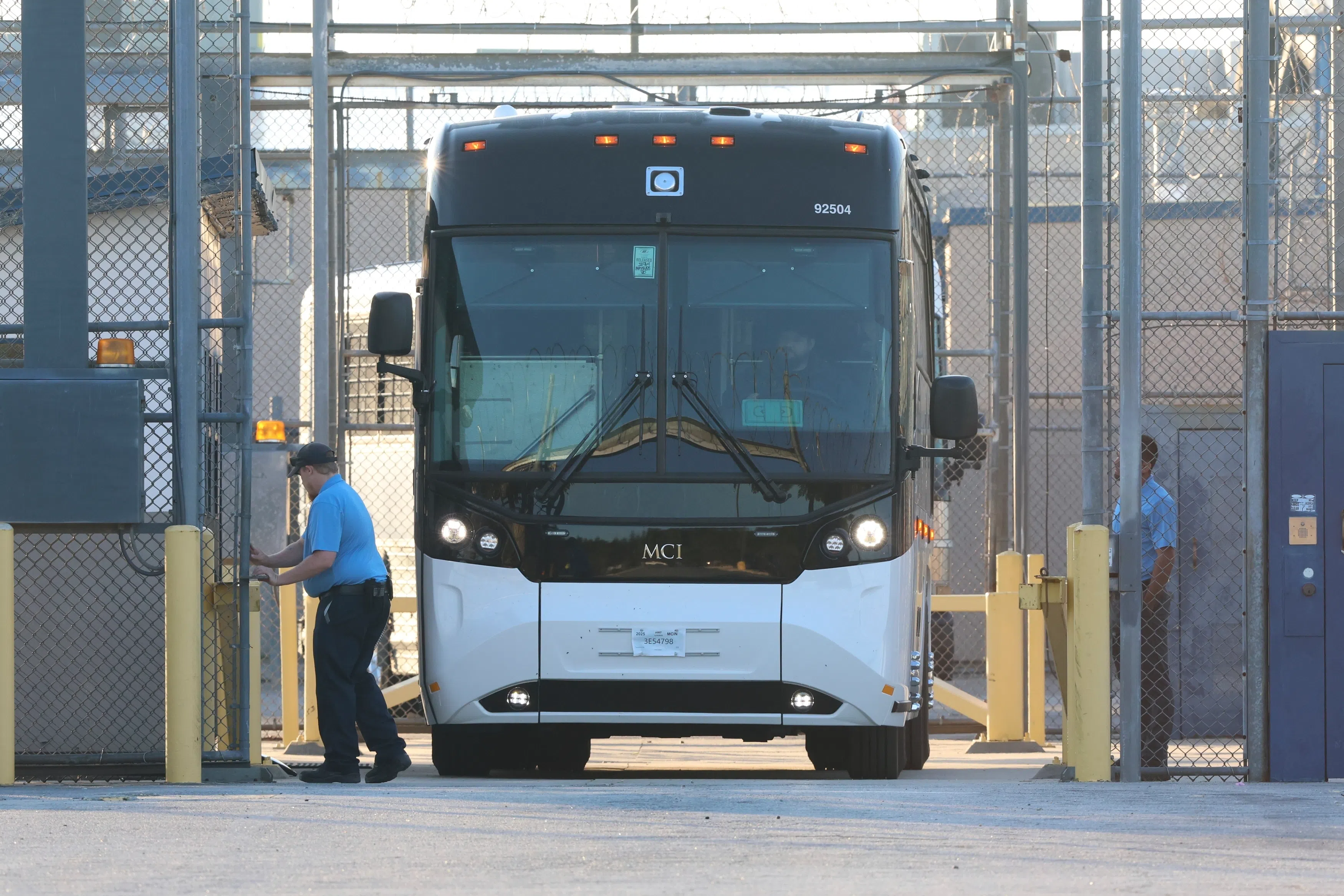
ATLANTA (AP) — A plane carrying more than 300 workers from South Korea who were detained during an immigration raid at a battery factory in Georgia last week left Atlanta shortly before noon Thursday (Sept. 11, 2025), bound for South Korea.
The workers traveled by bus from a detention center in southeast Georgia to Atlanta earlier in the day for their flight, which is expected to land in South Korea on Friday afternoon. South Korea’s Foreign Ministry said the detainees released by U.S. authorities included 316 Koreans, 10 Chinese nationals, three Japanese nationals and one Indonesian.
The workers were among about 475 people detained during last week’s raid at the battery factory under construction on the campus of Hyundai’s sprawling auto plant west of Savannah. They had been held at an immigration detention center in Folkston, 285 miles (460 kilometers) southeast of Atlanta.
South Korea’s President Lee Jae Myung on Thursday called for improvements to the United States’ visa system, saying Korean companies will likely hesitate to make new investments in the U.S. until that happens.
Lee said during a news conference that Korean and U.S. officials had a back-and-forth discussion over whether the detainees had to be handcuffed while they traveled by bus to Atlanta — something the Koreans “strongly opposed.” He said there was also a debate over whether they would be leaving under “voluntary departure” or deportation.
While those discussions were ongoing, U.S. officials started to return the detainees’ belongings. Then, however, “everything suddenly halted,” Lee said, adding that they were told that was due to instructions from the White House.
“President Trump had directed that the (detainees) should be allowed to return home freely and those who didn’t want to go didn’t have to,” he said. “We were told that, because of that instruction, the process was paused and the administrative procedures were changed accordingly.”
A South Korean Foreign Ministry official, speaking on condition of anonymity to discuss the diplomatic process, said Trump had halted the process to hear from South Korea on whether the Koreans should be allowed to stay to continue their work and help train U.S. workers or should be sent back to South Korea.
Lee said the U.S. gave the detainees a choice between staying and going home. Ultimately, one South Korean national who has relatives in the U.S. chose to stay, Lee said.
The Trump administration’s mass deportation agenda has included a string of workplace raids, but this one stood out for its scope and the fact that the target was a manufacturing site state officials have touted as Georgia’s largest economic development project. Hyundai Motor Group began manufacturing EVs a year ago at the $7.6 billion plant, which employs about 1,200 people.
In a statement Wednesday, Gov. Brian Kemp’s office stressed its “strong relationship with the Republic of Korea and Korean partners like Hyundai, stretching back 40 years to the establishment of Georgia’s trade office in Seoul.”
“We are thankful they are reiterating their commitment to adhere to all state and federal laws, just as we remain committed to not allowing this unfortunate incident to undo the decades of mutually beneficial partnerships we’ve built together,” a spokesperson said.
The detention of South Korean nationals also made the raid unusual as they are not often caught up in immigration enforcement actions.
Video released by U.S. Immigration and Customs Enforcement on Saturday showed a caravan of vehicles driving up to the site and then federal agents directing workers to line up outside. Some detainees were ordered to put their hands up against a bus as they were frisked and then shackled around their hands, ankles and waist. Others had plastic ties around their wrists as they boarded a Georgia inmate-transfer bus.
Sept. 10, 2025:
SEOUL, South Korea (AP) — A South Korean charter plane left for the U.S. on Wednesday to bring back Korean workers detained in an immigration raid in Georgia last week, though officials said the return of the plane with the workers onboard will not happen as quickly as they had hoped.
A total of 475 workers, more than 300 of them South Koreans, were rounded up in the Sept. 4 raid at the battery factory under construction at Hyundai’s sprawling auto plant. U.S. authorities released video showing some being shackled with chains around their hands, ankles and waists, causing shock and a sense of betrayal among many in South Korea, a key U.S. ally.
South Korea’s government later said it reached an agreement with the U.S. for the release of the workers.
Sept. 9, 2025:
SAVANNAH, Ga. (AP) — An immigration attorney says many South Korean workers detained in a U.S. immigration raid at a Hyundai plant in Georgia were brought in for highly specialized work that Americans aren’t trained to perform. Atlanta attorney Charles Kuck represents four South Koreans who were among 475 workers rounded up in the raid last week west of Savannah, They included 300 Korean nationals, and Kuck most had come for short-term jobs installing equipment for producing electric vehicle batteries. The detentions have caused confusion, shock and a sense of betrayal among many people in South Korea, a key U.S. ally.
Sept. 8, 2025, update:
LONDON (AP) — U.S. Homeland Security Secretary Kristi Noem said Monday (Sept. 8, 2025) she doesn’t think the detention of hundreds of South Koreans in an immigration raid at a Hyundai plant in Georgia will deter investment in the United States because such tough actions mean there is no uncertainty about the Trump administration’s policies.
The detention of 475 workers, more than 300 of them South Korean, in the Sept. 4, 2025, raid has caused confusion, shock and a sense of betrayal among many in the U.S.-allied nation.
“This is a great opportunity for us to make sure that all companies are reassured that when you come to the United States, you’ll know what the rules of the game are,” Noem said at a meeting in London of ministers from the “Five Eyes” intelligence-sharing partnership focused on border security.
“We’re encouraging all companies who want to come to the United States and help our economy and employ people, that we encourage them to employ U.S. citizens and to bring people to our country that want to follow our laws and work here the right way,” she told reporters.
The detained Koreans would be deported after most were detained for ignoring removal orders, while “a few” had engaged in other criminal activity and will “face the consequences,” Noem said.
Newly appointed U.K. Home Secretary Shabana Mahmood welcomed Noem and ministers from Canada, Australia and New Zealand to the 18th-century headquarters of the Honourable Artillery Company for talks on countering unauthorized migration, child sexual abuse and the spread of opioids.
Mahmood, who was given the interior minister job in a shakeup of Prime Minister Keir Starmer’s Cabinet on Friday, said the ministers would “agree new measures to protect our borders with our Five Eyes partners, hitting people-smugglers hard.”
The far-flung countries are close allies with some common problems but also widely differ in their approaches to migration. The Trump administration’s program of street raids, mass detentions and large-scale deportations of unauthorized migrants has drawn domestic and international criticism and a host of legal challenges.
Noem says tough measures are an inspiration to others
Noem said there had not been disagreements among the ministers in talks focused on sharing information on criminal gangs, using technology to disrupt their networks and speeding extradition arrangements.
“I don’t think that the discussion today has covered politics at all,” she said. “It is what resources do we have that we can share so we can each protect our countries better?”
Noem said that “when we put tough measures in place, the more that we can talk about that and share that is an inspiration to other countries to do the same.”
She denied a plan to expand immigration raids and deploy the National Guard in Chicago, which has met with opposition from local and state authorities, was on hold.
“Nothing’s on hold. Everything is full speed ahead,” Noem told reporters, saying “we can run as many operations every single day as we need to, to keep America safe.”
Also attending Monday’s talks were Canadian Public Safety Minister Gary Anandasangaree, Australia’s Home Affairs Minister Tony Burke and Judith Collins, the attorney general and defense minister of New Zealand.
UK grapples with migrant crossings
Britain’s center-left Labour government is struggling to bring down the number of migrants crossing the English Channel in small boats, some 30,000 so far this year. It faces calls from opposition parties to leave the European Convention on Human Rights in order to take tougher action.
The government says it won’t do that, but may tweak the interpretation of the rights convention in British law. It has struck a deal with France to return some migrants who cross the channel and is working on similar agreements with other countries.
Mahmood said Monday that the U.K. could suspend issuing visas to people from countries that do not agree to take back their citizens with no right to remain in Britain, though she did not name any potential countries.
“We do expect countries to play ball, play by the rules, and if one of your citizens has no right to be in our country, you do need to take them back,” she said.
Sept. 8, 2025:
SEOUL, South Korea (AP) — South Korea’s foreign minister departed for the U.S. on Monday (Sept. 8, 2025) to finalize steps for the return of several hundred South Korean workers detained in a massive immigration raid in Georgia, a spectacle that has caused confusion, shock and a sense of betrayal among many in the U.S.-allied nation.
The Sept. 4 raid on a battery factory under construction at a sprawling Hyundai auto plant resulted in the detainment of 475 workers, more than 300 them South Koreans. Some were shown being shackled with chains around their hands, ankles and waists in video released by U.S. Immigration and Customs Enforcement.
South Korea announced Sunday that the U.S. has agreed to release them and that it would bring them home on a charter flight once final administrative steps are completed.
President Donald Trump said the workers “were here illegally,” and that instead, the U.S. needs to work out arrangements with countries like South Korea to bring their experts in to train U.S. citizens to do work such as battery and computer manufacturing.
U.S. Homeland Security Secretary Kristi Noem told reporters in London that Trump sent a “powerful” message to investors and their employees.
“His message today that he sent to the world was, ‘Listen, our laws will be enforced, and we’re encouraging all companies who want to come to the United States and help our economy and employ people, that we encourage them to employ U.S. citizens and to bring people to our country that want to follow our laws and work here the right way,’” she said.
South Korean politicians roiled
Appearing at a legislative hearing before his departure, Foreign Minister Cho Hyun called the raid “a very serious matter” that he hadn’t anticipated at all, as many lawmakers lamented the American operation.
“If U.S. authorities detain hundreds of Koreans in this manner, almost like a military operation, how can South Korean companies investing in the U.S. continue to invest properly in the future?” said Cho Jeongsik, a lawmaker from the liberal governing Democratic Party.
Another lawmaker, Kim Gi-hyeon from the conservative opposition People Power Party, said the “unacceptable” raid dealt South Korea a “severe blow that will be difficult to heal.”
Some lawmakers even called for the government to retaliate by investigating Americans who are alleged to work illegally in South Korea.
Seoul has expressed regret over the raid, but experts say it won’t likely take any major tit-for-tat measures given the country’s security dependence on the U.S. in deterring potential North Korean aggressions and other spheres of cooperation between the two countries, including business ties.
Many South Koreans are stunned
The Trump administration has made a series of workplace raids to fulfill its mass deportation agenda, but this was the Homeland Security agency’s largest yet at a single site, and targeted Georgia, a symbol of bilateral cooperation where many large South Korean businesses operate and plan future investments.
Particularly stunning is that this raid came only weeks after South Korea promised to pour hundreds of billions of dollars into U.S. investments as part of a tariff deal, and days after Trump and South Korean President Lee Jae Myung held their first summit meeting in Washington on Aug. 25.
“The way that Trump is pressuring the Korean government and inflicting damages on its people is very rough and unilateral,” said Kim Taewoo, former head of Seoul’s Korea Institute for National Unification. “Can this be forgotten easily in South Korea? In a long-term perspective, it won’t be good for U.S. national interests as well.”
In an editorial Monday, South Korea’s biggest newspaper, Chosun Ilbo, wrote that “Fundamental doubts emerge: What does the U.S. mean by ‘alliance,’ and are investment benefits guaranteed across administrations?”
Paik Wooyeal, a professor at Seoul’s Yonsei University said the U.S. goal of restoring manufacturing through foreign investments is colliding with its lack of visa and immigration systems that could support such an effort.
South Korean companies operating in the U.S. will likely suffer “a great confusion” as they will now be forced to bring workers back home to resolve visa issues, he said. Such developments would undermine U.S. interests, but Trump won’t likely make any concessions anytime soon, Paik predicted.
South Koreans question US visa system
Steven Schrank, the lead Georgia agent of Homeland Security Investigations, said Friday that some of the detained workers had illegally crossed the U.S. border, while others had entered legally but had expired visas or had entered on a visa waiver that prohibited them from working.
But South Korean officials and experts have expressed frustration over what they call strict U.S. limits on visas for highly skilled foreign workers to protect its domestic workforce, and inaction on Seoul’s calls to expand work visas for skilled South Korean nationals. As a result, South Korean companies have been relying on short-term visitor visas or the Electronic System for Travel Authorization to send the workers they need to launch manufacturing facilities or handle other setup tasks.
“The incident will inevitably exacerbate shortages of skilled workers with legal work authorization and create pressure for increases in labor costs, potentially disrupting operations and rising costs across major business projects in the United States,” South Korea’s Eugene Investment & Securities said in a report Monday.
Daishin Securities, meanwhile, predicted in a report that the raid could delay operations at the targeted battery plant, which was slated to begin production early next year, potentially affecting Hyundai’s EV business in America.
During Monday’s legislative hearing, Cho, the foreign minister, told lawmakers that the U.S. had “not responded adequately” to South Korea’s requests to expand visas for its workers, and that Seoul plans to use this raid as an opportunity to move related negotiations forward.
Cho said some of the people detained in Georgia may need to return to the site to complete their work at the factory, and that South Korean officials are negotiating to ensure they can reenter the United States.
“I will clearly point out to them that a delay in (the factory’s) completion would also cause significant losses for the United States,” Cho said.


Comments