Oct. 8, 2025:
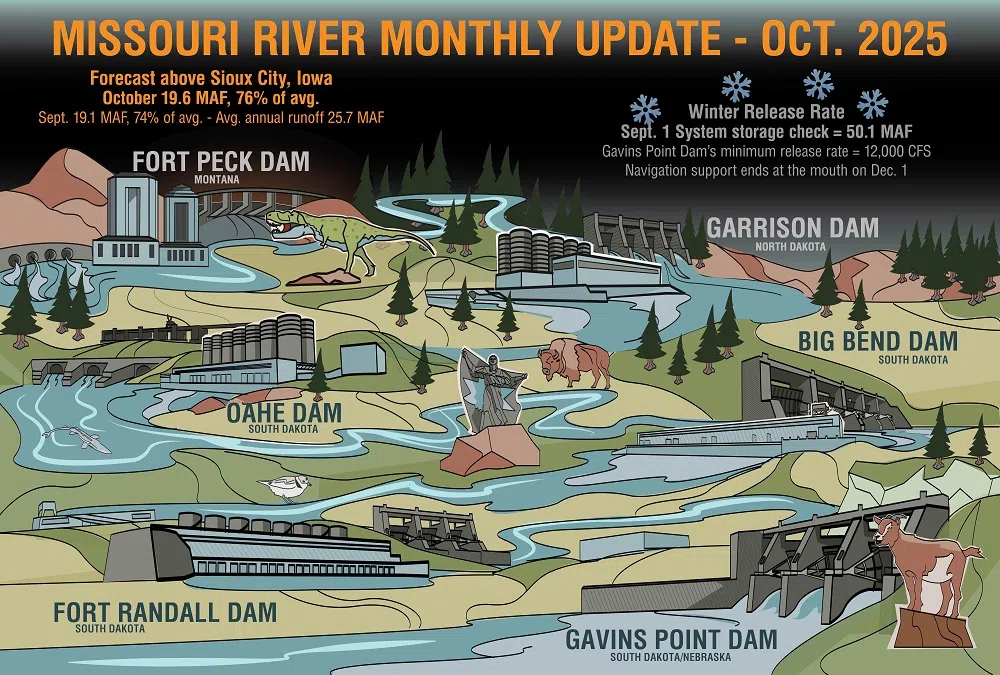
Runoff in the Missouri River Basin above Sioux City, Iowa, during September 2025 was 109% of average (1.3 million acre-feet).
John Remus, chief of the U.S. Army Corps of Engineers’ Missouri River Basin Water Management Division, says beneficial rainfall occurred over central South Dakota and North Dakota last month resulting in well-above average runoff into the Oahe, Big Bend, Fort Randall and Gavins Point reservoirs. He says the updated 2025 calendar year forecast for the upper Basin is 76% of average (19.6 MAF).
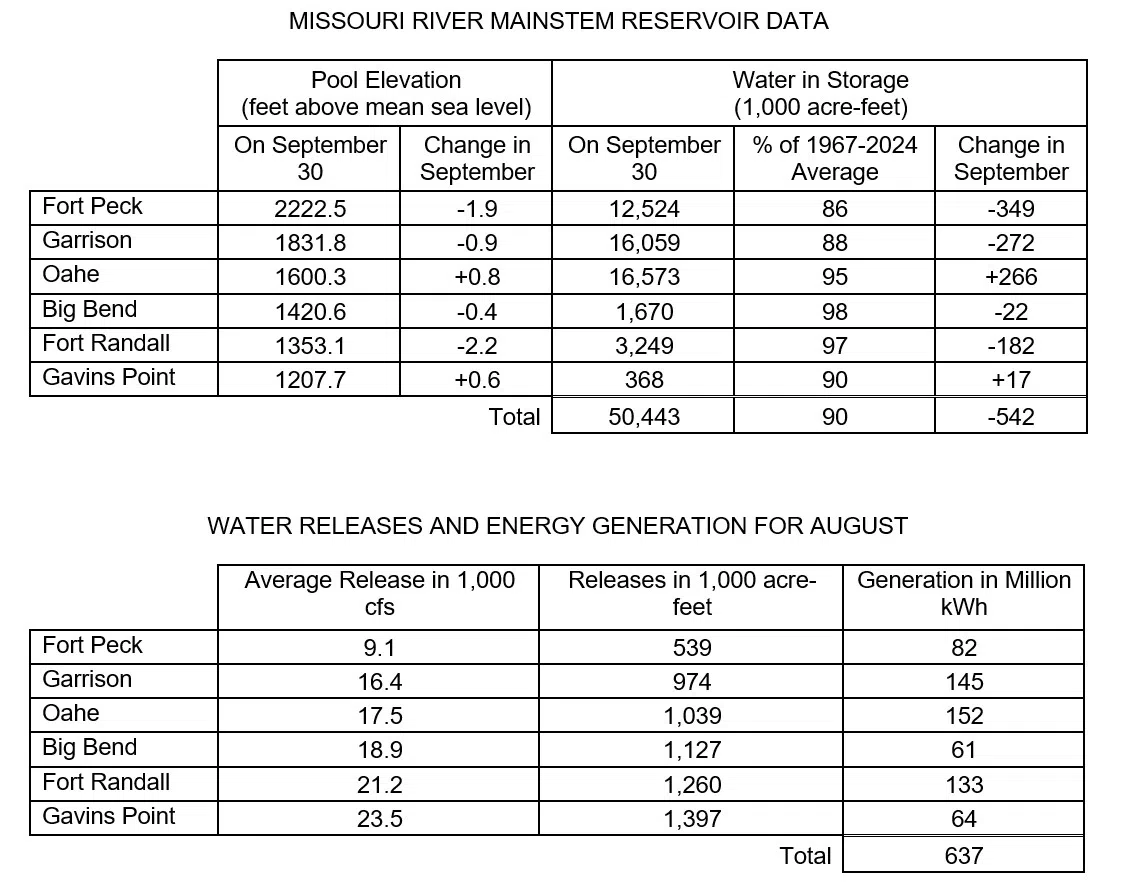
As of Oct. 1, the total volume of water stored in the System was 50.4 MAF, which is 5.7 MAF below the base of the System’s flood control zone. System storage will continue to decline through the fall. The updated reservoir studies indicate that the System storage is expected to be 48.5 MAF at the start of the 2026 runoff season, approximately 7.6 MAF below the base of flood control.
The six mainstem power plants generated 637 million kWh of electricity in September, below the typical energy generation of 900 million kWh for the month. The power plants are projected to generate 7.7 billion kWh of electricity this year, compared to the long-term average of 9.4 billion kWh.
At the end of Sept., the Oahe reservoir was at 1600.3 feet– up 0.8 feet since Aug. 31.
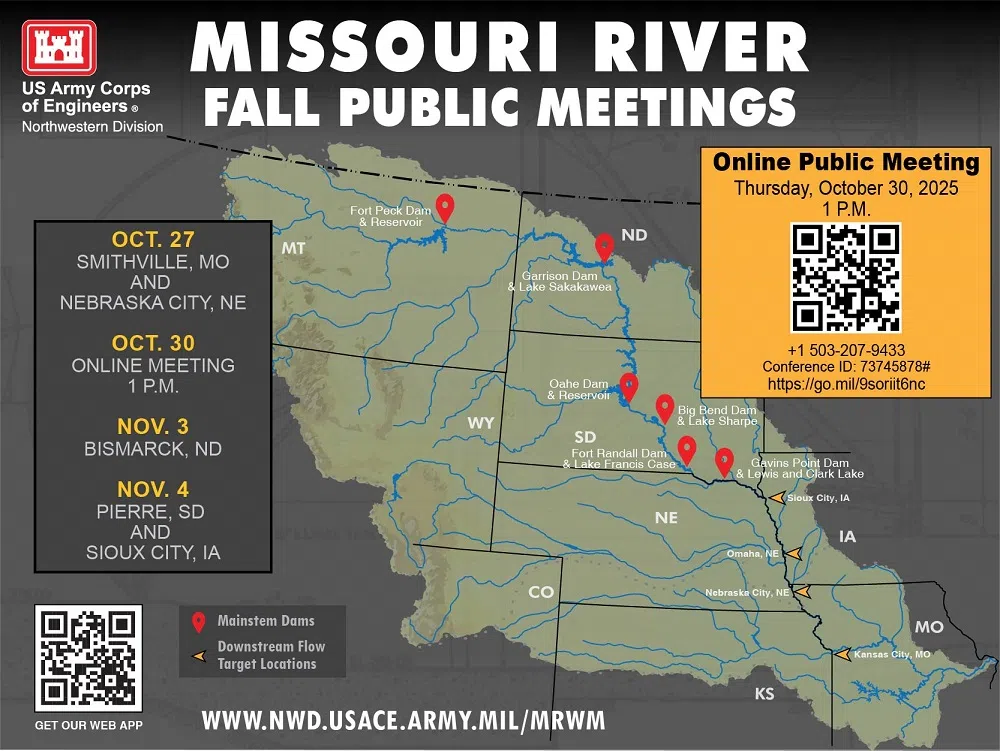
The Army Corps’ Northwestern Division is scheduling its annual Fall public meetings to recap 2025 and discuss the draft 2025-26 Annual Operating Plan, subject to the availability of funds. The Corps will host a webinar Oct. 30 and will hold a public meeting in Fort Pierre Nov. 4. The comment period will close on Nov. 26.
The AOP can be found online, https://go.mil/mr-meetings.
To view the detailed three-week release forecast for the mainstem dams, go to https://go.mil/mr-3wk-fcast.
Public meeting options include:
-
Thursday, Oct. 30 – Online Webinar
-
Start time: 1300 CT
-
https://go.mil/9soriit6nc
-
Call in by phone: +1 503-207-9433,,73745878#
-
-
Tuesday, Nov. 4 – Fort Pierre, SD
-
Start time: 0900 CT
-
Casey Tibbs Conference Center
-
210 Verendrye Drive
-
Fort Pierre, South Dakota 57532
-
NWDMonthlyUpdate
.
July 11, 2025:
The runoff forecast for the Missouri River above Sioux City, Iowa, for the rest of this year (2025) is currently 74% of average (19.1 MAF).
Missouri River Power Production Team Leader for the US Army Corps of Engineers Mike Swenson says the dam system’s reservoirs have plenty of storage space available.
Swenson says of the three largest dam reservoirs– Fort Peck, Garrison and Oahe– Fort Peck and Oahe are more than seven and eight feet below their exclusive flood control zones, respectively.
Swenson says the Corps will work to balance out the big three reservoirs before next year’s runoff season begins.
The runoff forecast is based on current soil moisture conditions, mountain snowpack, and long-term precipitation and temperature outlooks.
To view the detailed three-week release forecast for the mainstem dams, go to https://go.usa.gov/xARQB.
The Missouri Basin Web App provides links to these reports and others that are updated more frequently. http://go.usa.gov/xE6fC.
The six mainstem power plants generated 810 million kWh of electricity in June, which is below the typical energy generation of 842 million kWh for that month. The power plants are expected to generate 8.1 billion kWh this year, compared to the long-term average of 9.4 billion kWh.
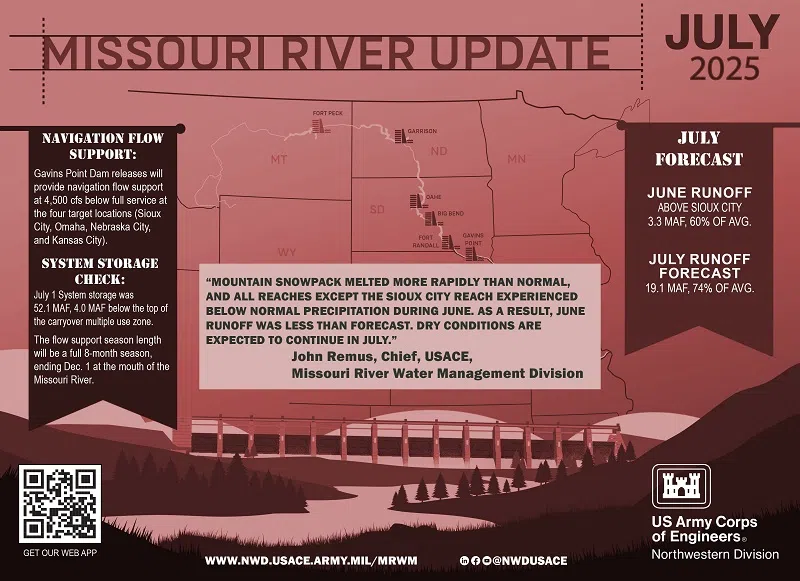
“Mountain snowpack melted more rapidly than normal, and all reaches except the Sioux City reach experienced below normal precipitation during June,” said John Remus, chief of the U.S. Army Corps of Engineers’ Missouri River Basin Water Management Division. “As a result, June runoff was less than forecast. Dry conditions are expected to continue in July.”
.
July 10, 2025:
Runoff in the Missouri River Basin above Sioux City, Iowa, during June 2025 was 60% of average (3.3 million acre-feet).
John Remus, chief of the U.S. Army Corps of Engineers’ Missouri River Basin Water Management Division says mountain snowpack melted more rapidly than normal. Additionally, all reaches except the Sioux City reach experienced below normal precipitation during June so the updated 2025 calendar year runoff forecast continues to be below average.
The 2025 calendar year runoff forecast above Sioux City is 74% of average (19.1 MAF) and slightly lower than last month’s forecast. The runoff forecast is based on current soil moisture conditions, mountain snowpack, and long-term precipitation and temperature outlooks.
The six mainstem power plants generated 810 million kWh of electricity in June, which is below the typical energy generation of 842 million kWh for that month. The power plants are expected to generate 8.1 billion kWh this year, compared to the long-term average of 9.4 billion kWh.
To view the detailed three-week release forecast for the mainstem dams, go to https://go.usa.gov/xARQB.
The Missouri Basin Web App provides links to these reports and others that are updated more frequently. http://go.usa.gov/xE6fC.
“Mountain snowpack melted more rapidly than normal, and all reaches except the Sioux City reach experienced below normal precipitation during June,” said John Remus, chief of the U.S. Army Corps of Engineers’ Missouri River Basin Water Management Division. “As a result, June runoff was less than forecast. Dry conditions are expected to continue in July.”
June 5, 2025:
Runoff in the Missouri River Basin above Sioux City, Iowa, during May 2025 was right on track at 100% of average (3.4 million acre-feet).
John Remus, chief of the U.S. Army Corps of Engineers’ Missouri River Basin Water Management Division, says heavy rainfall in western and central South Dakota and North Dakota during May supplemented the mountain snowmelt runoff. However, he says mountain snowpack is melting more rapidly than normal and as a result, the runoff forecast later this summer and fall has been slightly reduced.
The 2025 calendar year runoff forecast above Sioux City is 19.7 MAF, 77% of average, and slightly lower than last month’s forecast. The runoff forecast is based on current soil moisture conditions, mountain snowpack, and long-term precipitation and temperature outlooks.
The six mainstem power plants generated 829 million kWh of electricity in May, 40 million kWh more than average for the month (789 million kWh). The power plants are expected to generate 8.4 billion kWh this year, 10 billion kWh lower than the long-term average of 9.4 billion kWh.
To view the detailed three-week release forecast for the mainstem dams, go to https://go.usa.gov/xARQB.
The Missouri Basin Web App provides links to these reports and others that are updated more frequently. http://go.usa.gov/xE6fC.
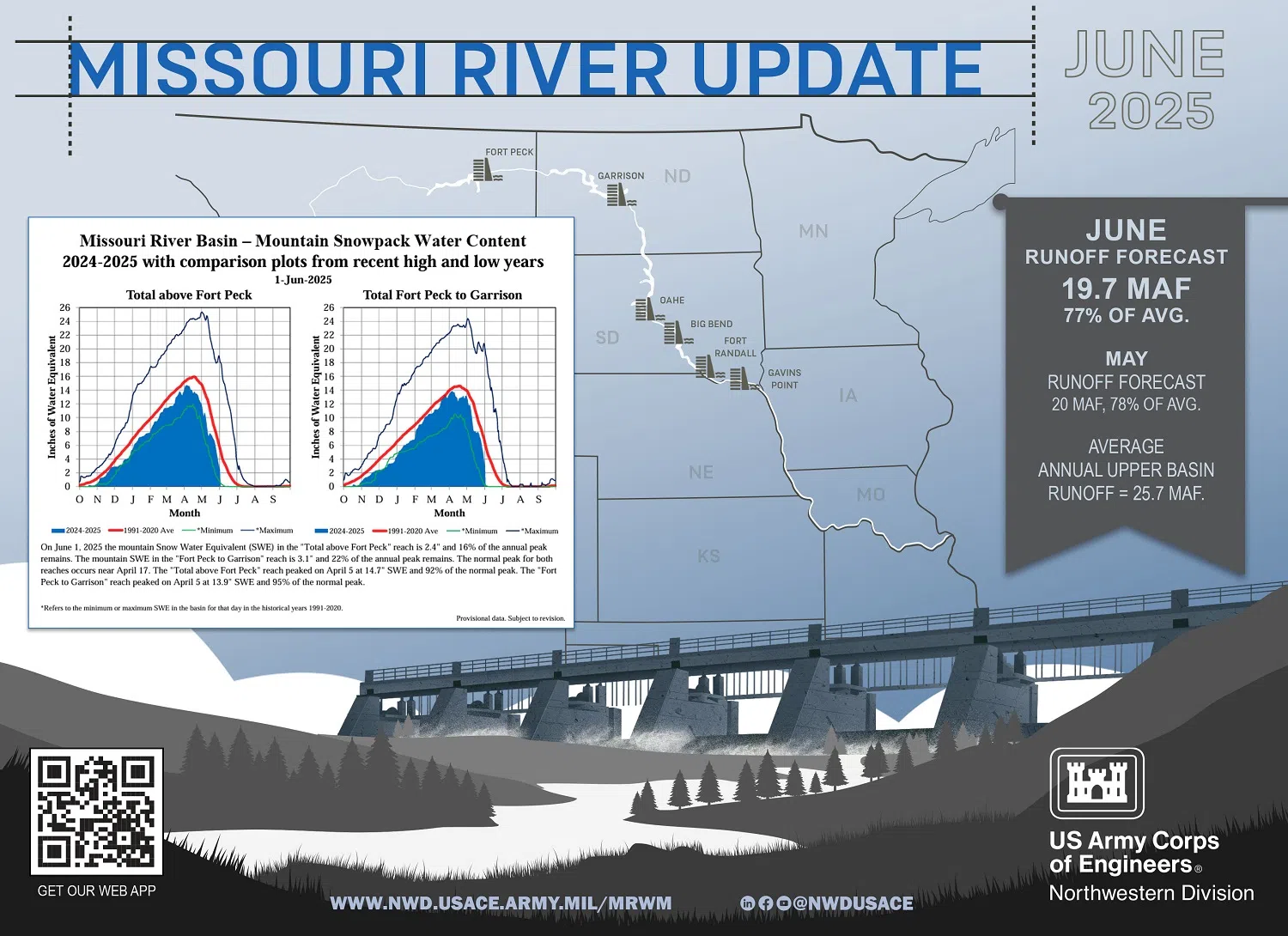
The June 2025 runoff forecast is slightly lower at 19.7 million acre feet, down from 20 MAF in May. Mountain Snowpack continues to decrease with 22% remaining in the Fort Peck to Garrison reach and 16% of the snowpack remaining in the above Fort Peck reach.
May 8, 2025:
Runoff in the Missouri River Basin above Sioux City during April 2025 was 48% of average (1.4 million acre-feet), putting the 2025 calendar year runoff forecast above Sioux City at 78% of average (20 MAF).
John Remus, chief of the U.S. Army Corps of Engineers’ Missouri River Basin Water Management Division, says drought or abnormally dry conditions are currently present in 75% of the basin. He says conditions have worsened in Montana and North Dakota and as a result, the runoff forecast was lowered by 1.9 MAF from last month. The runoff forecast is based on current soil moisture conditions, mountain snowpack, and long-term precipitation and temperature outlooks.
The six mainstem power plants generated 727 million kWh of electricity last month, an increase from the typical April average of 695 million kWh. Forecast generation for 2025 is 8.6 billion kWh compared to the long-term average of 9.4 billion kWh.
To view the detailed three-week release forecast for the mainstem dams, go to http://go.usa.gov/xVgWr.
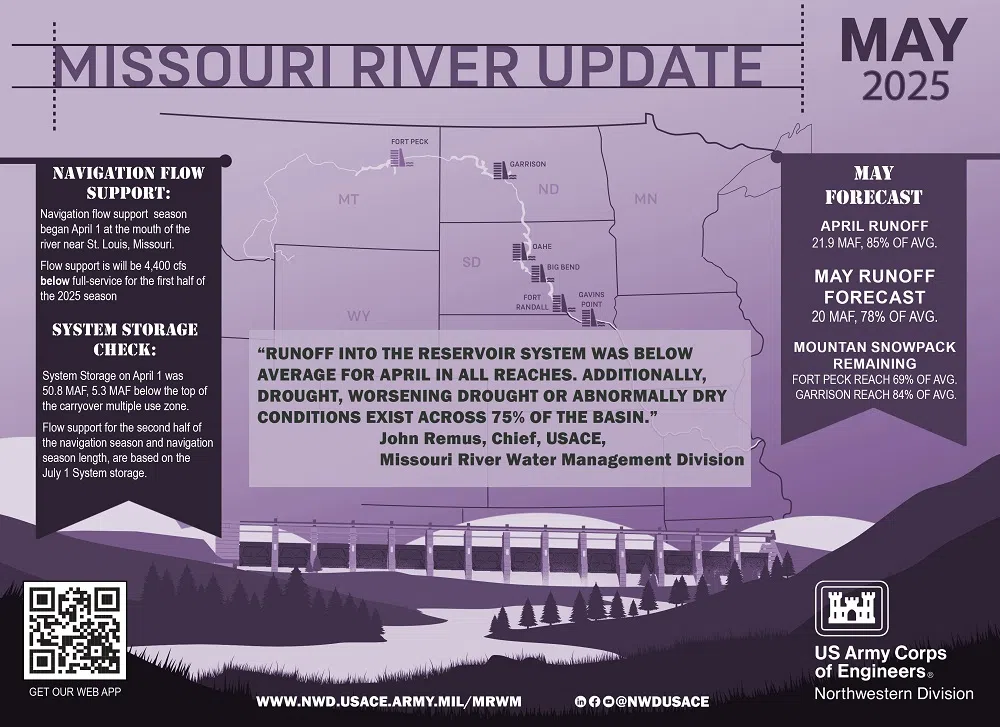
Runoff into the reservoir system was below average for April in all reaches. Additionally, drought, worsening drought or abnormally dry conditions exist across 75% of the basin. John Remus, Chief, USACE, Missouri River Water Management Division
April 11, 2025:
The updated 2025 calendar year runoff forecast for the Missouri River Basin above Sioux City, Iowa, continues to be below average.
The U.S. Army Corps of Engineers says March runoff in the upper Missouri River Basin was 76% of average. The 2025 calendar year runoff forecast above Sioux City is 85% of average. The runoff forecast is based on current soil moisture conditions, plains snowpack, mountain snowpack and long-term precipitation and temperature outlooks.
The six mainstem power plants generated 610-million kilowatt hours (kWh) of electricity in March, lower than the typical energy generation for the month of 636-million kWh. Forecast power generation for 2025 is 8.9-billion kWh, compared to the long-term average of 9.4 billion kWh.
To view the detailed three-week release forecast for the mainstem dams, go to http://go.usa.gov/xVgWr.
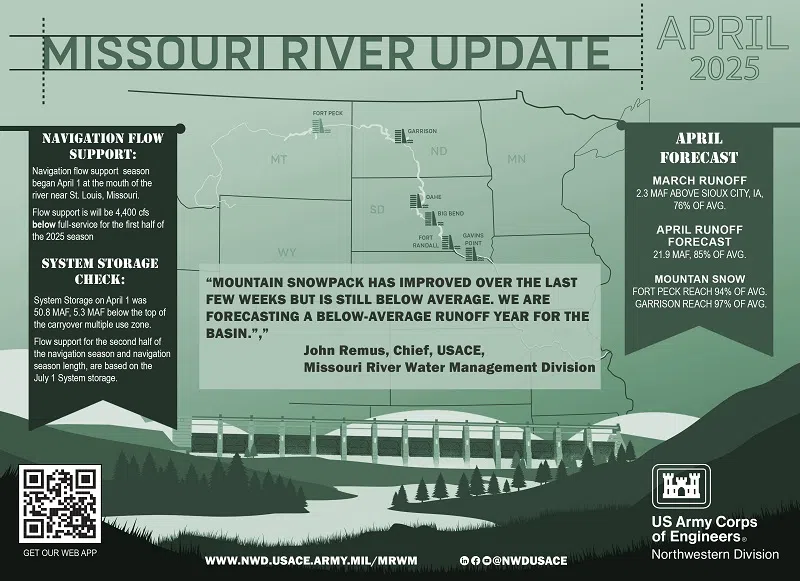
Runoff into the reservoir system was below average for the month of March and conditions across most of the basin remain dry,” said John Remus, chief of the U.S. Army Corps of Engineers’ Missouri River Basin Water Management Division. “Mountain snowpack has improved over the last few weeks but is still below average. We are forecasting a below-average runoff year for the basin”
March 7, 2025:
The updated 2025 calendar year runoff forecast for the Missouri River Basin above Sioux City, Iowa, continues to be below average.
The U.S. Army Corps of Engineers says February runoff in the upper Missouri River Basin was 91% of average. The 2025 calendar year runoff forecast above Sioux City is 86% of average. The runoff forecast is based on current soil moisture conditions, plains snowpack, mountain snowpack and long-term precipitation and temperature outlooks.
The six mainstem power plants generated 527 million kWh of electricity in February, lower than the typical energy generation for the month of 615 million kWh. Forecast power generation for 2025 is 8.8 billion kWh, compared to the long-term average of 9.4 billion kWh.
To view the detailed three-week release forecast for the mainstem dams, go to http://go.usa.gov/xVgWr.
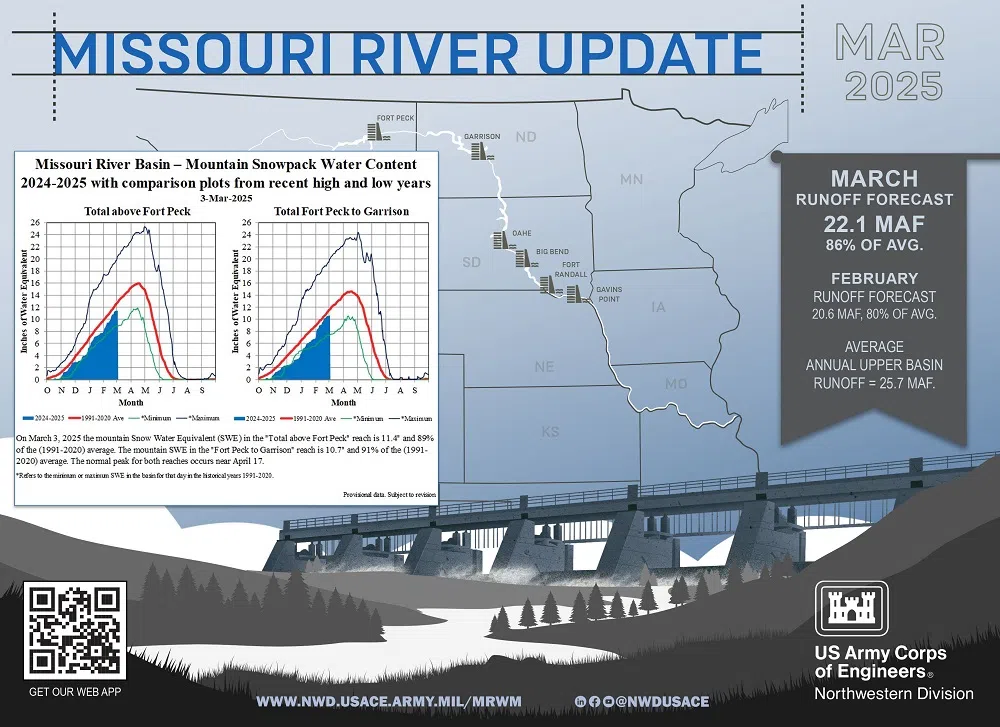
The 2025 calendar year runoff forecast above Sioux City is 22.1 MAF, 86% of average. The runoff forecast is based on current soil moisture conditions, plains snowpack, mountain snowpack, and long-term precipitation and temperature outlooks. In February, the runoff forecast was 20.6 MAF, which was 80% of average. Average is 25.7 MAF. The Mountain snowpack in the upper Missouri River Basin is accumulating at below average rates. The March 3 mountain snowpack in the Fort Peck reach was 89% of average, while the mountain snowpack in the Fort Peck to Garrison reach was 91% of average. By March 1, about 79% of the total mountain snowfall has typically accumulated. Mountain snow normally peaks near April 17.
February 6, 2025:
The updated 2025 calendar year runoff forecast for the Missouri River Basin above Sioux City, Iowa, continues to be below average.
January runoff in the Missouri River Basin above Sioux City was 0.7 million acre-feet, 92% of average. Runoff was near or below average for most of the Missouri River Basin, and most of the upper basin had below-normal precipitation.
“Runoff into the reservoir system was below average for the month of January and conditions across the basin remain dry,” said John Remus, chief of the U.S. Army Corps of Engineers’ Missouri River Basin Water Management Division. “With the below-average plains and mountain snowpack we are forecasting a below-average runoff year for the basin.”
The 2025 calendar year runoff forecast above Sioux City is 20.6 MAF, 80% of average. The runoff forecast is based on current soil moisture conditions, plains snowpack, mountain snowpack, and long-term precipitation and temperature outlooks.
At the start of the 2025 runoff season, which typically begins around March 1, the total volume of water stored in the Missouri River Mainstem Reservoir System is expected to be 50.0 MAF, 6.1 MAF below the top of the carryover multiple use zone.
Releases from Gavins Point Dam are currently 14,000 cubic-feet-per-second and will remain low during February to continuing conserving water in the System, based on the guidance in the Missouri River Mainstem System Master Manual.
“While the target winter release from Gavins Point Dam is 12,000 cfs, releases were increased to 14,000 cfs in mid-January to mitigate some of the effects of the much colder temperatures across the lower basin,” said Remus. “Releases will be held steady until ice effects stabilize downstream of Gavins, at which time releases will be reduced to the winter release of 12,000 cfs. Flows will continue to be adjusted to the extent practical based on cold weather conditions,” said Remus.
Basin and river conditions continue to be monitored, including plains and mountain snow accumulation, and System regulation will be adjusted based on the most up-to-date information.
Navigation:
Navigation flow support for the Missouri River is forecast to be at 4,400 cfs below full-service for the first half of the 2025 season, which begins April 1 at the mouth of the river near St. Louis, Missouri. The actual service level will be based on the total volume of water stored within the System on March 15, in accordance with the guidelines in the Master Manual. Flow support for the second half of the navigation season, as well as navigation season length, will be based on the storage in the System on July 1.
Mountain and Plains Snowpack:
Mountain snowpack in the upper Missouri River Basin is accumulating at below average rates. The Feb. 3 mountain snowpack in the Fort Peck reach was 85% of average, while the mountain snowpack in the Fort Peck to Garrison reach was 92% of average. By Feb. 1, about 60% of the total mountain snowfall has typically accumulated. Mountain snow normally peaks near April 17. The mountain snowpack graphics can be viewed at: http://go.usa.gov/xARQC.
Reservoir Forecasts:
Big Bend Dam
Average releases past month – 17,200 cfs
Forecast average release rate – 15,700 cfs
Forecast reservoir level – 1420.5 feet
Oahe Dam
Average releases past month – 17,100 cfs
Forecast average release rate – 15,600 cfs
End-of-January reservoir level – 1597.3 feet
Forecast end-of-February reservoir level – 1599.1 feet
Hydropower:
The six mainstem power plants generated 563 million kWh of electricity in January. Typical energy generation in January is 707 million kWh. Forecast generation for 2025 is 8.4 billion kWh compared to the long-term average of 9.4 billion kWh.
To view the detailed three-week release forecast for the mainstem dams, go to http://go.usa.gov/xVgWr.
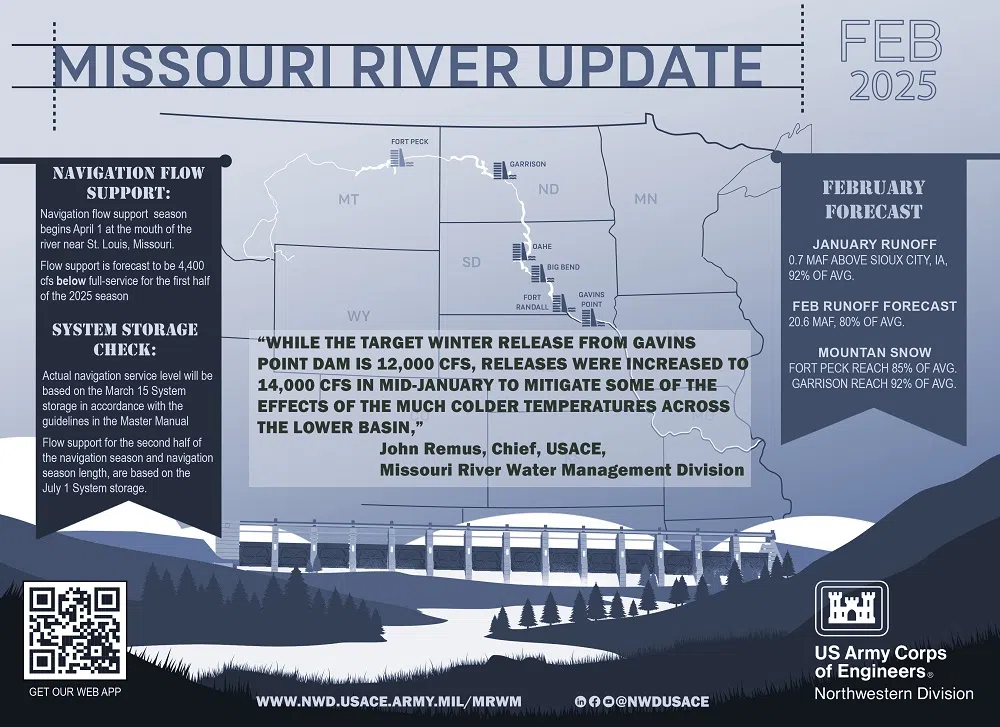
January runoff in the Missouri River Basin above Sioux City was 0.7 million acre-feet, 92% of average. The 2025 calendar year runoff forecast above Sioux City is 20.6 MAF, 80% of average. The runoff forecast is based on current soil moisture conditions, plains snowpack, mountain snowpack, and long-term precipitation and temperature outlooks.
January 9, 2025:
The U.S. Army Corps of Engineers says Missouri River basin runoff above Sioux City, Iowa, was 91% of average (23.3 million acre-feet) last year (2024).
National Weather Service Hydrologist Kevin Low says dry conditions continue to affect the upper basin.
The runoff forecast is based on below-average plains and mountain snowpack, drier than normal soil conditions and current runoff trends. Low says under current conditions, 2025 Missouri River basin runoff is forecast to be 79% of average (20.2 MAF).
Low says– again, based on current conditions– there’s minimal chance of flooding in the next three months.
Total energy generation from the six mainstem power plants along the Missouri River in 2024 was 8.2 billion kWh, 1.2 billion kWh below the long-term average (9.4 billion kWh). Anticipated power generation by the six dams in 2025 is 8.4 billion kWh.
The final Annual Operating Plan for the Missouri River Basin for 2024–2025 has been posted at https://www.nwd.usace.army.mil/MRWM/Reports/.
To view the detailed three-week release forecast for the mainstem dams, go to http://go.usa.gov/xVgWr.
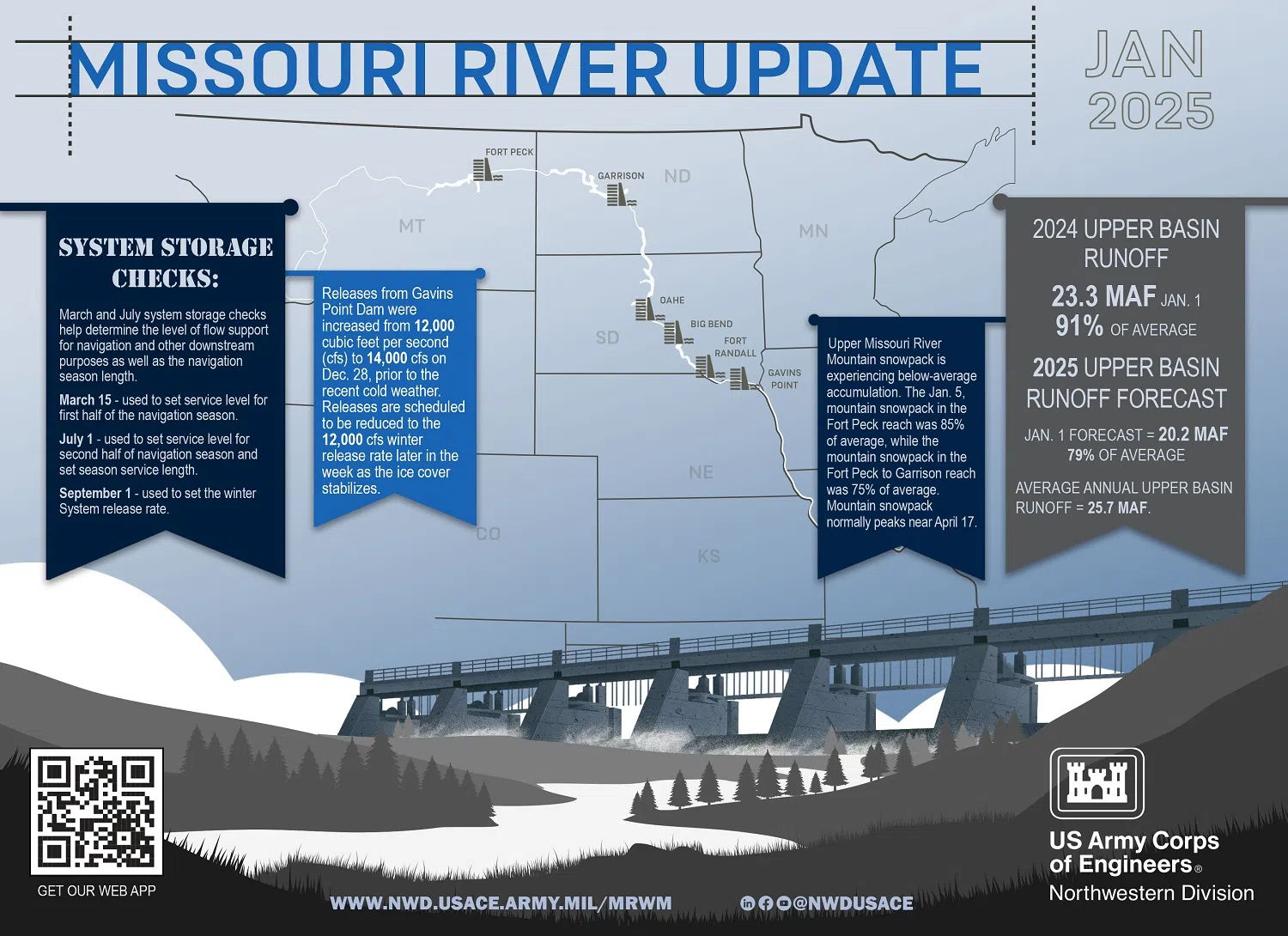
For the 2024 calendar year, Missouri River basin runoff above Sioux City, Iowa totaled 23.3 million acre-feet, 91% of average.
Dry conditions continue to affect the upper Missouri River Basin at the start of the 2025 calendar year, so the U.S. Army Corps of Engineers is forecasting below-average runoff into the mainstem reservoir system. For 2025, runoff in the Missouri River basin above Sioux City, Iowa is forecast to be 20.2 MAF, 79% of average.


Comments