South Dakota Legislative Session Week 7 by Rep. Mike Weisgram, District 24 (Fort Pierre)(March 6, 2026)
Week 8 of Session 2026 concluded on Thursday, March 5th—the 33rd day of this session—and I am writing this on Friday morning, March 6th. I note the timeframe to recall that while 33 days may not seem long, from my perspective, there are so many moving parts to legislative work that the time can become a blur. This week, I voted on 66 pieces of legislation covering a wide range of topics relevant to the citizens of District 24 and the State; all were important enough to make it this far in the legislative calendar. Let me give you some details and results regarding the more significant bills we voted on this week.
As mentioned in a previous legislative update article, a Tax Increment Financing (TIF) District is an economic development tool used by county and city governments. This year, there has been elevated notoriety and importance brought to them, as several legislators in the House and Senate introduced legislation to reform the rules around their proper use. SB 228, combined with an amendment to include HB 1319, was the work of legislators and involved stakeholders to bring reforms to this important tool while preserving the opportunities the program offers to local governing bodies and their communities. After months of work and weeks of negotiations, House members easily passed SB 228, respecting the work that went into the legislation and recognizing the value of TIFs for economic development.
SB 98 also passed easily this week. This consumer protection bill deals with purchases of cryptocurrency through an internet-connected terminal (most similar in size and appearance to a bank ATM). Users of these machines—which are usually located in convenience stores, bars, restaurants, and gas stations—deposit cash or funds from credit/debit cards to purchase cryptocurrency. Although this is a legitimate way to buy digital currency, these kiosks are heavily used in scams where criminals impersonate authorities or love interests to coerce victims into sending funds to unscrupulous actors. With research showing that over 50% of the transactions occurring at these kiosks are from people who are under stress, it was important to regulate kiosk operators with strong regulations demanding transparency, responsibility, and refund policies for customers who have been deceived. House members saw the necessity of this legislation, and it passed on Tuesday.
The Sioux Falls and Rapid City airports will receive low-interest loans ($15 million each) from the passage of SB 76. Both airport authorities have been lobbying for years to get state funds for the expansion of their facilities to improve and expand flight availability to popular destinations for incoming and outbound consumers. There is no doubt that active, modern, and efficient airports are economic drivers of any progressive city, so these low-interest loans should help them accomplish their goals.
This year, the Governor endorsed a plan to allocate money to these two airports by using unspent funds in the Housing Infrastructure Fund (HIF), which is administered by the SD Housing Authority and was established in 2023. This fund originally had $100 million in it and had a balance of $60 million as of January of this year. Many had concluded that since the money wasn’t going out of the HIF very fast, the funds would be better spent on the proposed airport expansions. Looking back several years, I had advocated consistently for the HIF to be established, as additional housing opportunities have been desperately needed in the state, and it was hard for me to see those funds go to other uses. SB 76 passed without my support, but hopefully, it will contribute to the economic benefits for South Dakota that the airport expansion advocates promise.
Undoubtedly, the most pondered legislation passed this week was SB 96—the Governor’s plan to let the people of each county decide if they want to raise their own sales tax rate by up to 0.5% to directly cut their owner-occupied property taxes. The funds raised from the optional sales tax would be placed into a Property Tax Reduction Fund at the county level and would be dedicated toward directly lowering the county property taxes for all homeowners within the county. The county commission could pass the homeowner tax relief option or refer it to a public vote.
If a county commission does not initiate the opportunity, voters could also have the right to bring an initiated ordinance to pass this plan. Opponents of this plan made a good argument that the plan favors larger cities and counties that have strong sales tax receipts, and the largest property tax relief will go to those with larger homes in larger towns. Also, lower-income households who often rent their dwellings will feel the burden of higher prices far more than property owners in more developed areas. It’s also fair to say that there is no perfect legislation, but this did get approval from House members on Thursday.
Well, there is one more week left in this session to consider further legislation and to vote on a balanced budget. I look forward to writing a concluding update for Session 2026 next week, and thanks again for the opportunity to serve in the House of Representatives from District 24.
As always, if you have any questions, please reach out to Representative Weisgram at Mike.Weisgram@sdlegislature.gov.
— mw

District 24 Rep. Mike Weisgram of Fort Pierre (third from left) was honored to be the House Prime Sponsor for HB 1035. This bill opens doors for aspiring CPAs by creating new licensure pathways.
Courtesy photo.
South Dakota Legislative Session Week 7 by Rep. Mike Weisgram, District 24 (Fort Pierre)( Feb. 27, 2026)
Welcome back to my latest legislative update for this session. I am writing this update on Thursday, February 26th. This week included “crossover day” (which was Tuesday), so the pressure to get House bills out of this chamber is over. We are now focusing on surviving Senate bills, but I would be remiss if I didn’t acknowledge some disappointments I had this week as well.
Two bills that I had been heavily involved with found their demise in House action this week. HB 1308, if amended, was an effort to raise the state sales tax from 4.2% to 5%. This would have allowed the additional revenue coming into the general fund to:
- Eliminate the sales tax on food.
- Lower the mill levies on general and special education by about half.
- Reduce owner-occupied property taxes by approximately 17–20% for city residents (and even more for those in the county).
- Provide modest revenue increases to the “Big 3” (K-12 public education, state employee salary increases, and support for Medicaid providers).
When the amendment failed to garner enough support from House members, the original HB 1308 came into play. The features of the unamended bill included a two-step increase in the state sales tax: from 4.2% to 4.7% in the first year, then a climb to 5.0% in the second year. Under this version, the increased revenue would have been applied to bring general and special education mill levies down to zero, achieving a robust 29% to 40% decrease in owner-occupied property taxes. It also included a more generous percentage increase in funding for the Big 3.
After much debate and discussion, the vote on HB 1308 didn’t garner enough support to pass. In fact, in my opinion, it went down decisively. Several of us worked on this bill for weeks; with the help of the very competent staff from the fiscal department of our Legislative Research Council (LRC), our numbers were solid and accurate. Representative Czmowski’s presentation of HB 1308 to our fellow Representatives was flawless.
Unfortunately, raising one tax to offset others simply didn’t find a receptive audience. We learned just how serious some are about lowering property taxes. The good that came out of the exercise was running the numbers and discussing at length the goals of providing the Big 3 with adequate funding and lowering property taxes by shifting… …towards another revenue source has raised the discussion of what is possible and what isn’t. Any kind of tax increase needs a two-thirds majority vote, and that is not easy to get from any legislature I have been a part of. As I leave the discussion on HB 1308, the positive is that discussions go on and my colleagues are more “clicked in” to the realities of possible solutions to the most talked-about issue this session.
The other bill that went down to defeat this week was HB 1113. I had invested a lot of time in this bill, having worked on it since last session, and I felt a little empty when I lost the effort by a single vote.
This bill would have allowed the South Dakota Housing Authority to set up a down payment assistance program for people looking to buy a manufactured home. Manufactured homes represent an excellent opportunity for homeownership, as the per-square-foot price for these homes is at least half of what a conventional stick-built house costs. Furthermore, these modern and efficient homes appreciate in value, unlike mobile homes of the past.
There are tradeoffs, to be sure, but the value is there. Since the Housing Authority didn’t have any programs for this category of housing, I thought it was time to pursue a program funded by a $5 million transfer from an existing housing infrastructure fund that hadn’t been robustly used.
Because of the repurposing of funds from infrastructure to a down payment assistance program, the vote required a two-thirds majority, and unfortunately, I fell short. When I asked some of my colleagues why they didn’t vote for it, some explained that they philosophically cannot support a government program as the answer to a problem that could be overcome by stricter personal budgeting and better spending choices.
I respectfully disagree with some of that sentiment—especially since the down payment assistance was a 0% loan that had to be paid back when the title of the home changed hands. While it was frustrating, I chose not to get down about it and instead move on to other challenges and opportunities.
I want to thank the professionals at the South Dakota Housing Authority; they were great to work with and provided excellent information and suggestions on how this program could work. If I am back for another term, I am going to take another run at it and maybe tweak it a bit to find a little bit more support. One must stay optimistic.
Thank you for reading and I appreciate the texts and emails you have sent me. See you next week.
– mw
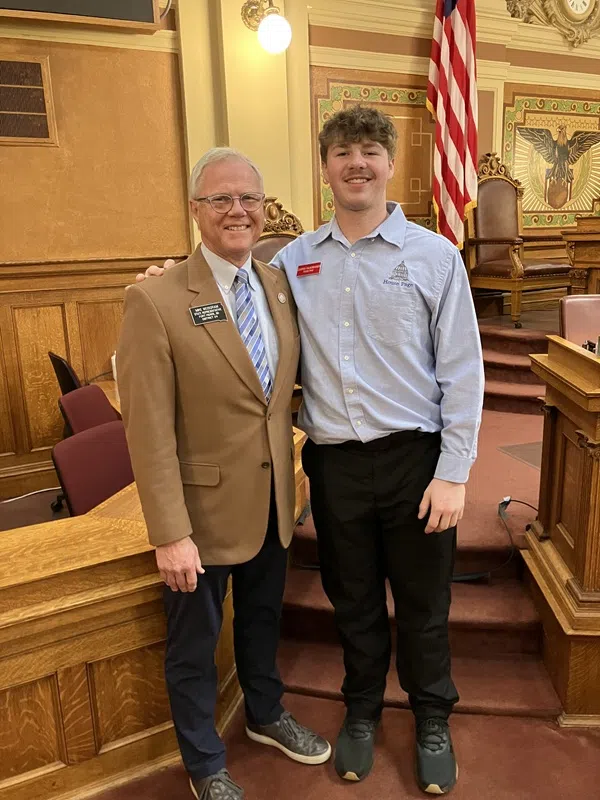
Rep. Mike Weisgram with Cooper Falkenhagen, a student at Agar-Blunt-Onida School in Onida.
Courtesy photo.
South Dakota Legislative Session Week 5 by Rep. Mike Weisgram, District 24 (Fort Pierre)( Feb. 21, 2026)
A full and busy week concluded yesterday, and it was a difficult one for me. Not so much legislatively, but health-wise; I had a full case of the “Capitol Crud,” and it was tough to feel fully prepared while trying to power through. I’m looking forward to resting up this weekend to get ready for next week.
As I was checking my notes, I realized that the “positives” for the week were more about defeating negative legislation than passing positive bills for South Dakotans. However, I believe passing HB 1275 was a good step. This legislation requires tech companies to implement age verification on app stores to create a safer digital environment for children by restricting access to harmful, age-inappropriate content. Although this seems like common sense, it may face First Amendment concerns and potential litigation. We’ll see if it makes it through the Senate.
Another good piece of legislation that passed the House this week was HB 1220. This bill requires vape shops to buy products for resale only from registered distributors and wholesalers who are registered with the Department of Revenue. These distributors must maintain strict documentation detailing the manufacturers they represent and the ingredients of all products, including nicotine. The Attorney General’s office continues to have concerns about vape shops selling harmful drugs to minors, and this legislation attempts to clean up the types of products lawfully sold in these establishments.
Three bills related to mRNA vaccine technology were defeated in the legislature this week. HB 1163 and HB 1210 both dealt with restricting employer authority to require individuals to receive genetic-based vaccinations. Meanwhile, HB 1171 would have required blood donation centers to disclose whether a donor had ever received an mRNA vaccination. It also would have allowed a patient needing a transfusion to request blood from a donor who hadn’t received a COVID-19 or mRNA vaccine.
Basically, proponents of these bills tend to mistrust mRNA technology and value the freedom to opt out, while opponents point to overwhelming evidence of their safety and efficacy. The existing short supply of blood and the potential negative impact on donor participation were also major factors in the defeat of HB 1171.
An anti-data center bill, HB 1246, was also defeated on the House floor. This legislation would have prohibited any state agency, county, city, or township from entering into an agreement with a data center developer that required confidentiality or the non-disclosure of confidential information. While the sponsor seemingly sought complete transparency in negotiations, any early-stage business negotiation can be sensitive. Premature leaks could easily disrupt a deal. My business sense made this an easy “no” vote, especially since the bill used the term “data center” broadly without a specific definition.
I mentioned HB 1182 last week, and that was also defeated. As you may recall, this sought to collect data on assisted reproductive technology (IVF) outcomes. The highly personal data required by this bill was neither desirable nor respectful. It also raised questions about how that data would be used, so it was another easy “no” for me.
Next week will finally bring action on the many property tax relief proposals remaining in the legislature. Out of more than two dozen proposals, I feel HB 1308 makes the most impactful difference, and I look forward to Monday’s debate. It does include a two-step sales tax increase, so it is technically a “tax shift,” with much of the new proceeds going toward reducing owner-occupied property taxes. However, some of that revenue would be directed toward our core responsibilities: supporting public education, Medicaid providers, and state employee salaries.
With crossover day looming on Tuesday, it is time to act or be comfortable with the status quo. We will see what happens. Thanks for your emails and texts this week; they are so helpful in gauging what is important to you and the future of South Dakota. See you next week!
– mw
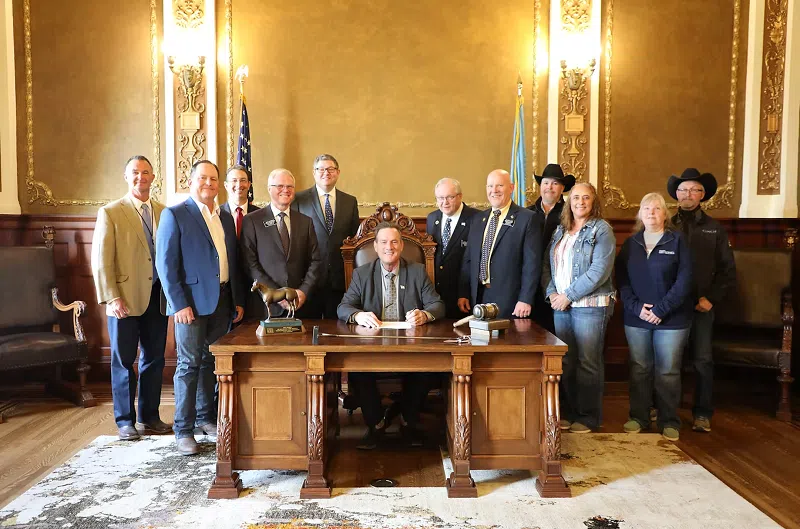
South Dakota Governor Larry Rhoden signs House Bill 1058 while bill supporters watch.
Feb. 17, 2026.
Courtesy photo.
South Dakota Legislative Session Week 5 by Rep. Mike Weisgram, District 24 (Fort Pierre)( Feb. 13, 2026)
Welcome back to my legislative update. We just completed legislative day 21, and there are a solid four weeks left in the session. These are very busy days; committee chairs are under a time crunch to get bills scheduled, heard, and acted upon before “crossover day,” which is next Tuesday. With the increase in bill introductions this year, I expect we will be working longer days, stretching into the evening hours, to clear each day’s agenda.
The positive news this week is that South Dakota’s budget outlook has improved. With these new positive numbers, our appropriations committee adopted revised revenue projections that are nearly $30 million higher than initially forecasted. This is robust enough to provide nominal raises to the “Big 3,” which includes state aid to K-12 education, increases for state employee salaries, and funding for Medicaid healthcare providers.
In December, Governor Rhoden gave a budget address detailing that there would be no increases for the Big 3 due to lagging revenues. That motivated me to introduce HB 1072, which provided a bonus for state employees from one-time revenues. While using one-time funds for salary increases isn’t the ideal scenario—as those should come from ongoing revenues—I felt we couldn’t disrespect our employees, and a bonus was better than nothing.
Now, with the increased ongoing revenue projections, Governor Rhoden’s administration is recommending a 1% increase in funding for the Big 3. I will allow that to materialize and then rescind, or “pull,” HB 1072 at the appropriate time.
An important bill that was defeated last week was HB 1198, and I was glad to see it meet its demise. This bill mandated that operators of a proposed high-energy-use facility obtain a conditional use permit from adjacent political subdivisions—specifically counties and municipalities—under certain conditions. This bill was brought on behalf of homeowners in Brandon, SD, who were upset with a proposed data center in northwest Sioux Falls located within one mile of an existing housing development. As a member of the House Energy and Commerce Committee, we heard this legislation on Wednesday; it passed by only one vote, which meant it would then be heard on the floor of the House the next day.
The committee hearing was dominated by emotional homeowners who were upset that they had no voice in the matter and would simply have to put up with the proposed data center or sell their houses and move. There is a fine line between emotion and facts, and I understand that those lines get blurred in the moment. Whether or not data centers of that size give off harmful radiation or obtrusive sounds depends on what kind of answers one is looking for; however, having been around a similar site several years ago, obnoxious sounds were not something I experienced.
Again, I understand their fears and respect them. The challenge with the legislation is something I raised in committee by providing a hypothetical example: if a fertilizer plant using plasma-based technology (which uses electricity instead of natural gas) wanted to locate in Stanley County close to the Missouri River, this proposed legislation would mean the project would also need approval from Hughes County—even if no footprint of the plant were in Hughes County. The challenge of multi-jurisdiction permitting would not only be difficult but extremely inefficient, bringing uncertainty and creating a heavy burden. Fortunately, the bill was soundly defeated on Thursday.
One bill I had hoped would be killed in committee is HB 1182. This bill mandates embryo tracking by measuring IVF outcomes, which the bill sponsor says will bring more accountability. Without getting too deep into the specifics of the bill, I am disappointed with the intent of collecting very personal information under the guise of patient care and medical outcomes. It’s unclear why this information is needed and what it will be used for in the future. The full House will hear this bill next week so more on the outcome of it next week.
I appreciate the texts and emails this week; I haven’t gotten back to everyone but I’m working on it.
– mw
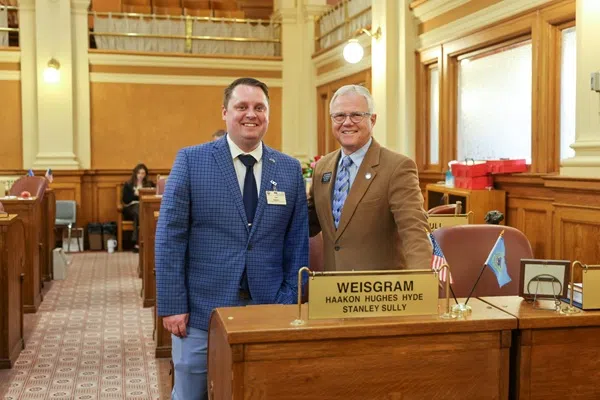
Rep. Mike Weisgram with Josh Anderson of Christensen Family Farms and Feedlots.
Courtesy photo.
South Dakota Legislative Session Week 4 by Rep. Mike Weisgram, District 24 (Fort Pierre)( Feb. 6 2026)
We just wrapped up our only five-day week today. The workload of the legislature has increased immensely with the introduction of another 162 pieces of legislation, bringing the total to 620. In my six sessions, this is the largest bill load I have seen. In this week’s column, I want to comment on bills that focus on economic development and the confusing messaging we are sending to the business community.
HB 1005 provided a sales and use tax exemption for data centers purchasing computer hardware and related equipment used exclusively for the maintenance and operation of a data center. To be eligible for the tax exemption, the legislation detailed that a data center must have a written agreement of a rate schedule with an electric utility that avoids shifting costs to other customers. Additionally, the facility’s water usage must comply with the consumption guidelines of local water providers.
For some background, Applied Digital announced in 2025 that they would pursue investing in and building a 420-megawatt AI data center in rural Deuel County (near Toronto, SD)—similar to a center they are currently building in Ellendale, ND—if our state offered tax incentives similar to North Dakota’s. That is why HB 1005 was introduced, complete with tax incentives and guidelines for responsible electricity and water use written into the legislation.
On Wednesday, the bill was heard and garnered robust proponent and opponent testimonies. These contrasted the benefits of a large data center—creating hundreds of high-paying jobs, generating millions in property and sales tax revenues, and spurring business and infrastructure upgrades—with claims that our state should not use tax incentives to lure large tech companies.
Ultimately, the bill was defeated by the House State Affairs Committee, ensuring that data centers will not have the same tax benefits North Dakota offers. Consequently, I am pessimistic that any large data center will choose our state for its location. Now, contrast that with the significant tax incentives and loans used to attract food industry investments for a new frozen food facility in Sioux Falls and a cheese factory expansion in Brookings. Seemingly, we can give incentives to companies wanting to locate or expand in our larger cities, yet a very large investment in a rural community receives no such favor. While a large data center is not a frozen food company or a cheese factory—so I am not comparing apples to apples—the distinction remains that we (the State of SD) give mixed messages to businesses, and our population centers get the incentives. For a long time, I have been convinced that our smaller and medium-sized cities are at a crossroads. I am extremely disappointed that our Governor’s Office of Economic Development sat on the sidelines and didn’t fight for the data center incentives that would have brought economic vitality and revenue to a rural community.
HB 1319 is legislation that I introduced this week in conjunction with the SD Municipal League and the Economic Development Professionals Association to strengthen and reform the economic development tool that cities and counties use called TIFs (Tax Increment Financing). A TIF is a public financing tool authorized by state law that allows cities and counties to fund infrastructure improvements by capturing new property tax revenue generated within a designated district. Pierre and Fort Pierre have used TIF districts to encourage economic development and support infrastructure for new businesses and housing projects.
We are seeing legislation this year from other SD legislators to severely limit the breadth and use of a TIF. Consequently, we (myself, the Municipal League, and the EDPA) thought it proactive to provide reforms to the program that make it more viable and usable. When I was a City Councilman, I remember first being introduced to this program and not readily understanding it, which made me skeptical of the economics. As I became comfortable with the concept and appropriate applications of a TIF, it was clear that a good project for the city could become feasible where conventional financing methods would make the project unaffordable. Hopefully, we can get HB 1319 through the legislature this session and defeat the bills that would cripple the effectiveness of a TIF.
In closing, incentivizing economic development has risks, but doing nothing in a highly competitive market ensures stagnation, fewer opportunities, and flat revenues. All would agree that growth at all costs is not the answer; yet research, learning from others, knowing our capacities and strengths, and taking a calculated risk is what business success is all about. It’s time we look at ourselves in the mirror and evaluate if we are really open for opportunities. South Dakota was rated the number one state for business by CNBC in 2013; our latest rating is 35th. Let’s get going and turn this ship around.
Thank you for the texts and emails this week. See you soon.
— mw
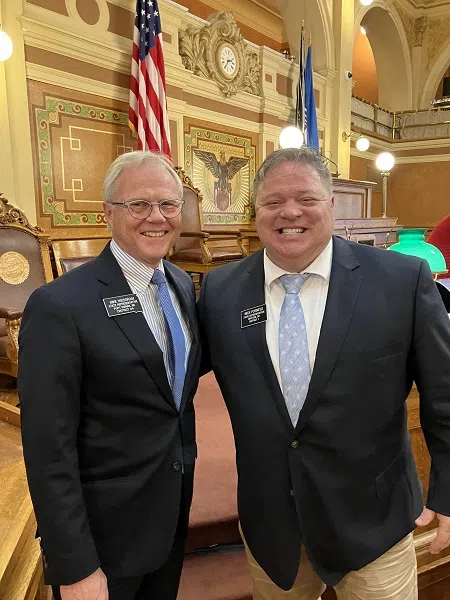
Rep. Weisgram (District 24) pictured with Rep. Fosness (District 1) Representing Brown, Day, Marshall, and Roberts Counties.
Courtesy photo.
South Dakota Legislative Session Week 3 by Rep. Mike Weisgram, District 24 (Fort Pierre). Jan. 30, 2026.
We have just completed legislative day 12, marking the end of our third week of this legislative session. Committee work is in full swing, and our legislative calendars are full each day. The working relationships between colleagues are cordial, but there have been a few “point of order” moments and one public apology given while we were in House session. In reviewing the week, I think the members are voting on bill content without bias toward personalities or friendships. To date, 485 pieces of legislation have been introduced—which is much more than last year at this time—and I predict more will come next week. Seems no one is bashful in this session.
The highlight of the week for me was the passing of HB 1058, which gives live horse racing events an updated funding mechanism to hopefully stay viable in our state. The bill passed out of the Commerce Committee on Monday and the full House on Tuesday. We are halfway there, and I am cautiously optimistic the momentum will continue in the Senate.
Other interesting legislation brought to the House floor included HB 1008 and HB 1078, which proposed amending rules to allow high school credit for participation in extracurricular varsity athletics and allowing agriculture science courses to be substituted for regular science courses. I think both bills had merit, yet I hesitated to support them as there are pathways to accomplish these requests through established rules by the Department of Education. In summary, I felt the legislature really shouldn’t be the “state school board” and voted to defeat them both. Both were narrowly defeated.
HB 1044 was legislation to allow spending authority to pursue the Rural Healthcare Transformation project, which was funded by the federal government toward the goal of making rural healthcare better and sustainable. I thought there was substantial opposition to this, as there are loud voices who do not like states getting federal dollars because of concerns about the federal debt and wasteful spending. I supported the legislation, and it passed on Monday with the needed 2/3 majority.
Continued distrust of established economic development incentives is apparent with HCR 6007. Although not as definitive or directive as regular legislation, a concurrent resolution is a formal statement of policy; in this case, I did not support it. Incentives to attract capital investment, create jobs, and stay competitive with neighboring states have been with us for many decades. Not recognizing them is shortsighted and dangerous to the growth of our state. It was defeated by only a small margin, which to me indicates a denial of facts in favor of a “purity” of political philosophy.
HB 1004 was soundly defeated in committee but was “smoked out” by its supporters, so it was up for a vote to be put on the calendar for consideration this week. HB 1004 was a measure to make it easier to recall a public official—in this case, a county commissioner. It is usually the case that a petition process must be completed if a public official is to be removed before their term expires. HB 1004 altered the existing requirements, and in the committee hearing, the members did not agree with the sponsor that the existing system is broken and needed to be amended. In short, many of us respect the committee process that hears all testimony and weighs the claims from proponents and opponents. Once again, the vote was close, but the legislation was not supported by enough legislators to be put on our calendar for full House consideration. The closeness of this vote and others shows the divide we have in political philosophies.
Finally, HJR 5002 proposed asking voters at the next general election to amend the Constitution of the State of South Dakota by repealing the Medicaid expansion that voters approved in 2022. As a reminder, Medicaid is a low-income health and disability insurance program that is jointly funded by the federal government (90% share) and our state (10% share). When we voted to expand it four years ago, we made eligibility available to adults with incomes up to 138% of the poverty level. For a family of four, an income level of $43,000 or less would make them eligible; for a single person, it is $21,000. Although Medicaid expansion costs the state approximately $36 million, I was in the majority voting to defeat HJR 5002, as the voters approved Medicaid expansion just four years ago with a 56% approval.
We have a full five-day work week next week, with the last day for new bill introductions being Wednesday, and I expect a flurry of activity. Thank you for your texts and emails, as I value your thoughts very much.
As always, if you have any questions, please reach out to Representative Weisgram at Mike.Weisgram@
You can also find this latest blog post here, https://www.mikeweisgram.com/
See you next week,
mw
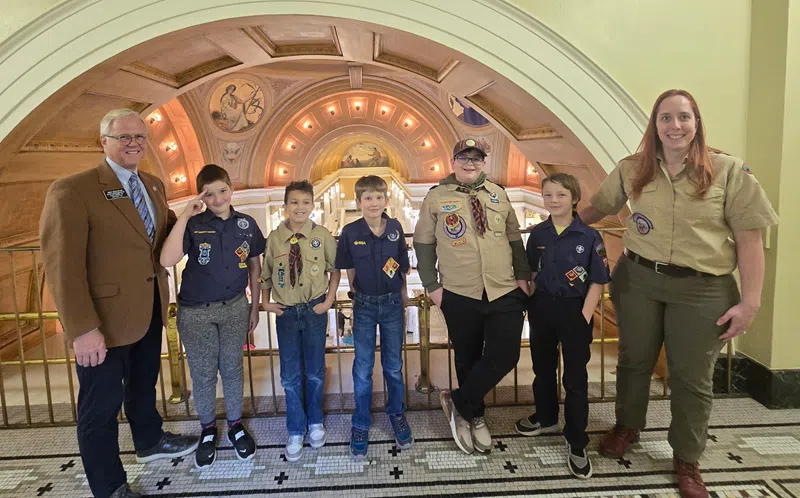
Rep. Mike Weisgram with pack 273 Weblo Cub Scouts with Emily Ward, Den Leader and Justin Bell, Pack Leader.
Courtesy photo.
South Dakota Legislative Session Week 2 by Rep. Mike Weisgram, District 24 (Fort Pierre). Jan. 23, 2026.
As legislators moved into week 2 of this year’s session, there have been a few “dust-ups,” but in general, we know each other better than last year, so there is some camaraderie in the sense that we need to get the people’s work attended to and don’t let philosophy issues get in the way of getting something positive done for our citizens and the institutions that serve them. There have been some reassignments of legislators to different committees because of some unfortunate words and actions of disgruntled legislators, but everyone seems to be over it and we are moving forward.
As of this writing, 268 pieces of legislation have been introduced, and I thought I would go over some of the bills I have introduced to give you an idea of what I’m up to. Remember, the inspiration for legislation comes from conversations with constituents (addressing their ideas or problems), from lobbyists representing South Dakota institutions (counties, cities, associations, etc.), and ideas I have that would address issues I see that would be helpful for citizens of our district and state.
Here are a few I’m working on: HB 1034, which allows County Treasurers to charge a larger amount of money to send license plates out to customers who want their plates or decals mailed to them. This has become a popular service and since the USPS raised postage, counties are not charging enough to cover the increase in postage charges. Although fee increases are never popular, this legislation just passed out of the House today by a 42-22 margin, and so on to the Senate for that one.
HB 1035 is an act to modify the requirements for a person with an accounting degree to be able to sit for the universal CPA test. This legislation takes into account real-world experience and lessens the amount of formal education needed to be able to sit for the test. It’s a needed new pathway for this licensure as the state needs more CPAs, as demand for their professional services has increased and more retirements are occurring.
HB 1058 asks for out-of-state online providers of pari-mutuel providers who encourage and accept wagers from South Dakota residents for horse races to be licensed and pay the same tax as in-state providers would. Current funding sources for live horse racing in South Dakota are antiquated and practically all wagering occurs now on devices that are on internet sites from out-of-state or offshore businesses. This legislation asks the SD Gaming Commission to license these businesses and subject them to the same tax and fees in-state brick-and-mortar businesses must remit. If passed, we can save live horse racing, which is important to horsemen and central South Dakota.
HB 1072 is legislation that would fund a “bonus/raise” for state employees. Ever since the Governor’s budget address, which did not suggest a raise for our state employee professionals, I have been thinking about what we could do for our employees even if we do not have enough ongoing revenue to pay for an increase. This isn’t a perfect solution, but as a former employer, it is difficult to keep a staff of professionals if there are no monetary rewards, even if it is a modest one. This bill will go to the Joint Appropriations Committee where they will consider it with all the other requests for funding. There’s a long way to go on that one.
HB 1113 is an idea I have had since my first session as I was on a summer housing study committee looking at affordable housing solutions. Basically, it is a loan program to help buyers of manufactured homes with down-payment assistance to get them into the most affordable housing that exists. With newer building standards, these homes do not depreciate like they used to and this program is likely sustainable as the recipients of these loans must pay them back when they sell the home. I have thought and worked on this for a long time; we will see if it “gets legs”. I’m working on a few more bills, but they are not fully mature enough to introduce.
As I mentioned last week, there will be many bills introduced that affect owner-occupied property taxes and sales tax rates, and I’m in a workgroup that will hopefully have a version as well. It’s way too early to talk about, but there are good, honest discussions trying to figure out a path to address that issue.
Lastly, other top-of-mind issues for me are Tax Increment Financing reforms, incentives to attract Data Centers, and public education funding.
Thank you for reading my legislative updates and please don’t hesitate to contact me if you have any thoughts or questions.
mw
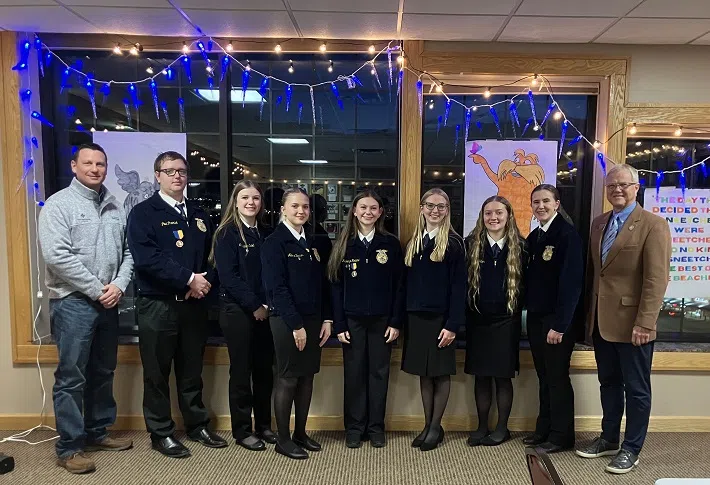
Representative Mike Weisgram of Fort Pierre with District 8 participants from the National FFA Organization (formerly known as Future Farmers of America).
South Dakota Legislative Session Week 1 by Rep. Mike Weisgram, District 24 (Fort Pierre). Jan. 16, 2026.
Welcome back to my legislative column on the activity of the South Dakota Legislature’s House of Representatives. Each week, I hope to convey the week’s highlights of activity, schedule, notable bill introductions, hearings, and speeches. Of course, my challenge is to condense the week into several informative paragraphs describing important legislation and direction. Hopefully, you will find these columns interesting and helpful in understanding the workings of the legislature.
The first two days of session included speeches from Governor Rhoden on the “State of the State,” Chief Justice Jensen’s “State of the Judiciary,” and the “State of the Tribes” address from President Kathleen Wooden Knife of the Rosebud Sioux Tribe. Governor Rhoden delivered a straightforward message that included his “Strong, Safe, and Free” mantra, which is the cornerstone of how he approaches leading South Dakota. Out of the many issues he spoke to, I particularly took note of three important points in his speech regarding his vision for moving South Dakota forward. Those three were: his solution to drive owner-occupied property taxes down, his thoughts on the next big industry opportunities for South Dakota, and our state’s participation in the rural healthcare transformation project funded by the federal government.
Governor Rhoden’s Senate Bill 96 gives counties the option to replace their share of property taxes with a half-cent sales tax. If SB 96 becomes law, this sales tax increase/owner-occupied property tax cut program could be adopted by a county’s Board of Commissioners and could be referred by the public of that county, making it a locally controlled issue. The Governor also presented that the next big industry in South Dakota could be focused on national security. Cybersecurity companies, warfare technology companies featuring drone munitions, future businesses supporting the B-21 Bomber deployment at Ellsworth AFB, and food companies contributing to our food security were examples he gave.
Finally, our state’s participation in the federally funded program called “Rural Healthcare Transformation” has the promise of improved healthcare delivery in rural South Dakota. I attended a presentation on South Dakota’s plan that was accepted by the federal government; the amount of work it took to brainstorm, deliberate, and present a plan that spends these federal funds ($189 million) efficiently on improved and sustainable services was very impressive. Although I think the project has the capacity for improved rural healthcare outcomes, some legislators are not as optimistic and are skeptical of accepting these federal dollars. More to come on that.
Chief Justice Jensen was very informative as he referenced the court’s vision—“Justice for All”—as a reminder that the courts exist for everyone regardless of their background or circumstance. He revealed six strategic pillars that shape the priorities used to address evolving challenges and opportunities within the justice system: enhancing access to justice for court users, building public trust and confidence, effective court operations, improving courthouse security, embracing technology, and fostering a strong workforce. Jensen is also seeking legislative approval for a pilot program to provide pretrial services to accused individuals while they await trial. These services could include supervision to monitor compliance with release conditions, ensuring individuals appear for scheduled court events, and connecting them with rehabilitation services prior to conviction.
President Kathleen Wooden Knife spoke of her desire for increased consultation and collaboration with the Governor and the legislature to improve healthcare, public safety, and foster care for Sioux Nation Tribes. Wooden Knife also encouraged the state to converse with tribes on issues of water rights, water pipelines, and drinking water access in the years ahead.
The week concluded with many fellow legislators introducing bills on a wide array of issues too numerous to mention. As of this writing, I count 197 pieces of legislation to be considered. Next week, we will have a full schedule of committee meetings to begin hearing these bill offerings as the process continues. As always, thank you for reading and for the emails and texts I have received regarding the issues most important to you.
See you next week,
MW
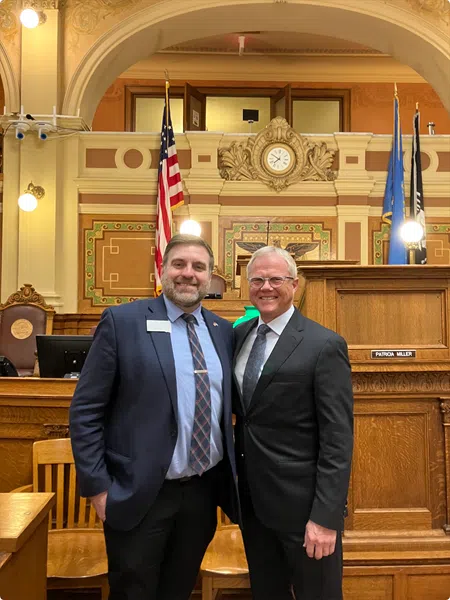
Rep. Mike Weisgram with Rep. Matt Roby from Watertown, District 5.


Comments