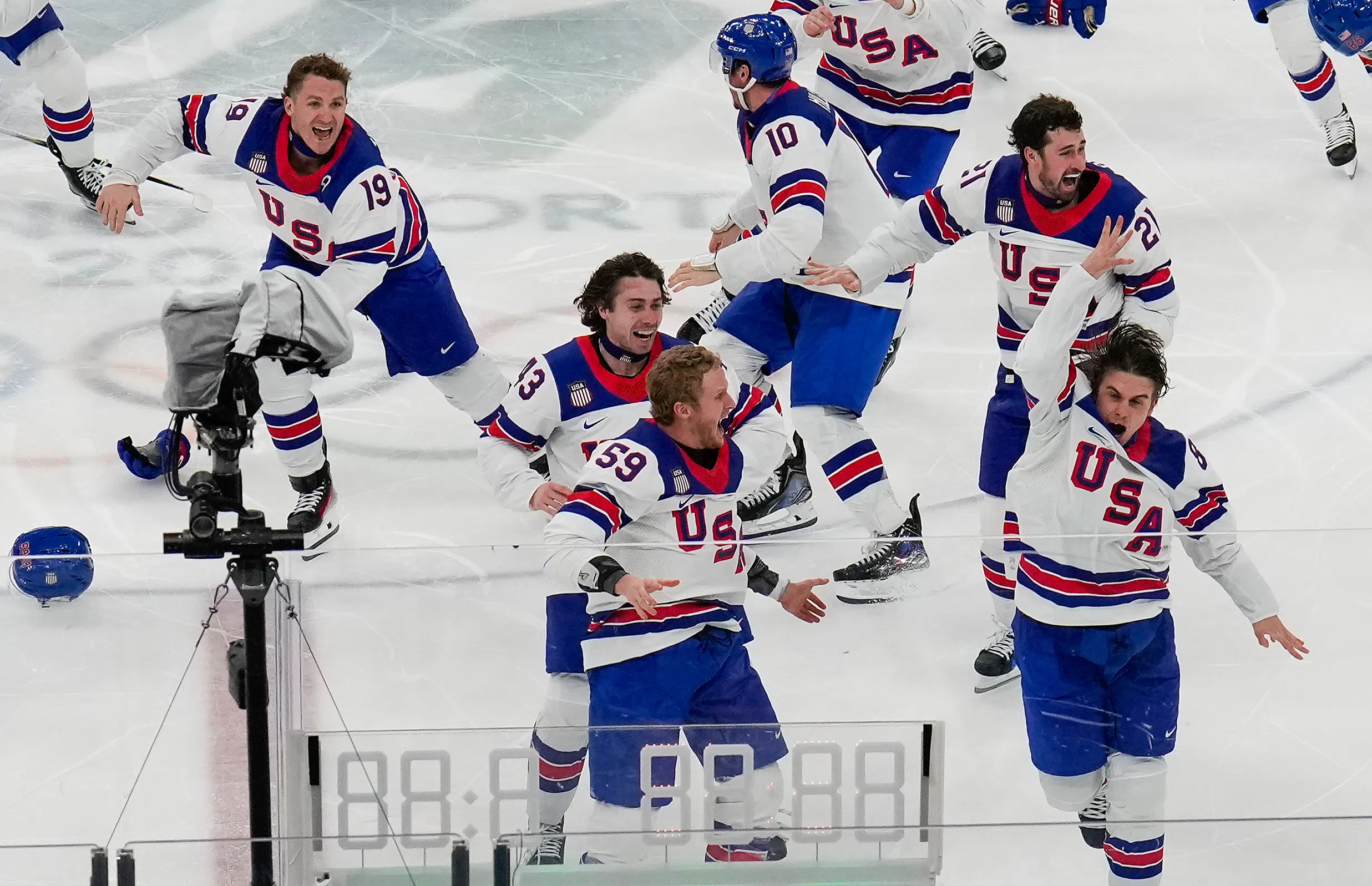
In the movie ‘Miracle’, Kurt Russell’s character portraying Herb Brooks gave a rousing speech that began with, “Great moments, are born from great opportunity. And that’s what you have here tonight, boys.” While it wasn’t a word-for-word transcription of what Brooks actually said behind the closed doors of the US locker room ahead of their semi-final matchup with the Soviets in 1980, the sentiment carried through to February 22nd, 2026. The day the US played Canada for the gold in men’s hockey.
The US Women’s team had already collected gold after their thrilling 2-1 OT win over Canada earlier in the weekend. It was a win that capped off a perfect Olympics in which the women won all six games, and outscored their opponents 33-2. The gold medal was somewhat of an expectation for the US Women’s squad, who had faced off with Canada in six of the last seven Winter Olympics. While Canada had gotten the better of the US in those games, the Americans certainly felt like they were the better team going into the final game. A belief that carried them to the top of the Olympic podium as the National Anthem played.
It was not exactly the same expectation for the men’s team, however. The US hadn’t won a gold medal in hockey since the 1980 Olympics when they defeated Finland 4-2. Of course, the most memorable moment of those Olympics didn’t come when the US won gold, it came the game prior when they defeated the Soviet Union in what almost everyone refers to as the ‘Miracle on Ice’. The Soviets had dominated Olympics play prior, and were made up of grown adults at the top of their game compared to the US team who was made up of misfit amateurs just trying to extend their playing career. As the final seconds ticked away, Al Michaels put the cherry on top by exclaiming, “Do you believe in Miracles?”, which became a rallying cry for Americans after the 4-3 win over the Soviets. It was an incredible moment and memory that Americans and hockey fans will never forget. Though 46 years later, they were starved and quite frankly due for another.
The US Men’s team was no longer made up of amateurs, but of NHL players who were allowed to play for their countries starting in 1998 in an effort to put the best players on the ice. By then, the Soviet Union had fallen and was long gone, and numerous countries all had their moment at the top of the podium. Gold medals rotated every four years between Russia, Sweden, Canada and others. The US was not on that list. America struggled to compete with international hockey talent that had been bred for the sport. They played tough, but rarely played their way to a medal. The US had “moments”, like when TJ Oshie buried shot after shot in the back of the net during a preliminary round shootout against Russia that the US would end up outlasting. A great moment, but no medal. Even Oshie himself said he would’ve traded the limelight for a medal. They earned medals in 2002 and 2010, but they were silvers. The US wanted to be back at the top of the world, and to do that, they would need to defeat their neighbors up north on Sunday.
The Americans were able to find the scoreboard early with a strong goal from Matt Body, step one. However, the Canadians answered back late in the second period with a game-tying goal which put the US back to square one. The third period and subsequent overtime period that would ensue would be one burned in US sports history.
Canada found themselves with countless opportunities to win the gold medal. Nathan MacKinnon missed an open net opportunity that would’ve spelled disaster for the Americans but instead gave them a lifeline they desperately needed. It wasn’t just bad luck for the Canadians, it was acts of will from US goaltender Connor Hellebuyck who made some saves that simply did not make sense. His greatest save was a behind the back paddle that denied Canadian defenseman Devon Toews a sure goal. For lack of a better term, it was pure insanity.
This paved the ice for the US to force an overtime period that head coach Mike Sullivan said was “crucial”. A 3-on-3 sudden death period that would decide who would take home the coveted gold. Less than two minutes in, missing two teeth, Jack Hughes jarred a pass free setting up a push for the Americans. Zach Werenski hurried back to the loose puck before turning to find a wide open Hughes in front of the net. Hughes, without a second thought, rifled a shot right between the legs of Binnington to win it for the US 2-1, and the madness unfolded.
The US flooded the ice after the goal with a look of pure jubilation painted across the faces of the red, white and blue both on and off the playing surface. Euphoria rained with the gloves and helmets discarded into the air by the Americans who were embracing every player around them while the distraught Canadians could only sit and watch. 46 years of waiting wiped away with one shot.
One of the most heartwarming moments came when the team picture was paused to grab the children of late-teammate John “Johnny” Gaudreau, who was killed by a drunk driver in August of 2024. Along with his two children was Gaudreau’s jersey being held up on the front row by alternate captain Matthew Tkachuk.
This moment of triumph was shared across the country as videos of bars and pubs across America hit social media showing the patrons celebrating just as the players were. Even youth hockey games were halted to celebrate the victory in real-time. A true depiction of how the gold medal game was more than just a game.
So, why is this win so important? Sure, it carries weight in the fact that the US has ended a 46-year gold medal drought in men’s hockey. It also, if only for a moment, answers the question of who has better hockey, Canada or the US? However, the two wins will also inspire a generation, much like the gold medal in 1980 did for American hockey. Millions of kids across the country watched the women’s team win gold and the men’s team follow suit on Sunday, and said to themselves, “One day, that will be me.” If that is indeed the case, then the future of hockey in America is in very, very good hands.


Comments