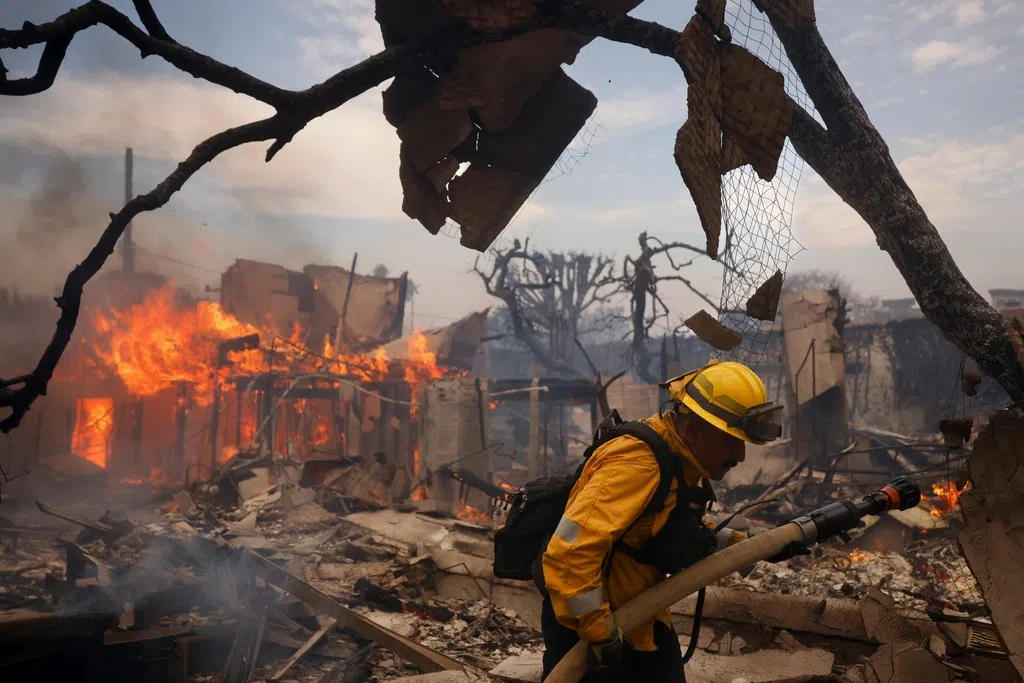
January 29, 2025:
Story Body
January 27, 2025:
LOS ANGELES (AP) — More rain fell Monday on parts of Southern California after causing mudflows over the weekend, helping firefighters but boosting the risk of toxic ash runoff in areas scorched by Los Angeles-area wildfires.
Flood watches were in effect for burn areas from recent fires that broke out around the Pacific Palisades neighborhood in Los Angeles, Altadena and Castaic Lake, said Joe Sirard, a meteorologist for the National Weather Service in Oxnard.
“All these fresh burns are very susceptible to rapid runoff,” Sirard said, warning of even small amounts of rain in a few minutes’ time. “What that means is we have a fairly high danger of mud and debris flows once we get above those thresholds.”
Los Angeles International Airport reported a little under an inch of rain (2.5 centimeters) in a 24-hour period ending at 3 a.m. Monday (Jan. 27, 2025), the National Oceanic and Atmospheric Administration reported. Surrounding areas reported lesser amounts.
School was closed Monday for the four Malibu schools in the Santa Monica-Malibu Unified School District “due to dangerous road conditions and challenges with access to our schools,” school officials posted online.
A portion of the Pacific Coast Highway in Los Angeles County was closed as of Sunday afternoon due to mudflows in Topanga Canyon, the California Department of Transportation said. Heavy snow fell in the mountains in San Bernardino and Riverside counties.
One benefit that could come from the rain: It may help firefighters who are reining in multiple wildfires after weeks of windy and dry weather.
Los Angeles County crews spent much of last week removing vegetation, shoring up slopes and reinforcing roads in devastated areas of the Palisades and Eaton fires, which reduced entire neighborhoods to rubble and ash after breaking out during powerful winds on Jan. 7.
The Palisades Fire, the largest of the blazes that destroyed thousands of homes and killed at least 11 people, reached 94% containment Monday. The Eaton Fire, which broke out near Altadena and has killed at least 16 people, was 98% contained.
The Hughes Fire, which ignited last week north of Los Angeles and caused evacuation orders or warnings for more than 50,000 people, was 95% contained as of Monday morning.
In San Diego County, firefighters made progress to contain the smaller Border 2 Fire as it burned through a remote area of the Otay Mountain Wilderness near the U.S.-Mexico border.
Most of the region was forecast to get about an inch of precipitation over several days, but the weather service warned of a risk of localized cloudbursts causing mud and debris to flow down hills.
“So the problem would be if one of those showers happens to park itself over a burn area,” weather service meteorologist Carol Smith said on social media. “That could be enough to create debris flows.”
Los Angeles Mayor Karen Bass issued an executive order last week to expedite cleanup efforts and mitigate the environmental impacts of fire-related pollutants. LA County supervisors also approved an emergency motion to install flood-control infrastructure and expedite and remove sediment in fire-impacted areas.
Fire crews filled sandbags for communities, while county workers installed barriers and cleared drainage pipes and basins.
Officials cautioned that ash in recent burn zones was a toxic mix of incinerated cars, electronics, batteries, building materials, paints, furniture and other household items. It contains pesticides, asbestos, plastics and lead. Residents were urged to wear protective gear while cleaning up.
Concerns about post-fire debris flows have been especially high since 2018, when the town of Montecito, up the coast from Los Angeles, was ravaged by mudslides after a downpour hit mountain slopes burned bare by a huge blaze. Hundreds of homes were damaged and 23 people died.
The rain snapped a near-record streak of dry weather for Southern California. Most of Southern California is currently in “extreme drought” or “severe drought,” according to the U.S. Drought Monitor.
January 24, 2025:
LOS ANGELES (AP) — Evacuation orders were lifted Thursday (Jan. 23, 2025) for tens of thousands as firefighters with air support slowed the spread of a huge wildfire churning through rugged mountains north of Los Angeles, but new blazes erupted in San Diego County, briefly triggering more evacuations.
Southern California is under a red flag warning for critical fire risk through Friday. The area has been facing constant challenges in controlling the fires, as dangerous winds gained strength again Thursday.
The Hughes Fire broke out late Wednesday morning and in less than a day charred nearly 16 square miles (41 square kilometers) of trees and brush near Castaic Lake, a popular recreation area about 40 miles (64 kilometers) from the devastating Eaton and Palisades fires that are burning for a third week.
Crews made significant progress by late afternoon on the Hughes Fire, with more than one-third of it contained.
Two new blazes were reported Thursday in the San Diego area. Evacuations were ordered but were later lifted after a brush fire erupted in the late afternoon in the wealthy enclave of La Jolla near the University of California, San Diego, School of Medicine. Further south, near the U.S.-Mexico border, another blaze was quickly spreading through the Otay Mountain Wilderness, home to the endangered Quino checkerspot butterfly and other unique species.
In Ventura County, a new fire briefly prompted the evacuation of California State University Channel Islands in Camarillo. Water-dropping helicopters made quick progress against the Laguna Fire that erupted in hills above the campus of about 7,000 students. The evacuation order was later downgraded to a warning.
Rain is forecast for the weekend, potentially ending Southern California’s monthslong dry spell. Winds are also not as strong as they were when the Palisades and Eaton fires broke out, allowing for firefighting aircraft to dump tens of thousands of gallons of fire retardant.
That helped the fight against the Hughes Fire in the Castaic area north of Los Angeles, allowing helicopters to drop water, which kept it from growing, fire spokesperson Jeremy Ruiz said.
“We had helicopters dropping water until around 3 a.m. That kept it in check,” he said.
Nearly 54,000 residents in the Castaic area were still under evacuation warnings Thursday, the Los Angeles County Sheriff’s Department said. There were no reports of homes or other structures burned.
Kayla Amara drove to Castaic’s Stonegate neighborhood Wednesday to collect items from the home of a friend who had rushed to pick up her daughter at preschool. As Amara was packing the car, she learned the fire had exploded in size and decided to hose down the property.
Amara, a nurse who lives in nearby Valencia, said she’s been on edge for weeks as major blazes devastated Southern California.
“It’s been stressful with those other fires, but now that this one is close to home it’s just super stressful,” she said.
The Palisades Fire was more than three-quarters contained, and the Eaton Fire was 95% under control Thursday. The two fires have killed at least 28 people and destroyed more than 14,000 structures since they broke out Jan. 7.
Rain was expected to start Saturday, according to the National Weather Service. Officials welcomed the wet weather, but crews also were shoring up hillsides and installing barriers to prevent debris flows as residents returned to the charred Pacific Palisades and Altadena areas.
The California fires have overall caused at least $28 billion in insured damage and probably a little more in uninsured damage, according to Karen Clark and Company, a disaster modeling firm known for accurate post-catastrophe damage assessments.
On the heels of that assessment, California Republicans are pushing back against suggestions by President Donald Trump, House Speaker Mike Johnson and others that federal disaster aid for victims of wildfires should come with strings attached.
The state Legislature approved a more than $2.5 billion fire relief package Thursday, in part to help the Los Angeles area recover from the fires.
Trump plans to travel to the state to see the damage firsthand Friday, but it isn’t clear whether he and Democratic Gov. Gavin Newsom will meet during the visit.
JANUARY 22, 2025:
LOS ANGELES (AP) — Evacuations were ordered on Wednesday (Jan. 22, 2025) for remote communities near a huge and fast-moving wildfire in mountains north of Los Angeles, as parched Southern California endured another round of dangerous winds ahead of possible rain over the weekend.
The Hughes Fire broke out in the late morning and quickly ripped through nearly 8 square miles (21 square kilometers) of trees and brush, sending up an enormous plume of dark smoke near Lake Castaic, a popular recreation area about 40 miles (64 kilometers) from the devastating Eaton and Palisades fires that are burning for a third week.
Offramps along Interstate 5, a major north-south artery, were closed as flames raced along hilltops and down into rugged canyons. Crews on the ground and in water-dropping aircraft tried to prevent the wind-driven fire from moving south toward more populated foothill communities in Castaic, home to about 18,000 people. At least three schools were evacuated as a precaution, the California Highway Patrol said.
Meanwhile, to the south, Los Angeles officials were preparing for potential rain even as some residents were allowed to return to the charred Pacific Palisades and Altadena areas. Gusty weather was expected to last through Thursday.
“We’re going to see another round of critical fire conditions across Southern California,” Todd Hall, a National Weather Service meteorologist, said Wednesday morning. “At this point, it sounds like a broken record.”
Los Angeles Mayor Karen Bass issued an executive order to expedite cleanup efforts in burn areas and mitigate the environmental impacts of fire-related pollutants. She ordered crews to remove vegetation, shore up hillsides and reinforce roads ahead of the possible rain.
Los Angeles County supervisors also approved an emergency motion to install flood control infrastructure and expedite and remove sediment in fire-impacted areas.
“As the fires have settled, new challenges lie ahead,” Supervisor Kathryn Barger said during a Wednesday news conference. “Rains are in the forecast and the threat of mud and debris flow in our fire-impacted communities is real.”
A 60% to 80% chance of a small amount of rain was forecast for Southern California starting Saturday, with most areas likely getting not more than a third of an inch (0.8 centimeters), according to Ryan Kittell, a meteorologist for the weather service’s office for Los Angeles. However, up to an inch (2 1/2 centimeters) could fall in localized thunderstorms, which would be a worst-case scenario if enough falls on scorched slopes.
“But even if the rain doesn’t materialize this time, it could be a good practice run for those communities because this will be a threat that they’ll have to deal with for months or years,” Kittell said Tuesday.
Fire crews were filling sandbags for communities while county workers were installing barriers and clearing drainage pipes and basins.
In 2018, Montecito, a town 80 miles (130 kilometers) up the coast from Los Angeles, was ravaged by mudslides after a downpour hit mountain slopes burned bare by a huge wildfire. Twenty-three people died, and hundreds of homes were damaged.
Red flag warnings for critical fire risk were extended through 8 p.m. Thursday in LA and Ventura counties. Officials remained concerned that the two major blazes, the Palisades and Eaton fires, could break their containment lines as firefighters continue to watch for hot spots, said David Acuna, a spokesman with the California Department of Forestry and Fire Protection, or Cal Fire.
Fire engines and water-dropping aircraft positioned strategically allowed crews to swiftly douse several small blazes that popped up in LA, San Diego and Riverside counties, officials said.
Authorities urged residents to review evacuation plans, prepare emergency kits, and be on the lookout for fires and report them quickly.
Bass also warned that winds could carry ash and advised Angelenos to visit the city’s website to learn how to protect themselves from toxic air during the latest Santa Ana wind event. LA County public health director Barbara Ferrer cautioned that the ash could contain heavy metals, arsenic and other harmful materials.
“Even a brief exposure can potentially cause skin irritation and lead to more serious problems,” Ferrer said Wednesday, asking people to wear protective gear while cleaning up.
The low humidity, bone-dry vegetation and strong winds came as firefighters continued to battle the Palisades and Eaton fires, which have killed at least 28 people and destroyed more than 14,000 structures since they broke out Jan. 7. Containment of the Palisades Fire reached 68%, and the Eaton Fire was at 91%.
LA County Sheriff Robert Luna said Wednesday that his department was still investigating 22 active missing person reports in both fire zones. All of those reported missing are adults, he said.
The federal Bureau of Alcohol, Tobacco and Firearms is investigating the causes of the fires but has not released any findings.
Several lawsuits have been filed by people who lost their homes in the Eaton Fire, alleging Southern California Edison’s equipment sparked the blaze. On Tuesday a judge overseeing one of the lawsuits ordered the utility to produce data from circuits in the area where the fire started.
President Donald Trump, who criticized the response to the wildfires during his inaugural address Monday, has said he will travel to Los Angeles on Friday. Barger said Wednesday that details of Trump’s visit were still being worked out.
JANUARY 20, 2025:
LOS ANGELES (AP) — Southern Californians are bracing for gusty winds and a heightened risk of wildfires, less than two weeks after the outbreak of deadly blazes that have killed at least 27 people and charred thousands of homes.
The National Weather Service has issued a warning of a “ particularly dangerous situation ” for parts of Los Angeles and Ventura counties from Monday afternoon (Jan. 20, 2025) through Tuesday morning due to low humidity and damaging Santa Ana winds. Gusts could peak at 70 mph (113 kph) along the coast and 100 mph (160 kph) in the mountains and foothills.
Windy weather and single-digit humidity are expected to linger through Thursday, said Rich Thompson, a meteorologist for the National Weather Service. He said the fire risk is also elevated because the region hasn’t seen rain since April.
Critical fire weather with wind gusts up to 60 mph (97 kph) was also forecast for Southern California communities stretching to San Diego on Monday and Tuesday, with residents urged to take steps to get ready to evacuate such as creating an emergency kit and keeping cars filled with at least a half tank of gas. A windblown dust and ash advisory was also issued, as high winds could disperse ash from existing fire zones across Southern California.
The warnings come as firefighters continue to battle two major blazes in the Los Angeles area, the Palisades and Eaton fires, which have destroyed more than 14,000 structures since they broke out during fierce winds on Jan. 7. The Palisades fire was 52% contained on Sunday and the Eaton fire 81% contained, according to fire officials.
Firefighters have made progress on the perimeter of the Palisades fire, which has blackened more than 37 square miles (96 square kilometers) near the Pacific coast, but there are areas in the interior that continue to burn, said Dan Collins, a spokesperson for the Palisades fire incident.
“There is always a possibility in a red flag warning something hot, or some type of burning material from the interior, could be perhaps whipped up and blown across the containment lines,” Collins said.
While firefighters are fairly confident the Eaton fire further inland will remain contained, there are concerns a new fire could break out with vegetation especially dry for this time of year, said Carlos Herrera, an Eaton fire spokesperson.
California Gov. Gavin Newsom has positioned fire engines, water-dropping aircraft and hand crews across the region to enable a quick response should a new fire break out, according to the governor’s office of emergency services.
“This proactive approach has proven to be a critical component of California’s wildfire response strategy, reducing response times and containing fires before they escalate,” the office said.
Damage estimates have continued to climb for the Palisades and Eaton fires nearly two weeks since they began. Inspectors have fanned out to check buildings and assess damages, but Collins said it is impossible to know whether the remaining structures affected in the Palisades fire are intact.
“Our damage inspection teams have to inspect every structure within the fire perimeter,” Collins said. “They’re about two-thirds of the way done.”
Fire officials said they were focused on repopulating evacuated areas, with residents allowed to return Sunday to the hillside area of Pacific Palisades known as the highlands.
Authorities said two people were arrested Saturday while attempting to enter an evacuation zone for the Palisades fire and are being investigated for impersonating firefighters. The pair were wearing turnout gear and claimed to be from an Oregon fire agency, but they weren’t, and the truck they were driving had been bought at auction, the Los Angeles County sheriff’s department said in a statement.
JANUARY 15, 2025, UPDATE:
Story Body
JANUARY 15, 2025:
LOS ANGELES (AP) — Millions of Southern Californians nervously kept watch as winds began picking up Wednesday (Jan. 15, 2025) during a final round of dangerous wildfire weather forecast for the region where two massive blazes have killed at least 25 people and destroyed thousands of homes.
A day after firefighters got a reprieve with lighter winds than expected, gusts were hitting up to 35 mph (56 kph) on the coast and in valleys and 55 mph (88 kph) in the mountains before dawn, National Weather Service meteorologist Todd Hall said. They were expected to increase through the morning.
“This is really just the last push of these winds here today,” Hall said. “Hopefully, if we get through today, we’re going to have some better conditions for late week, especially into Friday and Saturday.”
The more manageable winds on Tuesday allowed firefighters to make headway on controlling the most deadly and destructive fires that have been burning for just over a week. Almost half of the Eaton Fire just north of Los Angeles has been contained, and one-fifth of the fire that destroyed much of the seaside LA neighborhood of Pacific Palisades is now surrounded.
Both of those fires broke out Jan. 7 in conditions similar to what’s expected Wednesday. High winds last week pushed flames at remarkable speed and carried fire-sparking embers for miles.
The weather service issued red-flag warnings — indicating temperatures are warm, humidity is low and strong winds are expected — from 3 a.m. to 3 p.m. from the Central Coast 275 miles (443 kilometers) south to the border with Mexico. A “particularly dangerous situation” was in effect for an area that includes parts of Los Angeles and Ventura counties.
A state of alert
Weary and anxious residents were told to be ready to flee at a moment’s notice. They remained vigilant, keeping an eye on the skies and on each other: Police announced roughly 50 arrests, for looting, flying drones in fire zones, violating curfew and other crimes.
Of those, three people were arrested on suspicion of arson after being seen setting small fires that were immediately extinguished, LA Police Chief Jim McDonnell said. One was using a barbecue lighter, another ignited brush and a third tried to light a trash can, he said. All were far outside the disaster zones. Authorities have not determined a cause for any of the major fires.
Among nine people charged with looting was a group that stole an Emmy award from an evacuated house, Los Angeles County District Attorney Nathan Hochman said.
The biggest worry remained the threat from intense winds. Now backed by firefighters from other states, Canada and Mexico, crews were deployed to attack flareups or new blazes. The firefighting force was much bigger than a week ago, when the first wave of fires began destroying thousands of homes in what could become the nation’s costliest fire disaster.
Kaylin Johnson and her family planned to stay at their home, one of the few left standing in Altadena, near Pasadena. They hoped to ward off looting and to hose down the house and her neighbors’ properties to prevent flareups.
“Our lives have been put on hold indefinitely,” Johnson said via text message, adding that they cannot freely come and go because of restrictions on entering the burn areas. “But I would rather be here and not leave than to not be allowed back at all.”
Packed and ready to go
Residents said they were ready to make a hasty escape.
Javier Vega, who said he feels like he has been “sleeping with one eye open,” and his girlfriend have planned out how they can quickly pack up their two cats, eight fish and leopard gecko if they get orders to evacuate.
“Typically on any other night, hearing helicopters flying overhead from midnight to 4 in the morning, that would drive anyone crazy,” Vega said. But figuring they were helping firefighters to keep the flames from threatening their neighborhood, he explained, “it was actually soothing for me to go to sleep.”
Preparing for another outbreak
The two biggest fires haven’t spread very much in the past couple days.
Planes have been dousing homes and hillsides with bright pink fire-retardant chemicals, while crews and fire engines deployed to particularly vulnerable spots with dry brush in case new fires broke out.
Different kind of disaster
Thomas Martin works with Calvary Disaster Relief, a group that responds to disasters all over the world. He was recently in Florida and North Carolina helping with the recovery from Hurricane Helene.
Most times, he shows up after floods, tornadoes and hurricanes, helping people repair their roofs and rip out soggy carpet and walls.
“This is different,” he said. “This is total devastation. There’s nothing much we can do other than pray for the folks.”
Wildfires on the rise across LA
With almost no rain in more than eight months, the brush-filled region has had more than a dozen wildfires this year, mostly in the greater Los Angeles area.
Firefighters have jumped on small blazes that popped up, quickly smothering several in Los Angeles county, including a blaze Tuesday evening in the Angeles National Forest.
The four largest fires around the nation’s second-biggest city have scorched more than 63 square miles (163 square kilometers), roughly three times the size of Manhattan.
Searching for victims
The death toll is likely to rise, according to Los Angeles County Sheriff Robert Luna. Nearly 30 people were still missing, he said Tuesday. Some people reported as missing earlier have been found.
Hollywood on hold
Hollywood’s awards season has been put on hiatus because of the crisis. The Oscar nominations have been delayed twice, and some organizations postponed their awards shows and announcements without rescheduling.
JANUARY 14, 2025:
LOS ANGELES (AP) — While authorities still don’t know what sparked the deadly fires in the Los Angeles area, they do know one clear way the flames have spread: embers.
At least 24 people have died in the fires that have destroyed more than 12,000 structures since starting last Tuesday (Jan. 7, 2025). The flames have been fueled by strong winds, which not only aid combustion by increasing the oxygen supply but carry embers to unburned areas.
Contrary to popular belief, experts say most homes destroyed by wildfires aren’t overcome by a racing wall of flames, but rather burn after being ignited by airborne embers.
Here’s a look at what embers are and the role they play in wildfires.
What is an ember?
An ember is a piece of burning debris. Once it becomes airborne, the more technical term is firebrand, said James Urban, an assistant professor in the Department of Fire Protection Engineering at Worcester Polytechnic Institute.
“If it’s a wildland fire, it’s typically pieces of wood or other types of vegetation that are burning,” he said. “But when you have a fire that’s burning through an urban area, it can be vegetation, it can be pieces of the house, it can be almost anything that burns.”
They can range in size from tiny specks to larger chunks.
What are they capable of?
While many people might have seen stray embers rise from a campfire and even had one land on them, the embers involved in wildfires are drastically different, said Anne Cope, chief engineer at the Insurance Institute for Business & Home Safety.
“Those embers can travel for miles, and it’s often the neighborhoods that are closer to the wildlands that get inundated with just loads and loads — just showered with embers,” she said.
Wind allows embers to burn harder and release more energy, becoming a more potent ignition source, Urban said. The firebrands then accumulate and sort of work together, gathering between the slats of wood fences or in shrubbery and igniting new fires.
In 2017, embers blew across a six-lane highway in Northern California, igniting businesses and then jumping from house to house in the Coffey Park neighborhood in Santa Rosa.
“A common thought before that was, ‘We don’t think embers are going to get all the way across that interstate, that’s a far distance, they’ll never get there,” Cope said. Well, never is a dangerous word.”
A single ember that lands on the ground might burn out within minutes but can also smolder, Urban said. “And then a sudden change of conditions like wind gusts ignite flames and cause a lot of destruction,” he said.
How are researchers studying embers?
Together with San José State University, Worcester Polytech is part of a Wildfire Interdisciplinary Research Center. With funding from the U.S. Forest Service and National Science Foundation, researchers are examining how firebrands are produced and how that knowledge can be incorporated into models about how wildfires spread and defensive measures that can be applied to homes, Urban said. For example, his students have conducted experiments to see how vegetation management around buildings might affect how quickly a fire spreads between structures.
“I’m optimistic in a way that there’s a lot of research coming out of this and we’ll be better prepared in other fires,” he said. “We’re going to see more fires like this, and there’s going to need to be changes if we want to change the outcome.”
Cope agreed.
“I would love to see us strategically incorporate preparedness for wildfire embers in far more areas than we currently do,” she said.
JANUARY 13, 2025:
Story
JANUARY 12, 2025:
Story
JANUARY 9, 2025, UPDATE:
LOS ANGELES (AP) — Firefighters are making progress slowing the major fires in the Los Angeles area that have killed five people, ravaged communities from the Pacific Coast to Pasadena and caused thousands of people to flee their homes. Ferocious winds that drove the flames and prompted chaotic evacuations have calmed somewhat, but major gusts remain a threat Thursday (Jan. 9, 2025). Roughly 180,000 people are under evacuation orders in the Los Angeles area. Authorities are just beginning to calculate the toll. Los Angeles Fire Chief Kristin Crowley says the Palisades Fire along the coast burned thousands of structures. And cadaver dogs and search crew are searching the rubble for more victims.
JANUARY 9, 2025:
LOS ANGELES (AP) — Firefighters battled early Thursday (Jan. 9, 2025) to control a series of major fires in the Los Angeles area that have killed five people, ravaged communities from the Pacific Coast to Pasadena and sent thousands of people frantically fleeing their homes.
Ferocious winds that drove the flames and led to chaotic evacuations have calmed somewhat and were not expected to be as powerful during the day. That could provide an opportunity for firefighters to make progress reining in blazes that have hopscotched across the sprawling region, including massive ones in Pacific Palisades and Altadena.
The latest flames broke out Wednesday evening in the Hollywood Hills, striking closer to the heart of the city and the roots of its entertainment industry and putting densely populated neighborhoods on edge during exceptionally windy and dry conditions. But only about a mile away, the streets around the Hollywood Walk of Fame, the TCL Chinese Theatre and Madame Tussauds were bustling, and onlookers used their phones to record video of the blazing hills.
Within a few hours, firefighters had made major progress on the Sunset Fire in the hills. Los Angeles Fire Department Capt. Erik Scott said they were able to keep the fire in check because “we hit it hard and fast and mother nature was a little nicer to us today than she was yesterday.”
A day earlier, hurricane-force winds blew embers through the air, igniting block after block in the coastal neighborhood of Pacific Palisades as well as in Altadena, a community near Pasadena that is about 25 miles (40 kilometers) east. Aircraft had to be grounded for a time because of the winds, hampering firefighting efforts.
Nearly 2,000 homes, businesses and other structures have been destroyed in those blazes — called the Palisades and Eaton fires — and the number is expected to increase. The five deaths recorded so far were from the Eaton Fire.
Some 130,000 people have been put under evacuation orders, as fires have consumed a total of about 42 square miles (108 square kilometers) — nearly the size of the entire city of San Francisco. The Palisades Fire is already the most destructive in Los Angeles history.
As flames moved through his neighborhood, Jose Velasquez sprayed down his family’s Altadena home with water as embers rained down on the roof. He managed to save their home, which also houses their family business selling churros, a Mexican pastry. Others weren’t so lucky. Many of his neighbors were at work when they lost their homes.
“So we had to call a few people and then we had people messaging, asking if their house was still standing,” he said. “We had to tell them that it’s not.”
In Pasadena, Fire Chief Chad Augustin said the city’s water system was stretched and was further hampered by power outages, but even without those issues, firefighters would not have been able to stop the fire due to the intense winds fanning the flames.
“Those erratic wind gusts were throwing embers for multiple miles ahead of the fire,” he said.
The dramatic level of destruction was apparent in a comparison of satellite images before and after the fire.
A swath of about 250 homes in an Altadena neighborhood that had been dotted with the green canopies of leafy trees and aquamarine swimming pools was reduced to rubble. Only a few homes were left standing and some were still in flames in images from Maxar Technologies. Along a stretch of about 70 wall-to-wall homes overhanging the Pacific Ocean in Malibu, fewer than 10 appeared to be intact.
In Pacific Palisades, a hillside area along the coast dotted with celebrity homes, block after block of California Mission Style homes and bungalows were reduced to charred remains. Ornate iron railing wrapped around the smoldering frame of one house Swimming pools were blackened with soot, and sports cars slumped on melted tires.
More than half a dozen schools in the area were either damaged or destroyed, and UCLA has canceled classes for the week.
Another fire has hit Sylmar, a middle and working-class area on the northern edge of the San Fernando Valley that has been the site of many devastating blazes.
Fast-moving flames allowed little time to escape
The main fires grew rapidly in distinctly different areas that had two things in common: densely packed streets of homes in places that are choked with vegetation and primed to burn in dry conditions.
Flames moved so quickly that many barely had time to escape. Police sought shelter inside their patrol cars, and residents at a senior living center were pushed in wheelchairs and hospital beds down a street to safety.
In the race to get away in Pacific Palisades, roadways became impassable when scores of people abandoned their vehicles and set out on foot.
Actors lost homes
The flames marched toward highly populated and affluent neighborhoods, including Calabasas and Santa Monica, home to California’s rich and famous.
Mandy Moore, Cary Elwes and Paris Hilton were among the stars who lost homes. Billy Crystal and his wife Janice lost their home of 45 years in the Palisades Fire.
“We raised our children and grandchildren here. Every inch of our house was filled with love. Beautiful memories that can’t be taken away,” the Crystals wrote in the statement.
In Palisades Village, the public library, two major grocery stores, a pair of banks and several boutiques were destroyed.
“It’s just really weird coming back to somewhere that doesn’t really exist anymore,” said Dylan Vincent, who returned to the neighborhood to retrieve some items and saw that his elementary school had burned down and that whole blocks had been flattened.
Higher temperatures and less rain mean a longer fire season
California’s wildfire season is beginning earlier and ending later due to rising temperatures and decreased rainfall tied to climate change, according to recent data. Rains that usually end fire season are often delayed, meaning fires can burn through the winter months, according to the Western Fire Chiefs Association.
Dry winds, including the notorious Santa Anas, have contributed to warmer-than-average temperatures in Southern California, which has not seen more than 0.1 inches (2.5 millimeters) of rain since early May.
The winds increased to 80 mph (129 kph) Wednesday, according to reports received by the National Weather Service. Fire conditions could last through Friday — but wind speeds were expected to be lower on Thursday.
Landmarks get scorched and studios suspend production
President Joe Biden signed a federal emergency declaration after arriving at a Santa Monica fire station for a briefing with Gov. Gavin Newsom, who dispatched National Guard troops to help.
Several Hollywood studios suspended production, and Universal Studios closed its theme park between Pasadena and Pacific Palisades.
As of early Thursday, around 250,000 people were without power in southern California, according to the tracking website PowerOutage.us.
Several Southern California landmarks were heavily damaged, including the Reel Inn in Malibu, a seafood restaurant. Owner Teddy Leonard and her husband hope to rebuild.
“When you look at the grand scheme of things, as long as your family is well and everyone’s alive, you’re still winning, right?” she said.
JANUARY 10, 2025:
Story
JANUARY 9, 2025:
JANUARY 8, 2025:
WRIGHTWOOD, Calif. (AP) — Firefighters battling three major wildfires in the mountains east of Los Angeles took advantage of cooler weather Wednesday (Jan. 8,2025) as they slowly gained the upper hand, but not before dozens of homes were destroyed and thousands of people were forced to evacuate.
California is only now heading into the teeth of the wildfire season but already has seen nearly three times as much acreage burn than during all of 2023. The wildfires have threatened tens of thousands of homes and other structures across Southern California since they accelerated during a triple-digit heat wave over the weekend.
No deaths have been reported, but at least a dozen people, mainly firefighters, have been treated for injuries, mostly heat-related, authorities said.
In the small community of Wrightwood, about 90 minutes outside Los Angeles, authorities implored residents to flee the exploding Bridge Fire, which has burned more than a dozen homes in the area.
Resident Erin Arias said she was racing up the mountain when she got the order to leave and did, grabbing her passport and dog. On Wednesday, she and her husband doused water on the roof of their still-standing home. Their cat was missing, she said.
“It’s absolutely scary,” Arias said, looking at the burned embers of her neighbor’s home. “We’re really lucky.”
UCLA climate scientist Daniel Swain said the fire moved extraordinarily fast across complex terrain, likely giving residents less time to evacuate than usual and surprising even seasoned fire officials.
The Bridge Fire “had to go up mountain sides, burn down slope, jump across valleys, burn across new ridges, and then make it down slope again at least two other times in effectively one burning period,” he said.
The full extent of the damage caused by the fires remained unclear. The three blazes are:
— The Airport Fire in Orange County, which has burned more than 35 square miles (91 square kilometers). The fire was 5% contained Wednesday night and was reportedly sparked by heavy equipment operating in the area. Orange County Fire Capt. Steve Concialdi said eight firefighters have been treated for injuries, mostly heat-related. One resident suffered smoke inhalation and another burns, he said. Several homes burned in El Cariso Village.
— The Line Fire in the San Bernardino National Forest, which was 18% contained Wednesday and had charred 57 square miles (148 square kilometers). The blaze has injured three firefighters. Authorities said it was caused by arson in Highland. A suspect was arrested Tuesday.
— The Bridge Fire east of Los Angeles, which grew tenfold in a day and has burned 78 square miles (202 square kilometers), torched at least 33 homes and six cabins and forced the evacuation of 10,000 people. The cause of the fire is not yet known. It remained zero percent contained Wednesday night.
Gov. Gavin Newsom sent National Guard troops in to help with evacuations, and the White House said President Joe Biden was monitoring the situation.
In El Cariso Village, a community of 250 people along Highway 74 in Riverside County, an Associated Press photographer saw at least 10 homes and several cars engulfed in flames.
Orange County Fire Authority Incident Commander Kevin Fetterman said the blaze has been difficult to tame because of the terrain and dry conditions and because some areas hadn’t burned in decades.
More than 5,500 homes in Riverside County were under evacuation orders, affecting more than 19,000 residents. Several recreational cabins and structures in the Cleveland National Forest have been damaged.
In San Bernardino County, some 65,600 homes and buildings were under threat by the Line Fire, and residents along the southern edge of Big Bear Lake were told to leave Tuesday.
The Line Fire blanketed the area with a thick cloud of dark smoke, which provided shade for firefighters trying to get ahead of winds expected later Wednesday, said Fabian Herrera, a spokesperson for those battling the Line Fire.
A man from the town of Norco suspected of starting the Line Fire on Sept. 5 was arrested and charged with arson, San Bernardino County Sheriff’s Department said. Officials did not specify what was used to start the fire.
Investigators collected evidence from the man’s vehicle and home that suggests he could have been involved in starting other fires, San Bernardino County Sheriff Shannon Dicus said Wednesday.
On the Nevada border with California near Reno, the Davis Fire forced thousands of people to evacuate over the weekend, destroyed one home and a dozen structures and charred nearly 9 square miles (23 square kilometers) of timber and brush along the Sierra Nevada’s eastern front.
Rich Meyr and Evelyn Kelley were the first arrivals at an evacuation center set up Wednesday at a recreation center in south Reno. Both said they refused to evacuate previous fires but decided to play it safe this time.
“My son’s wedding is Saturday. I threw all the flowers and gowns in the RV and we left. It looks like a garden shop inside that RV,” Kelley said. “But who wants to burn alive?”
More than 600 firefighters kept the blaze from growing Wednesday despite high winds that grounded all aircraft that had dropped retardant on the flames over the past two days. The fire was about 30% contained Wednesday night.


Comments