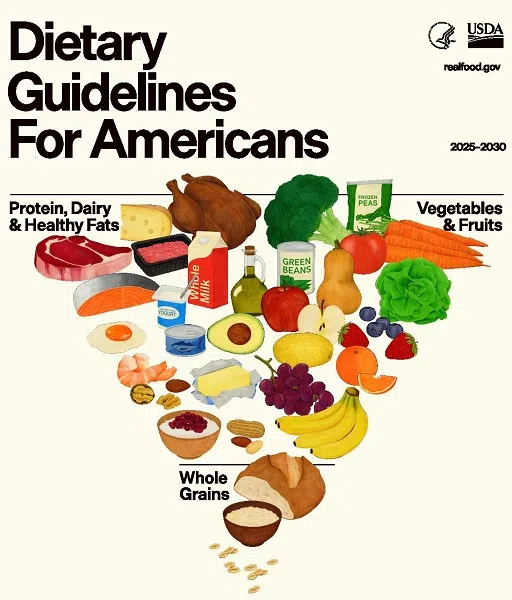
“It’s abundantly clear that chicken is a lean and affordable protein that can help all Americans across all stages of life meet the new dietary guidelines,” said Ashley Peterson, Ph.D., National Chicken Council senior vice president of scientific and regulatory affairs. “I want to thank President Trump, and Secretaries Rollins and Kennedy for their leadership in the formulation of the new guidelines. We’re pleased the administration took a science-based and common-sense approach to healthy eating and rejected recommendations put forth by the previous Dietary Guidelines Advisory Committee (DGAC) that emphasized plant-based proteins over lean meats like chicken, as evidenced in the new Food Pyramid.”
For the first time, the Guidelines recommend the consumption of healthy fats that are found in many whole foods, such as meat, poultry, eggs, omega 3–rich seafood, nuts, seeds, full-fat dairy, olives, and avocados.
“Combined with its nutritional value, positive health benefits, popularity, versatility, affordability, and environmental sustainability, chicken is a pillar of the protein subgroup, and we’re pleased that is reflected in the new Dietary Guidelines for Americans,” Peterson concluded. “Chicken is back at the top of the new Food Pyramid – where it belongs.”
NMPF President & CEO Gregg Doud: “National Milk Producers Federation thanks HHS and USDA for recognizing dairy’s critical role in a healthy diet in the new Dietary Guidelines for Americans, as shown by its continued recommendation of three servings of dairy for Americans, its recognition of dairy’s benefits at all fat levels, and dairy’s prominence in diverse diets. We are proud to benefit American health in fundamental ways, and we welcome the potential these guidelines hold for expanding upon dairy’s critical role in the diet.
“As also shown in the scientific report that preceded today’s guidelines, reducing or eliminating dairy from the diet leads to undernourishment in key nutrients for millions of Americans. These guidelines encourage consumption of dairy nutrients critical to human health. Meanwhile, not all fats are created equal, and because the guidelines acknowledge this, dairy’s benefits are better reflected in this iteration of the guidelines.
“Now that the guidelines are out, the federal government will begin applying them across federal programs. We look forward to working with the entire nutrition community to ensure that dairy is best used to generate positive health outcomes for families across America.”
“The new Dietary Guidelines send a clear and powerful message to Americans: dairy foods belong at the center of a healthy diet,” said Michael Dykes, D.V.M., president and CEO of International Dairy Foods Association. “IDFA applauds HHS and USDA for grounding the 2025–2030 DGA in today’s nutrition science, including the evidence showing that dairy products at all fat levels support healthy eating patterns. Recommending the consumption of whole and full-fat dairy products such as whole milk, yogurt, cheese, and other dairy products is an important victory for consumer choice and public health. Americans can now enjoy the wholesome dairy foods that work for their cultural, dietary and lifestyle preferences knowing that they are benefitting from dairy’s unique nutrient profile. IDFA encourages the administration to update federal nutrition programs tied to the DGA to ensure Americans can access whole, full-fat, and reduced-fat dairy products through these programs.”
Dairy foods—milk, cheese, yogurt, and other products—are a cornerstone of healthy dietary patterns, delivering 13 essential nutrients, with the DGA highlighting dairy’s high-quality protein, healthy fat, vitamins and minerals. IDFA has for many years highlighted that scientific evidence does not support previous DGA recommendations to limit dairy food consumption to low-fat or fat-free products. Nutrition science has evolved to show the benefits of whole and full-fat dairy foods, including less weight gain, neutral or lower risk of heart disease, and lower risk of childhood obesity. The new DGA reflect this growing body of research, providing Americans greater flexibility to choose dairy foods that meet their needs.
“The DGA also highlight dairy’s central role as a protein source alongside healthy meats, eggs, seafood, and other protein foods,” said Dykes. “These DGAs encourage Americans to look no further than wholesome dairy products like milk, yogurt, dairy powders, cheese, and other dairy foods when adding healthy protein that work best for themselves, their families and their unique situations.”
Dykes also cautioned that the DGA’s reference to “highly processed foods” could create unnecessary confusion among consumers and policymakers because there is no official or scientific consensus on what that term means. “Many nutritious, safe, and essential foods—including milk, yogurt, and cheese—undergo processing to ensure quality, safety, and accessibility,” he said. “Establishing dietary guidance around an undefined or inconsistently applied term risks discouraging consumption of nutrient-rich foods that are vital to public health. As we noted in recent comments to federal agencies, any move toward defining or classifying foods by processing level is premature and should be informed by rigorous, consensus-based science.”
“IDFA looks forward to continued collaboration with HHS and USDA to ensure the new DGA recommendations regarding dairy at all fat levels are reflected in federal nutrition programs like school meals, WIC, and SNAP dairy incentives. We also remain committed to partnering with these agencies to ensure future dietary recommendations reflect the best available science and support increased dairy consumption, contributing to healthier outcomes for all Americans,” said Dykes.


Comments