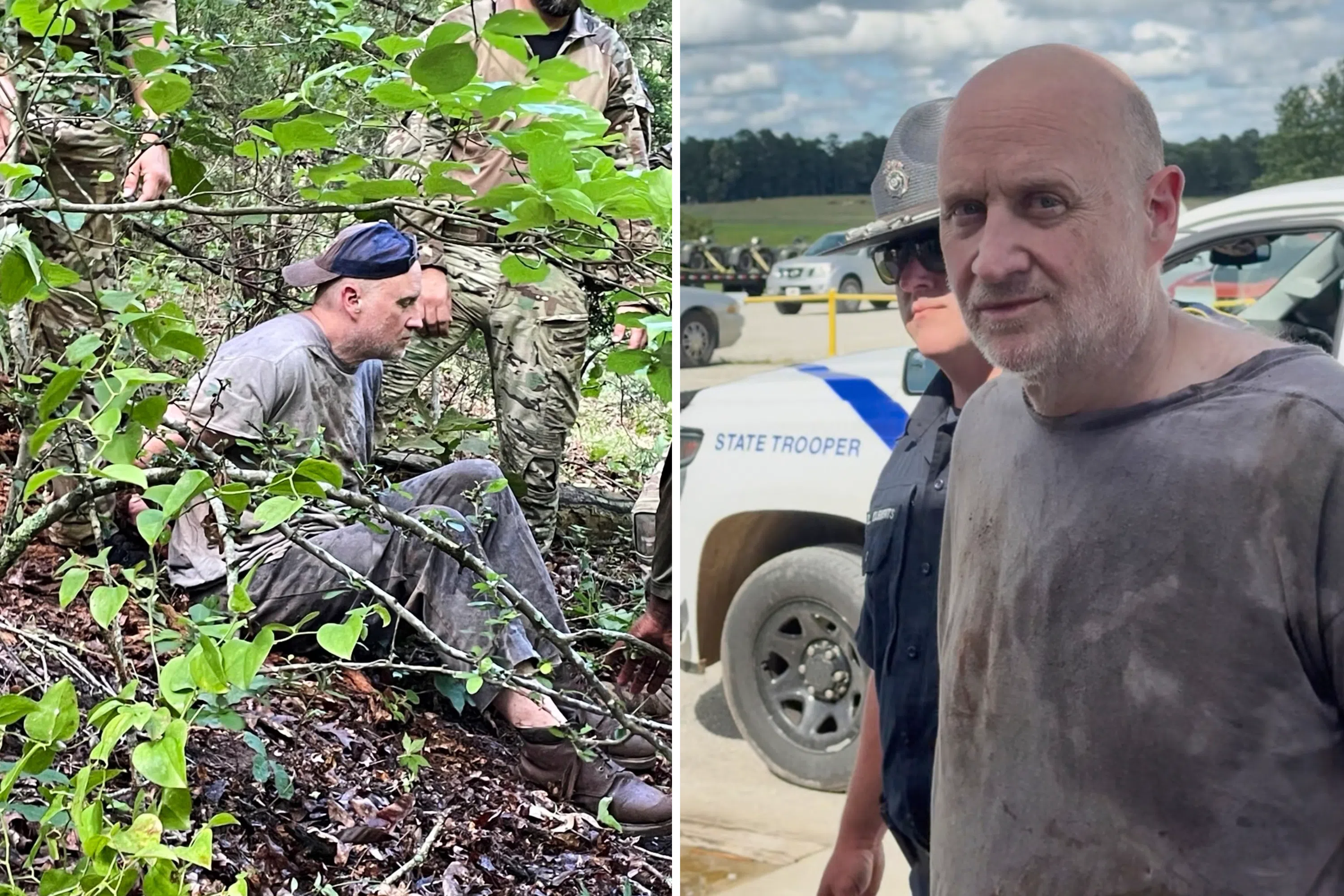
June 7, 2025:
June 4, 2025:
LITTLE ROCK, Ark. (AP) — Arkansas authorities on Tuesday (June 3, 2025) released a photo rendering of a convicted murderer and former police chief known as the “Devil in the Ozarks ” as the search for the escaped inmate entered its second week.
The new image was released as state legislators raised concerns about Hardin’s escape and said they planned to conduct a review of how it occurred.
The Arkansas Department of Corrections said the photo rendering of Grant Hardin, 56, depicts how he may look after he escaped May 25 from the Calico Rock prison. The rendering shows Hardin with some hair on his head and face.
Authorities have said Hardin escaped by donning an outfit designed to look like a law enforcement uniform.
Rand Champion, a department spokesperson, said officials are focusing their search on the north-central Arkansas region where the prison is located. Tips from elsewhere about potential Hardin sightings have come in, but so far none have panned out, Champion said.
Hardin, a former police chief in the small town of Gateway near the Arkansas-Missouri border, was serving lengthy sentences for murder and rape. He was the subject of the TV documentary “Devil in the Ozarks.”
Hardin was housed in a maximum-security wing of the primarily medium security prison, formally known as the North Central Unit. Officials are investigating whether a job Hardin held in the kitchen aided in his escape, including whether it gave him access to materials he could have used to fashion his makeshift uniform.
The co-chairs of a legislative subcommittee overseeing the prison system told the head of the state Board of Corrections that they planned to conduct a review of any “inadequacies or deviations” from security protocols that allowed Hardin to escape.
Area legislators have raised questions about why Hardin was being held at the Calico Rock facility.
The letter was sent Monday by Republican Rep. Howard Beaty and Sen. Matt McKee to Benny Magness, who heads the state board.
“Given Hardin’s background as a former law enforcement officer and his history of working for multiple law enforcement agencies, it is evident that he possesses knowledge and skills that enabled him to exploit weaknesses in our security protocols,” the lawmakers wrote. “His manipulation of the system by wearing a disguise resembling a uniform is disturbing and speaks to a broader system failure.”
May 29, 2025, update:
CALICO ROCK, Ark. (AP) — Arkansas authorities are looking at whether a prison kitchen job played a role in the escape of a convicted former police chief known as the “Devil in the Ozarks.” A prison system spokesperson said Thursday (May 29, 2025) that Grant Hardin was housed in a maximum-security wing of the Calico Rock prison from which he escaped over the weekend. Hardin escaped after donning an outfit designed to look like a law enforcement uniform. Hardin was serving lengthy sentences for murder and rape. The FBI on Thursday offered a reward of up to $10,000 for information leading to Hardin’s arrest.
May 29, 2025:
CALICO ROCK, Ark. (AP) — There are plenty of hideouts in the rugged terrain of the Ozark Mountains where searchers are hunting for a convicted former police chief known as the “Devil in the Ozarks.” Others are not only off the grid but beneath it, in the hundreds of caves that lead to vast subterranean spaces. A spokesman for the Arkansas Department of Corrections says caves in the area have been a priority for searchers. He said they present one of multiple challenges for authorities searching for Grant Hardin. He is a former police chief who was imprisoned for rape and murder and he escaped Sunday (May 25, 2025) by impersonating a corrections officer.
Story
CALICO ROCK, Ark. (AP) — There are plenty of hideouts in the rugged terrain of the Ozark Mountains, from abandoned cabins to campsites in the vast forests where searchers are hunting for a convicted former police chief known as the “Devil in the Ozarks.”
Others are not only off the grid but beneath it, in the hundreds of caves that lead to vast subterranean spaces.
Local, state and federal law enforcement have continued to scour the region around the prison throughout the third day of the search.
“Until we have credible evidence that he is not in the area, we assume that he’s probably still in the area,” Rand Champion, a spokesman for the Arkansas Department of Corrections, said at a press conference Wednesday (May 28, 2025) .
Fugitive Grant Hardin, 56, “knows where the caves are,” said Darla Nix, a cafe owner in Pea Ridge, Arkansas, whose sons grew up around him. Nix, who describes Hardin as a survivor, remembers him as a “very, very smart” and mostly quiet person.
For the searchers, “caves have definitely been a source of concern and a point of emphasis,” said Champion.
“That’s one of the challenges of this area — there are a lot of places to hide and take shelter, a lot of abandoned sheds, and there are a lot of caves in this area, so that’s been a priority for the search team,” Champion said.
The area around the prison is “one of the most cave-dense regions of the state,” said Matt Covington, a University of Arkansas geology professor who studies caves.
Impersonating an officer
Hardin, the former police chief in the small town of Gateway near the Arkansas-Missouri border, was serving lengthy sentences for murder and rape. He was the subject of the TV documentary “Devil in the Ozarks.”
He escaped Sunday from the North Central Unit — a medium-security prison also known as the Calico Rock prison — by wearing an outfit designed to look like a law enforcement uniform, according to Champion. A prison officer opened a secure gate, allowing him to leave the facility. Champion said that someone should have checked Hardin’s identity before he was allowed to leave the facility, describing the lack of verification as a “lapse” that is being investigated.
It took authorities approximately 30 minutes to notice Hardin had escaped.
Champion said that inmates are evaluated and given a classification when they first enter the prison system to determine where they are housed. There are portions of the Calico Rock facility that are maximum-security.
While incarcerated, Hardin did not have any major disciplinary issues, Champion said.
Authorities have been using canines, drones and helicopters to search for Hardin in the rugged northern Arkansas terrain, Champion said. The sheriffs of several counties across the Arkansas Ozarks had urged residents to lock their homes and vehicles and call 911 if they notice anything suspicious.
Dark places to hide
In some ways, the terrain is similar to the site of one of the most notorious manhunts in U.S. history.
Bomber Eric Rudolph, described by authorities as a skilled outdoorsman, evaded law officers for years in the Appalachian Mountains of western North Carolina. It was a five-year manhunt that finally ended in 2003 with his capture.
Rudolph knew of many cabins in the area owned by out-of-town people, and he also knew of caves in the area, former FBI executive Chris Swecker, who led the agency’s Charlotte, North Carolina, office at the time, said in the FBI’s historical account of the case.
“He was anticipating a great conflict and he had clearly lined up caves and campsites where he could go,” Swecker said.
Rudolph pleaded guilty to federal charges associated with four bombings in Georgia and Alabama.
There are nearly 2,000 documented caves in northern Arkansas, state officials say. Many of them have entrances only a few feet wide that are not obvious to passersby, said Michael Ray Taylor, who has written multiple books on caves, including “Hidden Nature: Wild Southern Caves.”
The key is finding the entrance, Taylor said.
“The entrance may look like a rabbit hole, but if you wriggle through it, suddenly you find enormous passageways,” he said.
It would be quite possible to hide out underground for an extended period, but “you have to go out for food, and you’re more likely to be discovered,” he said.
Checkered past
Hardin had a checkered and brief law enforcement career. He worked at the Fayetteville Police Department from August 1990 to May 1991, but was let go because he didn’t meet the standards of his training period, a department spokesman said.
Hardin worked about six months at the Huntsville Police Department before resigning, but records do not give a reason for his resignation, according to Police Chief Todd Thomas, who joined the department after Hardin worked there.
Hardin later worked at the Eureka Springs Police Department from 1993 to 1996. Former Chief Earl Hyatt said Hardin resigned because Hyatt was going to fire him over incidents that included the use of excessive force.
“He did not need to be a police officer at all,” Hyatt told television station KNWA.
He continued to have trouble in his brief stint as an officer in Gateway, according to the 450-person town’s mayor Cheryl Tillman.
While Hardin was the town’s sole officer, “there was things that I seen that wasn’t good. He was always angry,” said Tillman, who wasn’t mayor at the time.
Hardin pleaded guilty in 2017 to first-degree murder for the killing of James Appleton, 59. Appleton, who was Tillman’s brother, worked for the Gateway water department when he was shot in the head on Feb. 23, 2017, near Garfield. Police found Appleton’s body inside a car. Hardin was sentenced to 30 years in prison.
He was also serving 50 years for the 1997 rape of an elementary school teacher in Rogers, north of Fayetteville.
He had been held in the Calico Rock prison since 2017.
May 28, 2025:
CALICO ROCK, Ark. (AP) — Officials are scouring Arkansas’ rugged Ozark Mountains for a former police chief and convicted killer who escaped from prison over the weekend. Grant Hardin is the former police chief in the small town of Gateway near the Arkansas-Missouri border and became known as the “Devil in the Ozarks.” He was serving a decades-long sentence for murder and rape. He escaped Sunday (May 25, 2025) from the North Central Unit, a medium-security prison in Calico Rock. A court document shows Hardin escaped by impersonating a corrections officer and walking out through a secure gate a guard opened for him.
Story
CALICO ROCK, Ark. (AP) — Officials scoured Arkansas’ rugged Ozark Mountains for a former police chief and convicted killer who escaped from prison over the weekend.
Grant Hardin, who briefly served as police chief for the small town of Gateway near the Arkansas-Missouri border, was serving a decades-long sentence for murder and rape.
Known as the “Devil in the Ozarks,” he escaped Sunday (May 25, 2025) from the North Central Unit, a medium-security prison in Calico Rock.
Hardin’s escape happened days after 10 men fled a New Orleans jail by going through a hole behind a toilet. Eight of those fugitives have since been captured.
Here’s what to know about Hardin and his escape:
How did he escape?
Hardin escaped from the prison Sunday afternoon by impersonating a corrections officer “in dress and manner,” according to a court document. A prison officer opened a secure gate, allowing him to leave the facility.
The outfit was not a standard inmate or correctional uniform, said Rand Champion, a spokesperson for the Arkansas Department of Corrections. Officials are working to determine how he was either able to get the uniform or manufacture it himself.
Video surveillance shows Hardin escaped at about 2:55 p.m. on Sunday, Champion said. Officials announced his escape about two hours later.
But how he got out of the prison and escaped into a rural part of the state, as well as whether he had any help is still unclear.
Prison officials say they are investigating what led up to the escape “to help determine any assistance he may have had.”
Champion said the decision to house Hardin in a medium-security facility, which has a capacity of about 800 people, weighed the “needs of the different facilities and inmates” and “assessments” of his crimes.
Why was he in prison?
Hardin had been held at the Calico Rock prison since 2017 after pleading guilty to first-degree murder for fatally shooting James Appleton, 59.
Appleton, a Gateway water department employee, was shot in the head in 2017. Police found his body inside a car. Hardin was sentenced to 30 years in prison.
Hardin’s DNA was entered into the FBI’s Combined DNA Index System, and it matched the 1997 rape of a teacher at an elementary school in Rogers, north of Fayetteville. He was sentenced to 50 years in prison for that crime. He was a police officer in Eureka Springs at that time.
His short tenure as police chief
Hardin became police chief of Gateway, a town of about 450 people, in 2016.
Virtually overnight, people in the community described in the HBO documentary “Devil in the Ozarks” a dramatic shift.
“He was out chasing cars for no reason,” said Cheryl Tillman, one of Appleton’s sisters. “He was pulling guns on the citizens here in Gateway and then as time went on with him being the police chief things just started going down hill fast.”
The documentary revealed a crucial run-in between Hardin and Appleton in the Spring of 2016 in which Appleton stood up to Hardin about fixing a police car. A Benton county sheriff’s office lieutenant described several times when they got into each other’s faces and the dislike they both felt toward one another.
The city council gave him an ultimatum: resign or be fired. He stepped down four months after taking the position and nine months later, he killed Appleton.
The ‘Devil in the Ozarks’ documentary
Hardin was the focus of a popular 2023 HBO documentary, “Devil in the Ozarks,” that featured interviews with everyone from the victim of the 1997 rape and sisters of the murder victim to Hardin’s family.
It revealed key details about the bubbling resentment Hardin felt toward Appleton as well as revealing accounts of the moments right before and after the murder.
Then Gateway Mayor Andrew Tillman, who was Appleton’s brother-in-law, described being on the phone with him when he was shot, while local resident John Bray spoke about driving past Appleton’s car when the shooting happened. He was the first to find his body and identified Hardin as the shooter.
“I heard what I thought was someone had fired a rifle,” he said.
“I went back and I seen it looked like he had been shot,” he added, wiping away tears.
The documentary also includes security video of Hardin at a restaurant with his family just after the shooting and the police interrogation in which he tells law enforcement he has “the right to be silent” and opted not to give a statement.
The search for Hardin
Authorities are using canines, drones and helicopters to search the rugged northern Arkansas terrain, Champion said.
Although he did not reveal the exact areas of the search, he did say it has expanded as more time has elapsed since the escape.
Officials have faced challenges searching the areas as it’s very rocky and heavy rain has fallen in recent days.
The area around the prison is a rural part of the state, which can make Hardin’s escape more difficult. In a small community, there’s a higher chance someone will recognize him and alert the authorities, said Craig Caine, a retired inspector with the U.S. Marshals who has handled many cases involving escaped prisoners.
The Division of Correction and the Division of Community Correction are following leads with local, state and federal law enforcement agencies.


Comments