Sept. 29, 2025:
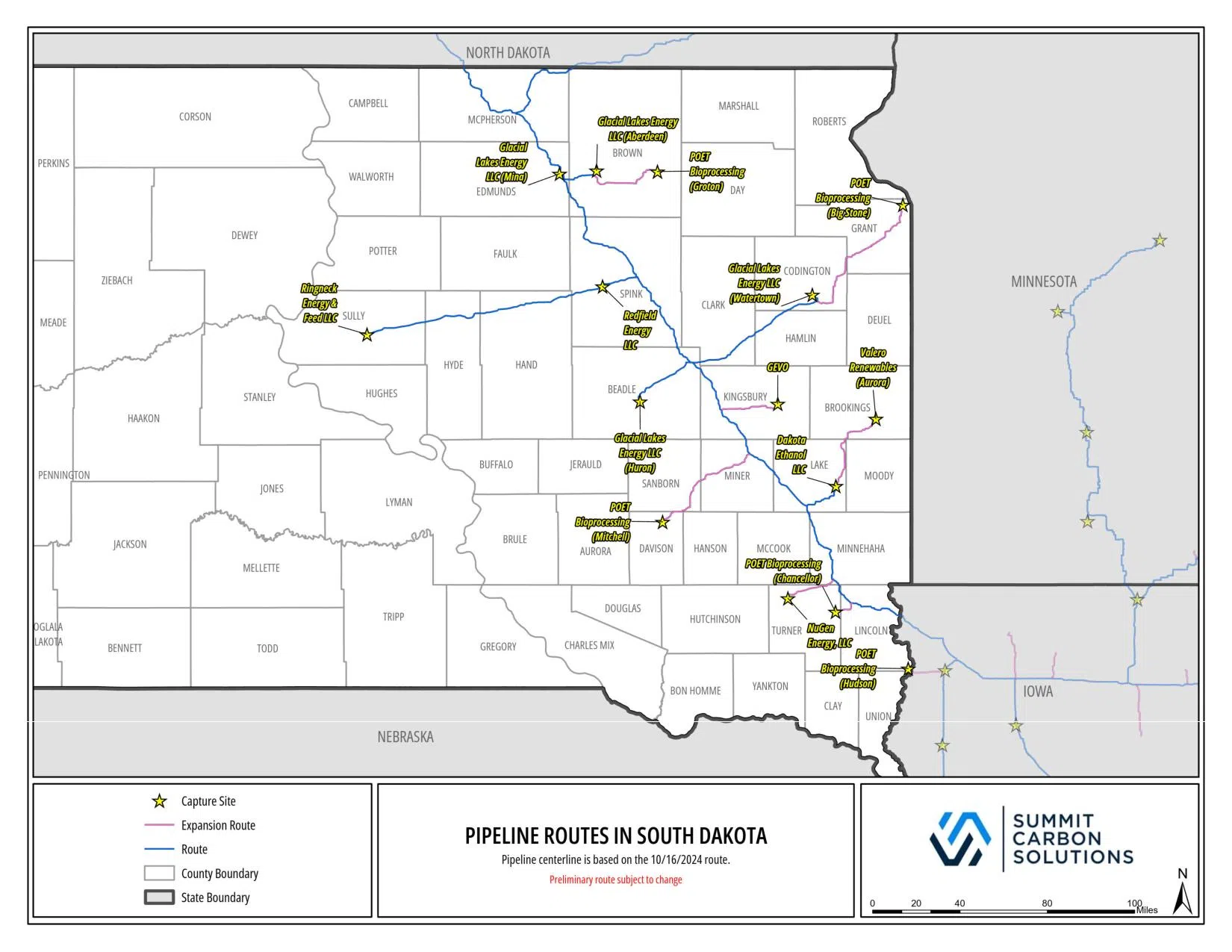
North Dakota Attorney General Drew Wrigley has decided not to pursue litigation against South Dakota over the state’s law banning the use of eminent domain for carbon pipelines.
Last week, Attorney General Wrigley said he was exploring all options against South Dakota because its eminent domain law impacts North Dakota’s access to the pipeline.
But the North Dakota AG announced Monday (Sept. 29, 2025) that he will not sue South Dakota over its law, telling the North Dakota Monitor that there was no “legal avenue” available for such a lawsuit.
“I have known Attorney General Wrigley for 20 years, serving together as United States attorneys and now as Attorneys General for our respective states, and I respect his ability as an attorney,” said Attorney General Jackley. “Our long-standing relationship, respect and ability to openly communicate helped us come to this favorable resolution for both states.”
Attorney General Jackley said South Dakota’s eminent domain law was supported by the voters, legislators, and signed by Gov. Larry Rhoden.
“As a proud owner of a family farm West River and ranch near Pierre, I understand the importance of private property owner rights,” said Attorney General Jackley. “As Attorney General I will continue to fight for and support the rights of private property owners and the laws of this state.”
May 13, 2025:
Story Body
May 1, 2025:
DES MOINES, Iowa (AP) — A proposed carbon-capture pipeline that would traverse through several Midwestern states could face more hurdles in Iowa as a dozen Republican state senators try to force the issue to a vote.
Summit Carbon Solutions already will likely have to readjust plans for their estimated $8.9 billion, 2,500-mile (4,023-kilometer) project after South Dakota’s governor signed a ban on the use of eminent domain — the government seizure of private property with compensation — to acquire land for carbon dioxide pipelines.
Now, after several proposals advanced through the Republican-controlled Iowa House, 12 GOP state senators have told their Republican leaders that they will not vote on any budget, which the Legislature is constitutionally required to approve, until they bring a pipeline bill to the floor.
“The people of South Dakota emphatically stated that eminent domain will never be granted for this pipeline to cross South Dakota, and it is past time for lowa to do the same,” the senators wrote in a joint letter, saying they believe “addressing eminent domain is more important than the budget or any other priority for the 2025 session.”
It’s unclear if the demands will be met or what a measure that passes the full chamber would look like, given the wide range of views on the issue among the 34 Senate Republicans, who hold a supermajority in the chamber.
The proposed 2,500-mile pipeline would carry carbon emissions from ethanol plants in Iowa, Minnesota, Nebraska, North Dakota and South Dakota to be stored underground permanently in North Dakota.
By lowering carbon emissions from the plants, the pipeline would lower their carbon intensity scores and make them more competitive in the renewable fuels market. The project would also allow ethanol producers and Summit to tap into federal tax credits.
The project received permit approvals in Iowa, Minnesota and North Dakota, but it does face various court challenges, and its application was rejected in South Dakota last month.
“Summit Carbon Solutions has invested four years and nearly $175 million on voluntary agreements in Iowa, signing agreements with more than 1,300 landowners and securing 75% of the Phase One route,” Summit spokesperson Sabrina Zenor said in a statement. “We are committed to building this project, committed to Iowa, and remain focused on working with legislators — including those with concerns.”
Some Midwest farmers, despite loyalty to the ethanol industry, have voiced strong opposition to the pipeline since its inception, objecting to its presence on or near their land and questioning the safety of having the pipeline in their backyards.
Then, a slew of eminent domain legal actions in South Dakota to obtain land provoked a groundswell of opposition in the state, sending the issue to the governor’s desk. Lee Enterprises and The Associated Press reviewed hundreds of cases, revealing the great legal lengths the company went to get the project built.
Iowa state Sen. Kevin Alons said the senators who are forcing the issue want an amendment to the bill that mimics South Dakota’s new law, but it remains to be seen what provisions, if any, would be included in a final version or whether Republican Gov. Kim Reynolds would give it her signature.
“A number of Republican Senators are working on policy surrounding eminent domain and pipeline issues and I am optimistic we will find a legislative solution,” Senate Majority Leader Jack Whitver said in a statement.
The Iowa House has sent several proposals to the Senate. During debate on the House floor, state Rep. Steven Holt expressed plenty of disappointment that the Senate had not taken up the issue in the past.
“Regardless of whether the Senate’s gonna pass it or not, we’re going to fight for it here because it’s the right thing to do,” Holt said.
“You chose to try to trample on the rights of citizens of Iowa and South Dakota,” he added of Summit, “and now the chickens are coming home to roost.”
March 20, 2025:
Iowa landowners who oppose the carbon pipeline project from Summit Carbon Solutions rallied with renewed energy this week at the state capitol.
The renewed energy comes after South Dakota Governor Larry Rhoden signed a law blocking the company from using eminent domain to build its carbon-capture pipelines. Since the South Dakota governor signed the law, Summit has asked the South Dakota Public Utilities Commission to suspend its pipeline permit application.
The Des Moines Register says Summit Carbon Solutions intends to build a carbon sequestration pipeline extending 2,500 miles across South Dakota, Iowa, Minnesota, Nebraska, and North Dakota to connect over 50 ethanol plants.
Several dozen Iowa landowners demanded lawmakers approve House File 943, which would eliminate eminent domain as a way to build carbon dioxide pipelines on agricultural land.
Summit’s communications director told the Register that it’s “unfortunate South Dakota’s laws changed the rules in the middle of the game.”
SEPTEMBER 3, 2024:
The Iowa Utilities Commission has found that Summit Carbon Solutions has substantially complied with the requirements of a June 25, 2024, order regarding the company’s application for a hazardous liquid pipeline permit. Last week, the IUC issued the permit. The order doesn’t modify the conditions Summit Carbon must establish in order to start construction. On June 25, the IUC issued its final decision and order regarding Summit Carbon’s petition for a hazardous liquid pipeline permit. As a part of its decision, the Commission required Summit Carbon to make several compliance filings with the IUC. Summit Carbon filed the compliance filings required by the IUC on August 5. The filings included revised petition exhibits. The pipeline will cross over 2,000 miles in five states, including 70 miles in Iowa. In planning the pipeline, Summit partnered with 57 ethanol plants and signed voluntary easement agreements with 75 percent of Iowa’s landowners along the route.
JULY 9, 2024:
Summit Carbon Solutions got approval from the Iowa state regulators for its carbon dioxide pipeline system it wants to build in the state. Summit wants to move forward with expansion requests for that system beginning in late August. Documents filed with the Iowa Utilities Commission show proposed public informational meeting dates for 23 counties that would take about four weeks to complete. The first meeting would be on August 26, 2024. The company must hold those meetings in the affected counties before it can negotiate with landowners for easements and file petitions for permits to build the extensions. The 14 proposed offshoots to additional ethanol plants from Summit’s initial proposal would increase the system size in Iowa by about 341 miles, or 50 percent. Summit can’t start laying pipe in Iowa until it obtains permits in the Dakotas. The company can use eminent domain in Iowa to force agreements with unwilling landowners.
JUNE 25, 2024:
The Iowa Utilities Board has announced their approval (June 25, 2024) of Summit Carbon Solutions base pipeline project (HLP-2021-0001). This approval represents a significant milestone not for just Summit Carbon Solutions, but for the entire agriculture industry as it seeks access to new and emerging markets, like sustainable aviation fuel, by lowering ethanol’s carbon intensity score (CI).
This comes on the heels of successful reapplication hearings for its Summit’s North Dakota pipeline permit in front of the North Dakota Public Service Commission (PSC).
“The momentum will continue as we prepare to file our South Dakota permit application in early July,” said Lee Blank, CEO of Summit Carbon Solutions. “We look forward to engaging with the state throughout this process and are confident in a successful outcome.”
Summit Carbon Solutions is partnering with 57 ethanol plants across five states and has signed voluntary easement agreements with 75% of Iowa landowners along this route. The company will continue to work with landowners every day.
In reaction to the announcement, American Carbon Alliance CEO Tom Buis issued the following statement:
“The Iowa Utilities Board should be commended for handling the pipeline proceedings fairly, transparently, and in accordance with Iowa law.
“This decision was the right one and will be transformative for the ag industry and Iowa’s economy. Capturing Carbon to lower the carbon index to open new markets such as Sustainable Aviation Fuels and higher blends for American consumers is the greatest opportunity for farmers since the buildout of the ethanol industry.
“The Summit Carbon pipeline will lead to increased demand for corn, benefiting farmers and increasing farm income, and stimulating economic activity for ethanol plants and ag-related business. This is a huge win for the future of rural America, for American consumers, and for America’s energy independence. Hopefully other states will also move forward quickly.”
JUNE 3, 2024:
A North Dakota Supreme Court ruling favored Summit Carbon Solutions, a pipeline company currently in a dispute with landowners over the right to access properties to survey the land. The decision affirms a lower court ruling that the pipeline company didn’t need permission from landowners before they accessed property to determine a possible route for the company’s carbon pipeline.
Yahoo says some landowners refused to grant Summit access to survey their property as Summit continues trying to build a carbon capture pipeline. Summit says it’s secured over 80 percent of its proposed North Dakota route through voluntary easements, but some landowners refused. North Dakota law doesn’t require written notice to landowners for survey access and allows crews access for projects that would benefit the public to show up at any time. Attorneys representing the landowners say the owners should get compensated, and written notice should be required upfront before getting access.


Comments