June 11, 2026:
As of the end of May 2026, the U.S. Army Corps of Engineers said the 2026 calendar year runoff forecast for the Missouri River Basin above Sioux City, Iowa, was 60% of average– or 15.5 million acre feet.
Corps of Engineers Missouri River Power Production Team Leader Mike Swenson explained how the low runoff affects the reservoirs at the three biggest dams– Fort Peck, Garrison and Oahe.
Swenson said the lower runoff has caused a reduction in the amount of energy being generated by the Missouri River dams.
National Drought Mitigation Center Climatologist Doug Kluck said South Dakota, North Dakota and Nebraska aren’t currently forecast to contribute much rain to the Missouri River this summer.
If the upper Missouri River Basin does receive only 60% of average runoff for the rest of the year, it would be the 11th lowest runoff since 1898. (The runoff forecast is based on current soil moisture conditions, mountain snowpack, and long-term precipitation and temperature outlooks.)
To view the detailed three-week release forecast for the mainstem dams, go to https://go.mil/mr-3wk-fcast.
The Missouri Basin Web App provides links to these reports and others that are updated more frequently. https://go.mil/mr-webapp.

June 4, 2026:
Runoff continues to be below average in the Missouri River Basin above Sioux City, Iowa.
The U.S. Army Corps of Engineers says below-normal precipitation, dry soil conditions in the western portions of the basin, and a lack of mountain snowpack resulted in May 2026 runoff being 46% of average (1.6 million acre-feet). The 2026 calendar year runoff forecast for the upper Basin is 60% of average, and 1.6 MAF lower than last month’s forecast. If realized, it would be the 11th lowest runoff since 1898. (The runoff forecast is based on current soil moisture conditions, mountain snowpack, and long-term precipitation and temperature outlooks.)
John Remus, chief of the Corps’ Missouri River Basin Water Management Division, said given current conditions, they expect runoff in June to be below normal, but it will depend on rainfall.
The six mainstem power plants generated 696 million kWh of electricity in May, 94 million kWh lower than the typical energy generation for that month. The power plants are expected to generate 7.2 billion kWh this year, which is 2.1 billion kWh below the long-term average of 9.3 billion kWh.
Reservoir Forecasts:
Big Bend Dam—
Average releases past month – 22,900 cfs
Forecast average release rate – 22,100 cfs
Forecast reservoir level – 1420.7 feet
Oahe Dam—
Average releases past month – 23,000 cfs
Forecast average release rate – 21,900 cfs
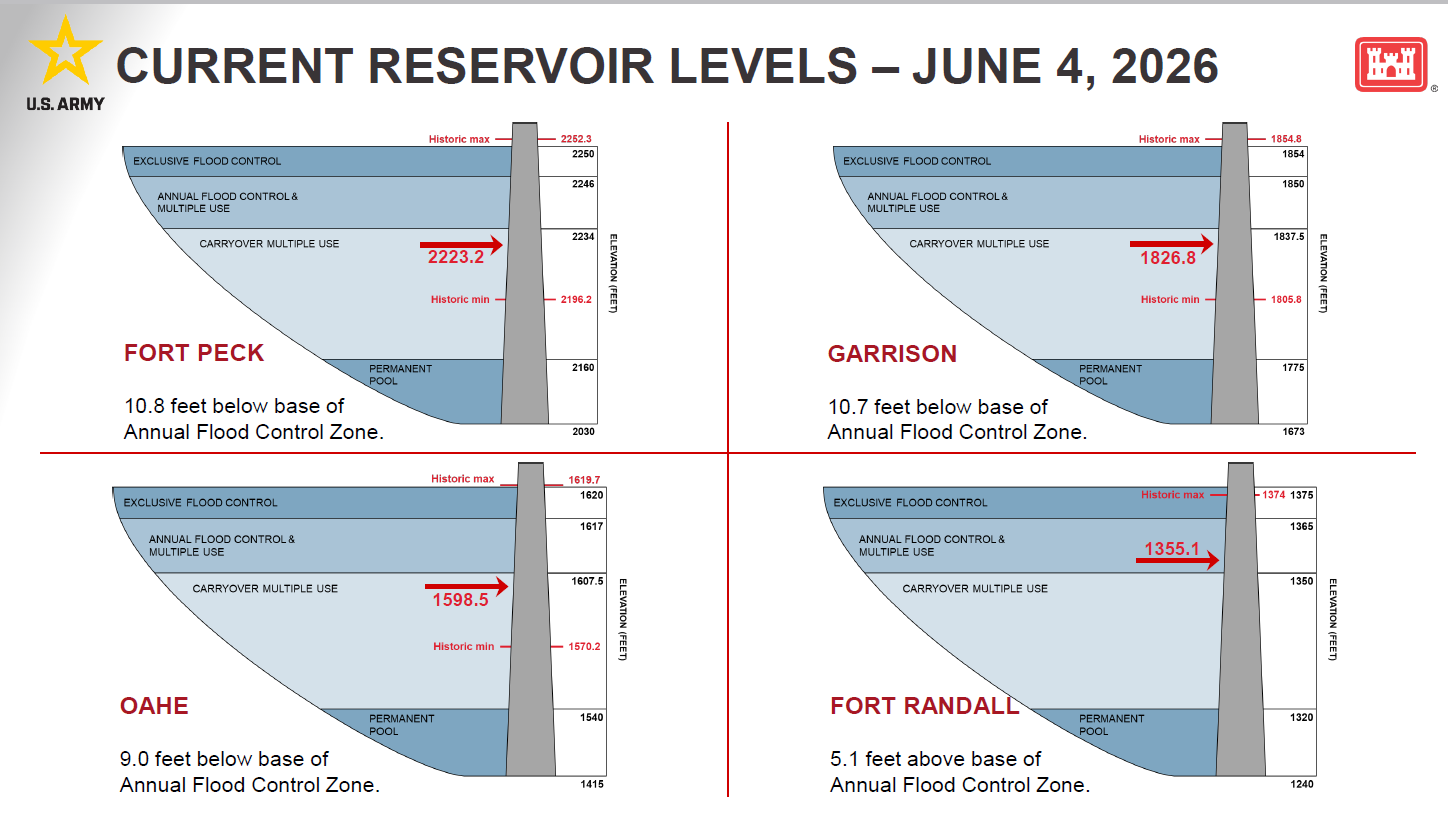
End-of-May reservoir level – 1598.5 feet (down 1.6 feet from April 30)
Forecast end-of-June reservoir level – 1598.1 feet
To view the detailed three-week release forecast for the mainstem dams, go to https://go.mil/mr-3wk-fcast. The Missouri Basin Web App provides links to these reports and others that are updated more frequently. https://go.mil/mr-webapp.

The 2026 calendar year runoff forecast above Sioux City is 15.5 MAF, 60% of average, and 1.6 MAF lower than last month’s forecast. The current runoff forecast suggests if conditions persist, navigation flow support will be reduced to the minimum service level, and the season length will be shortened.


Comments