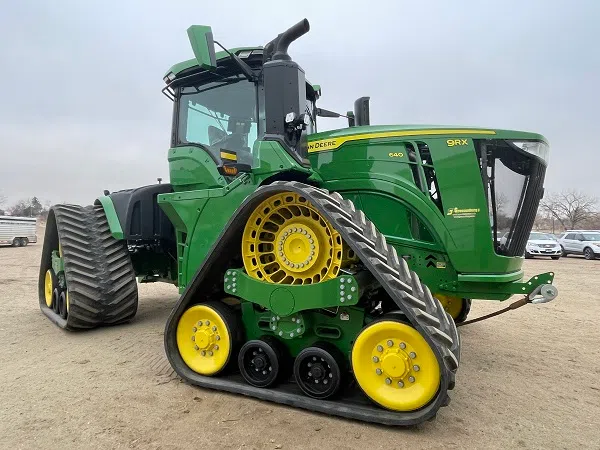
Not much can get done on a farm or ranch these days without a tractor, but tractors can also cause some of the most serious injuries or deaths on an agricultural operation.
John Shutske, the agricultural safety and health specialist for the University of Wisconsin Extension Service, said accidents are especially common in the spring and fall when farm machinery takes to the roads.
“Accidents and injuries and collisions on the highway, this time of the year, that is absolutely huge. You know, you’ve got to have the slow-moving vehicle emblem. You’ve got to have, even though the state law does not require it on all machinery, flashers, amber flashers, visible at all times, night and daytime, and those should also double as turn signals.”
Shutske said falls off tractors are a common type of on-farm injury.
“If you fall just a couple of feet, yeah, you could sprain ankles, you could break legs. When you’re getting on and off that equipment, we always talk about three points of contact. You always want to maintain that stability by going from two to three. You increase your stability by 50 percent, and if you do slip or fall, you’ve got some additional points of balance. We always want to think about a three-legged stool, and it’s exactly the same when you’re getting onto and off of equipment. It’s tempting, if you’re in a hurry, to jump from that second or third step from the top, and that’s when we see the sprained ankles and torn ACLs.”
He said everyone needs to use extra care around spinning power take-offs or PTOs.
“Even though they are fewer and they’re further aprt, we don’t see as many per year. When they do happen, people underestimate how incredibly powerful, even something like a 45-horsepower-utility tractor, you compare that to me as a typical human being, I can generate about a tenth of a horsepower when I’m out there working. If you become entangled with that piece of equipment, if it’s a piece of clothing, if it’s the string from like a hoodie, if I start to get wrapped up, I actually begin to rotate with that shield.”
Shutske said rollovers remain the number one cause of death in farm accidents.
“Although thanks to the rollover protective structure or ROPS, we’ve made a lot of progress compared to when I was a young farm safety specialist. Compared to now, like 35 years later, we’ve seen a dramatic reduction in farm fatalities, and that’s largely because of rollover protection. At the same time, we still see a lot of tractors out there without ROPS. Tractors can roll over either sideways, which typically involves either rough terrain, people hitting a rut, or driving over a stump or rock or, more often, a slope. Any slope that’s greater than, I would say, 12 to 15 degrees is potentially dangerous.”


Comments